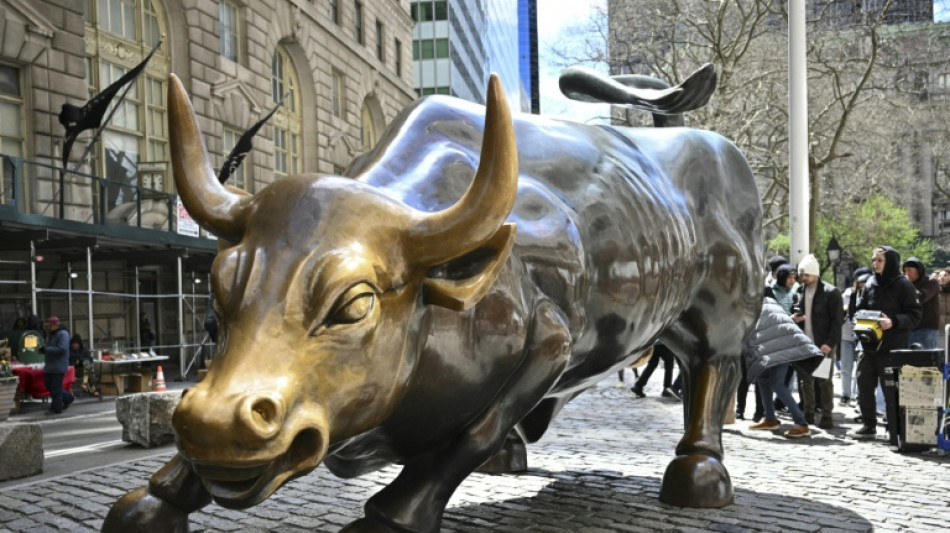
Why are stock markets hitting record highs? / Photo: ANGELA WEISS - AFP/File

Why have stock markets around the world -- from Wall Street to Tokyo and from Paris to Seoul, been striking record highs despite the uncertain political and economic outlook?
"For a start, it is the fading uncertainty over trade wars," City Index analyst Fawad Razaqzada told AFP.
US President Donald Trump's move to apply tariffs on nearly all countries around the world initially sent equity markets slumping.
Trade tensions have since eased -- but the recent record highs go beyond a simple rebound from those concerns, which have not completely gone away.
The recovery also has to do with a flood of money on the markets, the performance of tech stocks and a renewed sense of confidence by investors.
- Cutting interest rates -
With the post-pandemic surge in inflation largely tamed, central banks have been able to lower interest rates to support growth and employment.
The US Federal Reserve began its latest rate-cutting cycle in September 2024, and is expected to cut rates by another quarter percentage point on Wednesday.
Lower interest rates make it less expensive and easier for companies and consumers to borrow money, thus favouring economic activity.
"The Fed -- the world's most influential central bank -- is clearly back in easing mode, and that alone resets the global risk-on tone," said Stephen Innes, managing partner at SPI Asset Management.
This accommodative monetary policy or easing of interest rates has seen investors pour funds, or liquidity, into equity markets to chase gains.
The result has been "a liquidity tide that's lifting nearly every market from New York to Tokyo", said Innes.
Other central banks have also been cutting their rates.
"You have major central banks now cutting interest rates which is providing a favourable backdrop for stock markets and helping to cushion the impact of economic weakness and political uncertainties," said Razaqzada.
- Corporate earnings results -
The corporate earnings calendar also plays a key role in driving stock markets to record highs.
Companies with publicly traded shares are required to regularly publish information on their financial performance, and these announcements can have a large impact on share prices.
And in the recently completed third quarter "you have companies beating earnings expectations", said Razaqzada.
Moreover, their results are "not showing much in the way of tariff-related hits in their top or bottom lines", he added.
Daniela Sabin Hathorn, senior market analyst at Capital.com, noted that the forward growth estimates of companies are also "ticking higher".
- AI euphoria -
Hathorn also pointed to the boom in AI spending on chips, hardware and cloud structure: "You have a structural growth narrative that extends well beyond a simple cyclical rebound."
Tech shares have helped Wall Street's three main indices hit records, as have chipmakers listed on Seoul's Kospi index.
Innes said the big tech and AI firms "are being treated as the modern infrastructure of the digital economy, not just cyclical growth stories".
While there has been ample talk that there may be an AI bubble, nothing has come along yet to pop it.
Tech firms' "massive spending cycles and resilient profitability are cushioning the broader indices and giving this rally an aura of inevitability," said Innes.
- Politics aside, for the moment -
Local political and economic developments have had relatively less of an impact on equity markets recently.
The Paris stock exchange set a fresh record last week despite persistent uncertainty about the fate of the French government and its ability to pass a budget.
"Many listed companies earn a large share of revenue overseas, and the major indices are heavily skewed toward such multinationals," said Hathorn.
"Thus, weak local politics or data don't necessarily derail the broader market ascent if the issues are contained to the domestic borders," she added.
But a prolonging of the current US government shutdown over a budget dispute could begin to unsettle investors, as likely would another collapse of the French government.
"We're living in a very volatile context marked by great uncertainty," said Javier Diaz-Gimenez, an economics professor at Barcelona's IESE business school.
"In general, political instability isn't good for stock markets," he added.
T.Ueda--JT