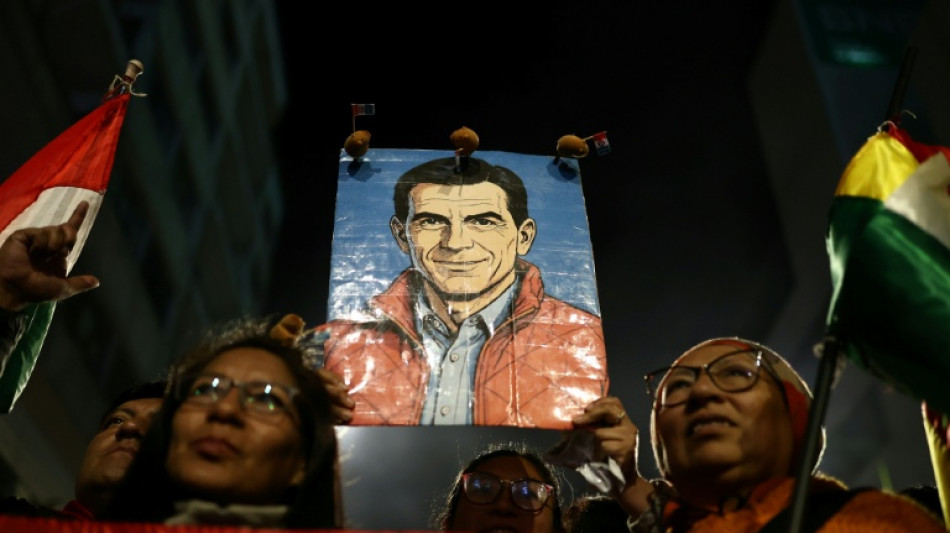
Bolivia's new president faces worst economic crisis in decades / Photo: Lucas AGUAYO - AFP/File

Bolivians elected Rodrigo Paz as president on Sunday, selecting the center-right senator and economist to address the country's worst economic crisis in 40 years.
Paz, 58, campaigned on slashing public spending, especially on fuel subsidies, and vowed a "capitalism for all" approach to economic reform in a marked shift from the preceding two decades of socialist government.
The president-elect, who will assume office on November 8, has promised that his governance style will be one of "consensus," as he hopes to gain public trust in a divided society.
- Economy -
Bolivia is in the grips of an economic crisis, with year-on-year inflation at 23 percent and a chronic shortage of fuel.
One of Paz's main challenges at the start of his tenure will be to find a way out of the fuel crisis and overcome a severe shortage of dollars -- the result of large government subsidies and a decrease in gas exports -- while curbing an uptick in the cost of living.
"Stabilizing the economy will require very firm measures," economist Napoleon Pacheco, a professor at La Paz's San Andres university, told AFP.
But analyst Daniela Osorio of the German Institute for Global and Area Studies warned that such measures "could lead to a social uprising."
- Mistrust -
Maria Teresa Zegada, a sociologist at San Simon university in La Paz, said there was "growing public dissatisfaction with politics."
A breakdown of the results of Sunday's run-off illustrates the divisions in the country, with the more conservative and richer east largely supporting right-wing candidate Jorge Quiroga, while the more impoverished west and its large Indigenous population backed Paz.
Osorio said these trends point to a revival of traditional "divisions between the east and the west, as well as between urban and rural areas."
Maria Choquetapi, a woman from the Aymara Indigenous group, told AFP from her town of Laja west of the capital: "I would like the new government to roll up their sleeves and really get to work, not like their predecessors."
- Parliament -
Paz's party is the biggest in parliament. But with no outright majority, the new president will have to "find agreements" to rule effectively, said Zegada.
The four right-wing parties in Bolivia's parliament will hold 119 of 130 seats in the Chamber of Deputies and all 36 in the Senate.
That means Paz will have to work with some of his political rivals despite painful "wounds" from the run-off campaign, according to Osorio.
- Morales -
Evo Morales, who served as president from 2006 to 2019 and was barred from running again this year, remains popular, especially among Indigenous Bolivians.
He cast a long shadow over the campaign, and in the first round, got nearly one in five voters to spoil their ballot over his exclusion from the election.
But internal divisions in his Movement Towards Socialism party have seen Morales's influence weaken.
The former president is also the target of an arrest warrant for human trafficking over an alleged sexual relationship with a minor -- an accusation he denies.
Analyst Osorio said that even a weaker Morales "remains a destabilizing factor."
Zegada, the sociologist, said that his supporters "have already warned that if the next government does not live up to its promises, they will mobilize to overthrow it."
K.Tanaka--JT