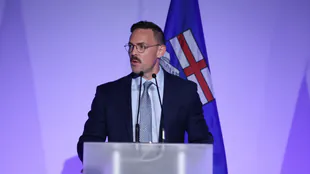
Plastic pollution treaty talks in disarray / Photo: JOHAN ORDONEZ - AFP

Attempts to finalise a landmark treaty combating plastic pollution descended into disarray on the penultimate day on Wednesday as dozens of countries rejected outright the latest draft text, leaving the talks in limbo.
With some 30 hours left to seal a deal among the 184 countries gathered at the United Nations in Geneva, states lined up to slam the proposed text put forward by talks chair Luis Vayas Valdivieso.
The larger bloc of more ambitious countries blasted the dearth of legally-binding action, saying that the draft text was the lowest common denominator and would reduce the treaty to a toothless waste-management agreement.
But oil-producing states from across the aisle said that the text went too far for their liking, crossing their red lines too and not going far enough in reducing the scope of what the treaty should be about.
The talks towards striking an international, legally-binding instrument on tackling plastic pollution opened on August 5.
Five previous rounds over the past two and a half years failed to seal an agreement, including a supposedly final round in South Korea late last year.
However, countries seem no further forwards in finding a consensus on what to do about the ever-growing tide of plastic rubbish polluting land, sea and human health.
With a day left to go, Ecuadoran diplomat Vayas presented a new draft -- but matters quickly unravelled as the text was savaged from all quarters.
- 'Without ambition entirely' -
Panama said that the goal was to end plastic pollution, not simply to reach an agreement.
"This text is about closing a wound... but the text presented here makes that wound fatal and we will not accept it," their negotiator said, adding: "It is not ambition: it is surrender."
The EU said it was "not acceptable" and lacked "clear, robust and actionable measures", while Kenya decried that there were "no global binding obligations on anything", meaning it "does not have any demonstrable value".
Tuvalu, speaking for 14 Pacific small island developing states, said the draft risked producing a treaty "that fails to protect our people, culture and ecosystem from the existential threat of plastic pollution".
Britain called it a text that drives countries "towards the lowest common denominator", while Norway added simply: "It's not delivering on our promise... to end plastic pollution."
Bangladesh said the draft "fundamentally fails" to reflect the "urgency of the crisis", saying that it did not address the full life cycle of plastic, health, toxic chemical ingredients or reliable implementation.
"This is, as such, without ambition entirely."
A cluster of mostly oil-producing states calling themselves the Like-Minded Group -- including Saudi Arabia, Russia and Iran -- want the treaty to focus primarily on waste management.
Kuwait, speaking for the club, said the text had "gone beyond our red lines", insisting: "Without consensus, there is no treaty worth signing.
"This is not about lowering ambition: it's about making ambition possible for all."
Saudi Arabia said that there were "many red lines crossed for the Arab Group", and reiterated calls for the scope of the treaty to be defined "once and for all".
- 'Betrayal of humanity' -
Environmental non-governmental organisations following the talks closely also blasted the draft.
The proposed text "is a gift to the petrochemical industry and a betrayal of humanity", said Greenpeace delegation chief Graham Forbes.
The World Wide Fund for Nature slammed the draft text, calling it a "devastating blow" to people suffering from the impact of plastic pollution.
The Center for International Environmental Law delegation chief David Azoulay said it "all but ensures that nothing will change" and would "damn future generations".
While 15 percent of plastic waste is collected for recycling, only nine percent is actually recycled.
Nearly half, or 46 percent, ends up in landfills, while 17 percent is incinerated and 22 percent is mismanaged and becomes litter.
H.Nakamura--JT