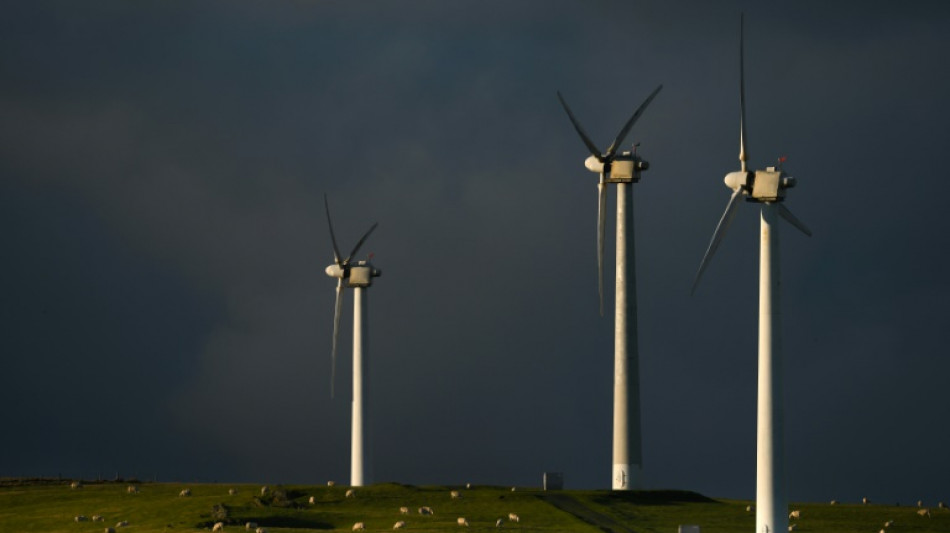
UK carbon emissions cut by half since 1990: experts / Photo: Daniel LEAL - AFP

The UK has cut its carbon emissions by 50.4 percent since 1990 levels, a group of experts tasked with advising the government said on Wednesday.
The figures are included in the first assessment of the new Labour government's progress on reducing emissions by the Climate Change Committee (CCC) since it took office last July.
The report covers carbon pollution from power generation, industry, road transport, residential buildings, aviation and farming.
It does not take account of emissions from UK consumption of goods, wherever in the world this pollution arises along the supply chain.
Emissions relating to imports rose 80 percent between 1996 and 2022, particularly from China, as the UK shifted away from manufacturing to services, according to a separate government report published in May.
Much of the drop in emissions of planet-heating greenhouse gases was the due to the closure of the UK's coal-fired power generation plants, the CCC said in its report to parliament.
"The UK can be proud of our progress in reducing emissions. We've cut them by over 50 percent since 1990," interim committee chair Piers Forster.
"Progress to date has been primarily driven by decarbonisation of the electricity system, with renewables replacing both coal and, increasingly, gas," the report said.
- Aviation emissions -
This improvement was partially offset by an increase in emissions from flying, it said.
"As a result of this increase, aviation now contributes a greater share of total UK emissions than the entire electricity supply sector. Continued emissions growth in this sector could put future targets at risk."
Forster said Prime Minister Keir Starmer's government needed to do ensure people saw the benefits of moving away from fossil fuels, namely by making their electricity bills cheaper.
"Given increasingly unstable geopolitics, it is also important to get off unreliable fossil fuels and onto homegrown, renewable energy as quickly as possible," he added.
The report said that more than 80 percent of the emissions savings the UK needed to make between now and 2030 needed to come from sectors other than energy supply.
It said there had already been progress in curbing pollution from road transport, with electric vehicles now representing 19.6 percent of the car market.
There are now 1.5 million electric cars on UK roads, a doubling in the past two years.
Heat pump installations were also up by 56 percent in 2024, although this still represented only around of one percent of homes, among the lowest in Europe.
And planting trees to absorb carbon increased too increased by 59 percent in 2023-24, the highest planting rate in two decades.
- Greater reductions -
The CCC said the emissions covered in its assessment fell by 2.5 percent in 2024 -- the 10th consecutive year they had dropped, excluding the Covid 19 pandemic years of 2020 and 2021.
Much of the progress could be attributed to the policies of the previous Conservative government, the report said.
But it credited Starmer's government with "bold policy decisions this year".
These included "removing planning barriers on renewable deployment, clarity on the clean power mission and the reinstatement of the 2030 phase-out date for new petrol and diesel vehicles", the experts said in a statement.
The government's relaxation of planning rules has proved divisive, however, with environment groups saying inappropriately sited renewables developments, such as on peatlands, could lead to a rise in emissions of powerful greenhouse gases such as methane.
The committee is charged with reviewing the UK's progress on adapting to climate change every two years.
Starmer pledged in November to reduce greenhouse gas emissions by 81 percent on 1990 levels by 2035, strengthening the UK government's ambitions to help curb climate change.
Starmer unveiled the revised target -- the latest environmental policy change since winning power -- at the start of the United Nations COP29 climate conference in Baku, Azerbaijan.
M.Fujitav--JT