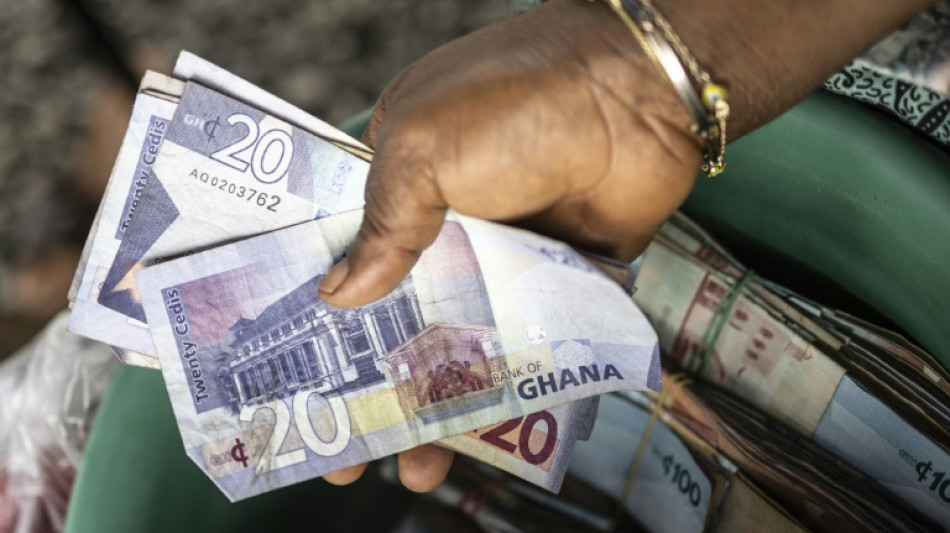
Facing a broken economy, Ghana's tech-savvy teens turn to fraud / Photo: OLYMPIA DE MAISMONT - AFP

In the dusty alleys of Nima, a shanty town in the heart of Ghana's capital, a 17-year-old called Ghost reclines on a faded plastic chair inside a dimly lit internet cafe.
Outside, barefoot children chase a punctured football. Inside, Ghost's fingers dance across the keyboard, his eyes locked on WhatsApp as he engineers a phishing scam that could earn him thousands of cedis in just a few hours.
"I made GHC12,000 ($770) last month," Ghost told AFP, his voice low and calculated, describing an online store he set up on Instagram.
"People bought phones and laptops. None of it existed."
Ghost, a pseudonym he gave AFP, is one of a growing number of Accra's teenagers turning to cybercrime to survive in a country mired in economic crisis, battling both youth unemployment and broken dreams.
From mobile money fraud to investment scams, a murky digital underworld is sucking in minors, many working from their bedrooms or small kiosks operating in plain sight -- anywhere with a stable internet connection.
- Too good to be true -
Nima’s 441 neighbourhood is a tightly packed, working class community of corrugated iron housing and open drains. Opportunities are scarce -- but mobile phones are not.
Ghana's Cyber Security Authority (CSA) has raised the alarm over a surge in cyberfraud, with financial losses tallying $282,776 between January and March 2025, nearly doubling the $154,241 recorded during the same period in 2024.
Officials warn that youth-led scams, powered by social media and peer pressure, are driving the spike.
Phishing scams, brand impersonation and fake online shops dominate the scene, with teenagers posing on Snapchat and TikTok as vendors with offers that are too good to be true.
Mercy Adumoah, 20, was one such victim.
"I saw a page on Snapchat selling heels. I needed a pair for an event, so I paid without thinking twice," she recounted.
After they received the money, the sellers blocked her account.
Experts say these crimes have become systemic in a country with a battered economy that is still recovering from a 2023 debt default. Inflation shot above 54 percent in 2022 and has remained above 20 percent into 2025.
At a junior high school near Nima, teacher Mohammed Inusah has witnessed a transformation.
"Some of my students have iPhones more expensive than my salary," he told AFP. "They flaunt cash, buy designer clothes and sneakers."
"The parents are either unaware or too afraid to confront them."
- 'I know it's wrong' -
A soft-spoken boy with a mop of dreadlocks who gave the name Tricky said he got his start in scamming by copying scripts from online forums in Nigeria.
Later, his cousin taught him mobile money fraud -- how to pose as an agent from the local telecom company to get access to people's accounts.
Tricky claims his biggest hit since in his two years of scamming was $500 -- twice the monthly salary of a public health nurse or a teacher.
"I bought clothes, helped my mum pay rent," he said. "I know it's wrong, but tell me, what else can I do?"
The CSA has also flagged a dramatic rise in online investment fraud. Between January and August 2024 alone, 149 cases were recorded with losses nearing $128,534.
"I fell for one," admits 18-year-old "Bronzy", who went from victim to perpetrator. "A guy scammed me using a fake forex trading site. So I learnt the game."
He now runs a group on Telegram promising 20 percent weekly returns.
"People invest and I disappear," he said.
Abubakar Issaka, president of the Cyber Security Experts Association of Ghana, said the situation is only getting worse.
"The regulations exist... but enforcement is weak. The number of professionals is not growing fast enough to match the fraud cases," he said.
Tracing perpetrators "is a challenge due to poor data integration" between telecoms operators and the national ID database, he added.
In some cases, the phone numbers used in frauds "belong to people who died years ago. Fraudsters are steps ahead."
- No end in sight -
Victims suffer anxiety and financial ruin. Scammers are not untouched. Ghost admits he's often afraid.
"Sometimes, I can't sleep. I wonder if the police will knock. But when I see my friends living large, I feel like I must keep going."
As dusk settles over Nima, Ghost logs off, pockets his burner phone, and steps into the fading light.
He didn't make any money that day. His world is one of quick, fickle wins and quiet fear. But with Ghana's economy showing no signs of rapid recovery, many more are likely to follow him into the shadows.
strs/nro/cw
M.Fujitav--JT