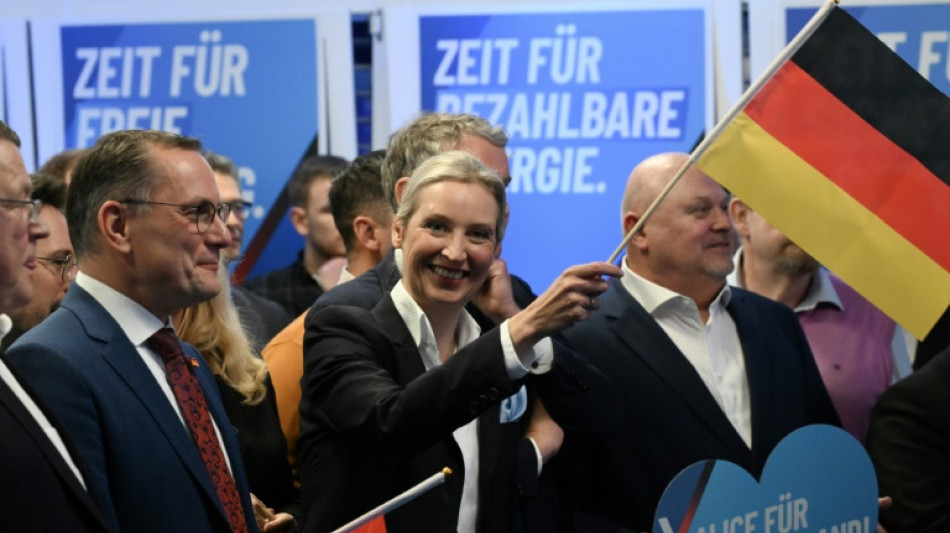
Germany's AfD dealt blow with right-wing extremist label / Photo: RALF HIRSCHBERGER - AFP/File

Germany's domestic intelligence service on Friday designated the far-right AfD party as an extremist group, handing authorities greater powers to monitor it and fuelling calls for it to be banned.
The anti-immigration Alternative for Germany (AfD) slammed the move as a "heavy blow" to democracy, just months after they won second place in national polls, and vowed to mount a legal challenge.
The BfV domestic intelligence agency, which had already designated several local AfD branches as right-wing extremist groups, said it decided to give the entire party the label due to its attempts to "undermine the free, democratic" order in Germany.
It cited in particular the "xenophobic, anti-minority, Islamophobic and anti-Muslim statements made by leading party officials".
The classification gives authorities greater powers to monitor the party by lowering the barriers for such steps as intercepting telephone calls and deploying undercover agents.
The decision drew swift condemnation from the conservative US administration. US Secretary of State Marco Rubio called the move "tyranny in disguise" and said "Germany should reverse course".
The designation revived calls within Germany to ban the party, however, heightening political tensions in Europe's top economy where conservative Friedrich Merz is to become chancellor next Tuesday leading a coalition government with the centre-left Social Democrats (SPD).
Lars Klingbeil, an SPD politician set to become vice-chancellor and finance minister in the coalition, said the government would examine the possibility of banning the AfD.
"They want a different country, they want to destroy our democracy. And we must take that very seriously," he told Bild newspaper, although he added the coalition would not make a hasty decision.
Incoming interior minister Alexander Dobrindt added that the spy agency's move "inevitably means there will be further observation of the AfD".
AfD co-leaders Alice Weidel and Tino Chrupalla charged in a statement that their party was "being publicly discredited and criminalised", and that the decision was "clearly politically motivated" -- a claim denied by the outgoing government.
Announcing its decision, the intelligence agency said that the AfD "aims to exclude certain population groups from equal participation in society".
In particular, the AfD does not consider German citizens with a migrant background from countries with large Muslim populations to be "equal members of the German people", it added.
- Welter of controversies -
The party, founded in 2013, has surged in popularity by capitalising on growing concern about migration while Germany has suffered from a recession.
It won more than 20 percent of the vote in February's election, a record result and behind only the centre-right CDU/CSU bloc of Merz.
More recent opinion polls have shown the party running neck-and-neck or even slightly ahead of the CDU/CSU alliance.
In a country still haunted by its Nazi past in World War II, establishment parties have vowed not to go into government or work with the AfD.
Merz breached this so-called "firewall" during the election campaign by relying on its support to pass a parliamentary motion demanding tougher immigration measures. That sparked widespread anger and nationwide protests.
He has since insisted he will not work with the AfD as he has formed a coalition with the SPD.
The AfD during the election campaign won the enthusiastic backing of tech billionaire Elon Musk, a close adviser to US President Donald Trump.
Musk said only the AfD could "save Germany", appeared by video at one of their rallies and hosted an interview with Weidel on his platform X.
On Friday he said that banning the AfD "would be an extreme attack on democracy".
The party has faced frequent controversies. One leading member has been convicted for using a banned Nazi slogan and others have been criticised for downplaying Nazi atrocities.
It has also faced allegations of close ties to Russia. This week a former aide to an AfD European Parliament lawmaker was charged over suspected spying on behalf of China.
AfD supporter Manuela Spitzwieser, a 54-year-old cleaner from the western city of Duisburg, echoed the party's claim that the BfV decision was politically motivated.
"It's totally obvious -- at the moment the AfD is leading in the polls," she told AFP.
She predicted that if the party was banned there would be civil unrest "like they had in France with the yellow vests... or we would found a new party which would go through the roof at the next election."
S.Fujimoto--JT