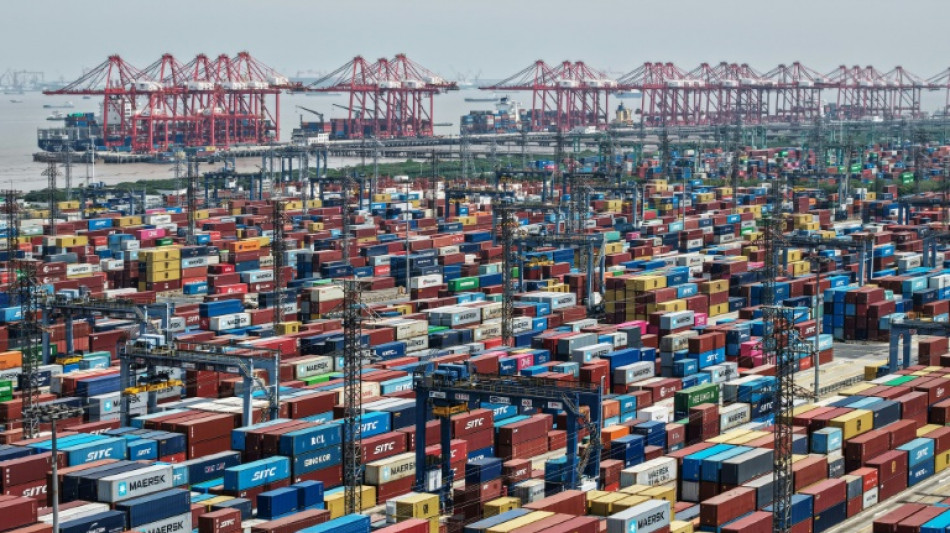
IMF slashes China growth forecasts as trade war deepens / Photo: STR - AFP

The IMF said Tuesday it now believed China's economy will only grow by four percent this year, well below Beijing's official target as it fights a mounting trade war with the United States that threatens to hammer the global economy.
China and the United States -- the world's two largest economies -- are engaged in a mounting tit-for-tat trade row that has sparked global recession fears and rattled markets.
China faces tariffs of up to 145 percent on many products, with others receiving even higher levies. Beijing has responded with duties of 125 percent on US goods.
Also contributing to downward pressure on growth in the Chinese economy are a persistent crisis in the property sector, local government debt and sluggish consumer spending.
The International Monetary Fund said Tuesday in its latest World Economic Outlook report that recent trends had led it to revise down a projection for global growth this year to 2.8 percent.
That reading represents a slowdown from the estimated 3.3 percent growth recorded last year, and is also half a percentage point lower than a previous IMF forecast in January.
The woes have been severely compounded by a second term for US President Donald Trump, whose push to bring manufacturing back to the United States stands to hammer China's manufacturing heartlands -- for decades a key driver of growth.
In view of an increasingly uncertain landscape in which "downside risks dominate", the IMF said, the Chinese economy is expected to grow four percent this year, slower than the 4.6 percent expansion predicted in January.
Growth next year is also now forecast to be four percent, down from the previous projection of 4.5 percent.
- Choppier waters -
The cuts reflect doubts about the ability of the world's second-largest economy to hold up against mounting domestic pressures and hurdles for exports from the manufacturing powerhouse.
"For China, the prolonged weakness in the real estate sector and its ramifications, including those for local government finances, have been key," said the IMF.
The report noted that consumer confidence in the country has not recovered since plunging in early 2022 -- and said that China is among the countries most affected by Trump's recent trade blitz.
Beijing has said it is targeting annual growth this year of around five percent -- the same as last year and a figure considered ambitious by many economists.
Data this month showed China's economy grew faster than expected in the first quarter, as exporters rushed to complete shipments before Trump's expected tariffs kicked in.
And observers warn that the full effect of the US levies is yet to be felt, with next month's release of several key macro indicators expected to shed light on how the economy is reacting.
China last year announced a string of aggressive measures to reignite its economy, including interest rate cuts, cancelling restrictions on homebuying, hiking the debt ceiling for local governments and bolstering support for financial markets.
But after a blistering market rally last year fuelled by hopes for a long-awaited "bazooka stimulus", optimism waned as authorities refrained from providing a specific figure for the bailout.
Analysts now think that the impact of tariffs may lead Beijing to reconsider its caution and push ahead with fresh stimulus.
- Continental impact -
China is far from the only major Asian economy to face the pressure of new tariffs from Trump's Washington.
The fresh levies -- though most are suspended for a 90-day period to allow for negotiations -- vary from 24 percent for Japan to a whopping 46 percent for Vietnam.
In light of the major trade turbulence, the IMF reduced its 2025 growth forecast for emerging and developing Asian economies including China by 0.6 percentage points.
The fund now anticipates a 4.5 percent expansion in those countries this year before bouncing back slightly to 4.6 percent next year.
India -- which has been spared from the most aggressive of Trump's tariffs -- has a "relatively more stable" growth outlook this year, said the IMF.
The world's most populous country is forecast to chart an economic expansion of 6.2 percent in 2025, according to the report -- "supported by private consumption, particularly in rural areas".
That growth rate, however, represents a 0.3 percentage point reduction from the IMF's previous forecast.
Japan, a manufacturing powerhouse that relies heavily on car exports, has been hit particularly hard by the tariff war.
The IMF said Tuesday it expects economic growth of 0.6 percent in Japan this year, dropping from the 1.1 percent expansion it predicted in January.
"The effect of tariffs announced on April 2 and associated uncertainty offset the expected strengthening of private consumption with above inflation wage growth boosting household disposable income," the IMF said.
M.Fujitav--JT