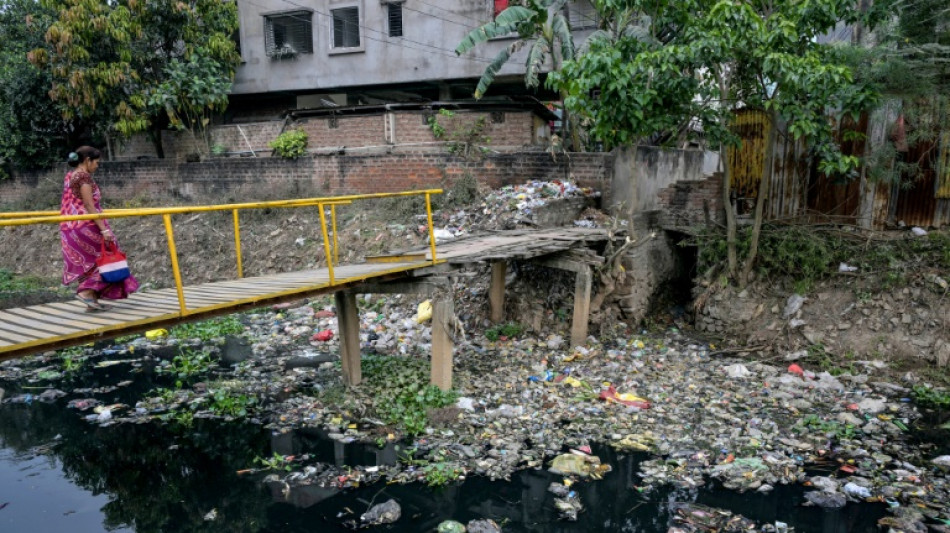
Global plastic recycling rates 'stagnant' at under 10%: study / Photo: Biju BORO - AFP

The amount of plastic being recycled around the world is stagnant at less than 10 percent with most new plastic still made from fossil fuels, a new study said Thursday.
Researchers from Tsinghua University in China said the rate of recycling had barely budged even as plastic production had exploded, presenting a "pressing global environmental challenge".
Their findings, published in the journal Communications Earth & Environment, come as nations prepare to battle again over a treaty to address plastic pollution after the last round of negotiations failed to broker an agreement.
Plastic has been found in the depths of the remotest oceans and in snow atop the highest mountains, and tiny particles have been detected in blood and breast milk.
Yet despite growing international concern, there has been "a notable lack of comprehensive analysis of plastics along their supply chain", wrote Quanyin Tan and colleagues.
To address this, they drew on national statistics, industry reports, and international databases to create the first detailed global analysis of the plastics sector in 2022 from manufacture to disposal.
They found that just 9.5 percent of the 400 million tonnes of new plastic in 2022 was produced from recycled materials.
"The global recycling rate remained stagnant... reflecting little improvement from previous years," wrote the authors.
The rest was produced from fossil fuels, predominantly oil and gas, demonstrating "little progress" in addressing environmental concerns related to plastics production.
"The high reliance on fossil-fuel feedstocks for plastics production will further compromise the global efforts to mitigate climate change," the authors wrote.
- Recycling roadblocks -
Contamination with food and labels made some plastics more difficult to recycle, while the diversity and complexity of additives in materials posed another obstacle.
But another hindrance is purely economic: it is often cheaper to make new or "virgin" plastic than it is to recycle it.
"This economic barrier discourages investment in recycling infrastructure and technology, perpetuating the cycle of low recycling rates," the authors wrote.
They identified the United States, the largest consumer of plastic per capita, as having one of the lowest recycling rates with just five percent reused.
They also noted a "significant shift" in global waste disposal, with landfill in decline and around one-third of plastic waste being incinerated.
Landfill remained the main destination for most plastic waste, accounting for 40 percent of the global total.
But burning was "emerging as the most practiced method for managing plastic waste" with the European Union, China and Japan having among the highest incineration rates.
However the study did not account for "the significant role" of informal waste disposal schemes, which could affect the overall recycling rate, the authors noted.
In September, a separate study in Nature by researchers from the University of Leeds found that burning plastic in dumps and open fires was as big a problem for the planet as littering.
That study said burning plastic informally, mostly in poorer countries where no alternatives exist, spread plastic in the environment, worsened air quality, and exposed workers to toxic chemicals.
The authors of the more recent study said they hoped their research would "support the treaty negotiations" for a world-first plastic treaty which resume in August in Geneva after the last round collapsed.
K.Okada--JT