The Japan Times - Bank of Japan holds rates and warns of trade uncertainty

EUR -
AED 4.033141
AFN 70.834935
ALL 90.226994
AMD 394.187676
ANG 1.966222
AOA 1007.050323
ARS 1718.558814
AUD 1.64633
AWG 1.976762
AZN 1.856167
BAM 1.959227
BBD 2.217859
BDT 136.959555
BGN 1.947627
BHD 0.415523
BIF 3307.540013
BMD 1.098201
BND 1.419964
BOB 12.944641
BRL 6.518259
BSD 1.101116
BTN 102.675186
BWP 15.554064
BYN 3.292935
BYR 21524.736732
BZD 2.214653
CAD 1.57309
CDF 2503.898376
CHF 0.92496
CLF 0.028323
CLP 1114.706703
CNY 7.32132
CNH 7.325625
COP 3767.465885
CRC 492.957739
CUC 1.098201
CUP 26.427382
CVE 110.457698
CZK 24.4339
DJF 196.091196
DKK 7.474136
DOP 66.285336
DZD 150.593453
EGP 59.099021
ERN 16.473013
ETB 180.736479
FJD 2.517739
FKP 0.837439
GBP 0.837691
GEL 2.849865
GGP 0.837439
GHS 12.944582
GIP 0.837439
GMD 81.266692
GNF 9761.89667
GTQ 8.418687
GYD 230.312838
HKD 8.60951
HNL 29.600504
HRK 7.50287
HTG 144.366595
HUF 373.618294
IDR 20061.933195
ILS 3.646792
IMP 0.837439
INR 102.147611
IQD 1669.366672
IRR 2127560.427059
ISK 137.198361
JEP 0.837439
JMD 174.275617
JOD 0.778645
JPY 174.828631
KES 142.831605
KGS 96.037702
KHR 4480.735214
KMF 493.092031
KPW 988.381153
KRW 1467.899261
KWD 0.342177
KYD 0.917705
KZT 495.767142
LAK 24811.397402
LBP 98614.185223
LKR 366.531096
LRD 184.991039
LSL 18.970982
LTL 3.242702
LVL 0.664291
LYD 7.1264
MAD 10.951155
MDL 20.206343
MGA 4971.6506
MKD 61.569716
MMK 2306.010052
MNT 3961.387418
MOP 8.897779
MRU 44.917133
MUR 51.374007
MVR 16.922997
MWK 1909.422367
MXN 20.984421
MYR 4.516022
MZN 70.18622
NAD 18.970376
NGN 1485.360768
NIO 40.520135
NOK 10.718329
NPR 164.280846
NZD 1.996156
OMR 0.422256
PAB 1.101226
PEN 3.757472
PGK 4.953619
PHP 70.096512
PKR 304.389834
PLN 4.438977
PYG 6904.012883
QAR 4.002983
RON 5.34901
RSD 117.628893
RUB 89.827515
RWF 1629.735717
SAR 4.120148
SBD 8.929052
SCR 15.353922
SDG 660.558526
SEK 11.179531
SGD 1.416745
SHP 0.835261
SLE 25.062385
SLL 23028.726825
SOS 629.303575
SRD 41.028588
STD 22730.540412
STN 24.54304
SVC 9.634852
SYP 14278.807869
SZL 18.966001
THB 37.285567
TJS 10.130681
TMT 3.854685
TND 3.336621
TOP 2.644205
TRY 55.544362
TTD 7.471831
TWD 36.199448
TZS 2919.021141
UAH 49.605413
UGX 4663.135019
USD 1.098201
UYU 44.69757
UZS 13192.074143
VES 1007.728596
VND 28308.872505
VUV 133.051632
WST 3.100531
XAF 655.957
XAG 0.026097
XAU 0.000308757017
XCD 2.967943
XCG 1.984508
XDR 0.776485
XOF 655.957
XPF 119.331742
YER 259.779317
ZAR 19.231117
ZMK 9885.156731
ZMW 22.629375
ZWL 353.620227
SSP 6350.50592
MXV 2.352287
  • RYCEF

    0.1000

    19.81

    +0.5%

  • VOD

    -0.2500

    16.33

    -1.53%

  • CMSC

    -0.2800

    20.12

    -1.39%

  • RBGPF

    -2.0000

    65

    -3.08%

  • RIO

    -0.2500

    94.16

    -0.27%

  • BTI

    -1.2000

    54.85

    -2.19%

  • NGG

    -0.3000

    74.94

    -0.4%

  • GSK

    -0.3500

    49.35

    -0.71%

  • BCE

    -0.4200

    20.14

    -2.09%

  • CMSD

    -0.3400

    19.93

    -1.71%

  • BP

    -0.9100

    43.52

    -2.09%

  • RELX

    0.1700

    33.24

    +0.51%

  • BCC

    -0.6200

    75.97

    -0.82%

  • AZN

    -1.9400

    164.21

    -1.18%

  • JRI

    0.0000

    10.77

    0%

Bank of Japan holds rates and warns of trade uncertainty
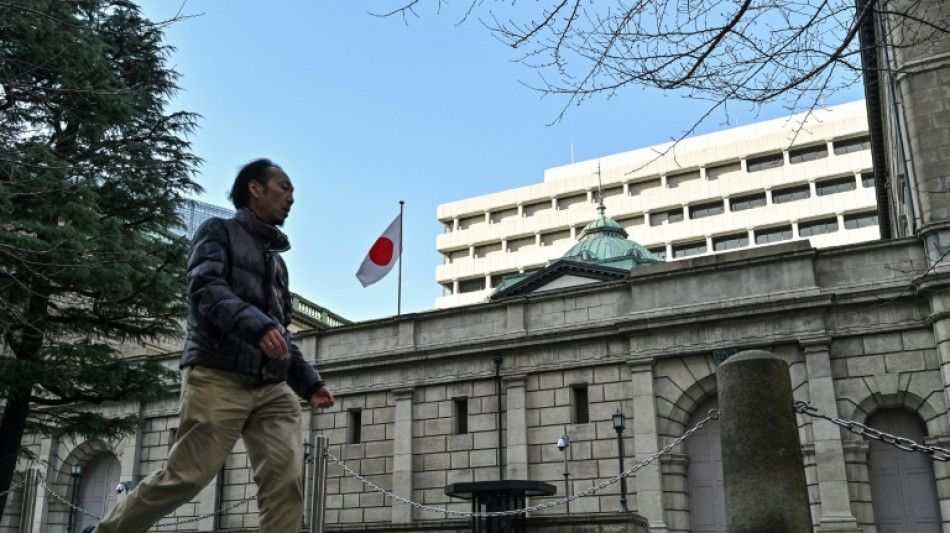
Bank of Japan holds rates and warns of trade uncertainty / Photo: Richard A. Brooks - AFP

Bank of Japan holds rates and warns of trade uncertainty

The Bank of Japan left its key interest rate unchanged Wednesday and warned about the economic outlook amid global uncertainty fuelled by Donald Trump's trade war.

Text size:

Officials began lifting borrowing costs last year after nearly two decades of ultra-loose monetary policies aimed at kickstarting torpid growth in the world's number four economy.

But since coming to office in January the Trump administration has embarked on a hardball campaign to rectify what it says are unfair trade imbalances, and imposed levies on multiple trading partners and imports including steel.

The uncertainty unleashed by that has forced central banks around the world to reassess their recent monetary policies.

On Wednesday the BoJ, after a two-day meeting, said it would stand pat on its key rate, having lifted it to a 17-year high of around 0.5 percent in January.

In a statement it said: "There remain high uncertainties surrounding Japan's economic activity and prices, including the evolving situation regarding trade."

Later, governor Kazuo Ueda told reporters: "Tariffs can directly affect the economy through trade -- especially production volumes, inflation and prices.

"On the other hand, tariffs, or even the prospect of tariffs, can affect the mindset or confidence of households and businesses, which could directly impact spending."

Stefan Angrick of Moody's Analytics said the BoJ statement "paints a fairly upbeat picture of the economy, which suggests the central bank is looking to tighten monetary policy further".

But "with the dust still settling from January's rate hike... the BoJ wants to gauge the impact of recent policy changes before tightening further", he wrote in a note.

- 'Pulse check' -

SPI Asset Management's Stephen Innes said the Federal Reserve and Bank of England were also expected to hold rates this week "as policymakers take their first collective pulse check on the fallout from Trump's trade policies".

Headline inflation in Japan has been above the bank's two-percent target every month since April 2022, and a year ago it finally lifted its interest rates above zero, before increasing them to 0.25 percent in July.

Wage trends are also key, after trade unions said early data showed they had secured an average 5.5 percent pay rise for members this year, a three-decade high and up from last year's preliminary reading of 5.3 percent.

The BoJ said on Wednesday that in Japan, "the employment and income situation has improved moderately".

"If the annual spring labour negotiations lead to significantly higher wages then we believe there is a possibility for an interest rate hike in the summer and another one six months later," Katsutoshi Inadome of SuMi TRUST said.

Prices excluding fresh food rose 3.2 percent on-year in January, accelerating from 3.0 percent in December. February inflation figures are due on Friday.

The BoJ is aware that rising prices "are contributing negatively to people's lives", Ueda said on Wednesday.

"A rise in food prices, including rice... can affect the basic pace of inflation through a change in households' mindset and expectation of future inflation," he said.

H.Hayashi--JT