The Japan Times - Japan to release emergency rice reserves to fight runaway inflation

EUR -
AED 4.029739
AFN 70.778474
ALL 90.058708
AMD 395.7146
ANG 1.96456
AOA 1007.296808
ARS 1720.666958
AUD 1.657266
AWG 1.977834
AZN 1.86972
BAM 1.956429
BBD 2.20782
BDT 136.343834
BGN 1.945981
BHD 0.413896
BIF 3301.631383
BMD 1.097273
BND 1.414142
BOB 12.797706
BRL 6.528229
BSD 1.096137
BTN 101.528716
BWP 15.628811
BYN 3.290828
BYR 21506.546342
BZD 2.204619
CAD 1.574642
CDF 2501.782318
CHF 0.922196
CLF 0.028442
CLP 1119.405199
CNY 7.327314
CNH 7.326205
COP 3845.842313
CRC 490.653273
CUC 1.097273
CUP 26.308098
CVE 110.770119
CZK 24.468858
DJF 195.203647
DKK 7.47781
DOP 65.562479
DZD 149.391641
EGP 58.61085
ERN 16.459092
ETB 176.468938
FJD 2.533059
FKP 0.836731
GBP 0.838894
GEL 2.857146
GGP 0.836731
GHS 12.975295
GIP 0.836731
GMD 81.198575
GNF 9718.035777
GTQ 8.378426
GYD 229.326413
HKD 8.600918
HNL 29.714573
HRK 7.496529
HTG 143.744904
HUF 373.391377
IDR 20072.355965
ILS 3.666044
IMP 0.836731
INR 101.661719
IQD 1661.819614
IRR 2125817.320551
ISK 137.28022
JEP 0.836731
JMD 173.646619
JOD 0.77801
JPY 173.977031
KES 142.733664
KGS 95.956926
KHR 4471.386933
KMF 492.675859
KPW 987.545879
KRW 1476.4848
KWD 0.342108
KYD 0.913494
KZT 500.03076
LAK 24732.528676
LBP 98260.777165
LKR 364.542217
LRD 183.607356
LSL 19.246583
LTL 3.239962
LVL 0.66373
LYD 7.093911
MAD 10.964503
MDL 20.092185
MGA 5036.482406
MKD 61.580129
MMK 2304.061261
MNT 3958.03968
MOP 8.850045
MRU 44.626499
MUR 51.330836
MVR 16.902103
MWK 1905.963184
MXN 21.021666
MYR 4.513125
MZN 70.119822
NAD 19.246578
NGN 1486.804984
NIO 40.358106
NOK 10.711083
NPR 162.445746
NZD 2.006534
OMR 0.419111
PAB 1.096117
PEN 3.792728
PGK 4.955326
PHP 70.245251
PKR 303.368532
PLN 4.459811
PYG 6912.253783
QAR 3.997407
RON 5.352281
RSD 118.471486
RUB 89.402865
RWF 1619.398498
SAR 4.099393
SBD 8.914258
SCR 15.255878
SDG 660.013606
SEK 11.223898
SGD 1.415267
SHP 0.838605
SLE 25.07309
SLL 23009.265425
SOS 626.492853
SRD 40.997955
STD 22711.331007
STN 24.798365
SVC 9.591084
SYP 14266.740959
SZL 19.246569
THB 37.23087
TJS 10.079341
TMT 3.840455
TND 3.345311
TOP 2.64197
TRY 55.433347
TTD 7.440392
TWD 36.176649
TZS 2929.67994
UAH 49.228854
UGX 4631.341246
USD 1.097273
UYU 44.573721
UZS 13200.19182
VES 1006.876973
VND 28311.283441
VUV 132.939191
WST 3.097911
XAF 655.957
XAG 0.026772
XAU 0.000311300718
XCD 2.965435
XCG 1.975635
XDR 0.775829
XOF 655.957
XPF 119.331742
YER 259.618676
ZAR 19.287466
ZMK 9876.775613
ZMW 22.570359
ZWL 353.321385
SSP 6345.139156
MXV 2.356462
  • RYCEF

    0.1000

    19.81

    +0.5%

  • VOD

    -0.2500

    16.33

    -1.53%

  • CMSC

    -0.2800

    20.12

    -1.39%

  • RBGPF

    -2.0000

    65

    -3.08%

  • RIO

    -0.2500

    94.16

    -0.27%

  • BTI

    -1.2000

    54.85

    -2.19%

  • NGG

    -0.3000

    74.94

    -0.4%

  • GSK

    -0.3500

    49.35

    -0.71%

  • BCE

    -0.4200

    20.14

    -2.09%

  • CMSD

    -0.3400

    19.93

    -1.71%

  • BP

    -0.9100

    43.52

    -2.09%

  • RELX

    0.1700

    33.24

    +0.51%

  • BCC

    -0.6200

    75.97

    -0.82%

  • AZN

    -1.9400

    164.21

    -1.18%

  • JRI

    0.0000

    10.77

    0%

Japan to release emergency rice reserves to fight runaway inflation
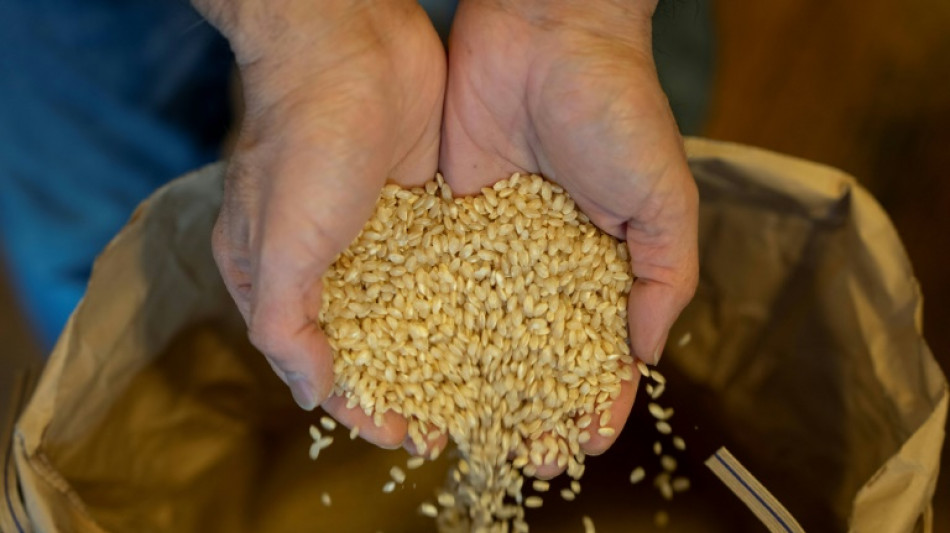
Japan to release emergency rice reserves to fight runaway inflation / Photo: Yuichi YAMAZAKI - AFP

Japan to release emergency rice reserves to fight runaway inflation

The Japanese government said Friday it will release a fifth of its emergency rice stockpile after hot weather, poor harvests and panic buying over a "megaquake" warning nearly doubled prices over a year.

Text size:

Japan has previously tapped into its reserves to cope with disasters, but this marked the first time since the stockpile was built in 1995 that it was doing so because of supply chain problems.

Some supermarket shelves were emptied in August of rice following a week-long holiday, a series of typhoons and warnings of a looming major earthquake that has so far failed to materialise.

The government had initially hoped prices would stabilise late last year once newly harvested rice arrived in stores, but inflation continued unabated, this time because some distributors were hoarding for fear of running out.

Agriculture Minister Taku Eto told reporters on Friday the government will release 210,000 tonnes of rice from its stock of one million tonnes.

"I hope you will take this as our strong determination to improve at all costs the situation where distribution has been delayed and stuck," he said.

Rice prices had already began to change consumption patterns for some like Tokyo resident Eriko Kato.

"I still do buy rice occasionally, but since it's so expensive I sometimes give up on buying it once I see the price," Kato, 41, told AFP.

A five-kilogramme (11-pound) bag was retailing at 3,688 yen ($24) in the last week of January, according to a government survey, up from 2,023 yen last year.

- Cashing in on crisis -

The law for the government to stockpile the grain was enacted in 1995 after a major rice crop failure two years earlier sent shoppers scrambling to buy the staple.

Masayuki Ogawa, assistant professor at Utsunomiya University, told AFP that a series of factors had contributed to the current crisis.

Among them is the tourism boom and shortage triggered by the extreme heat in 2023 -- joint record hottest summer.

The crisis was exacerbated by distributors that were believed to be hoarding in hopes of cashing in later, he said.

"It's suspected that some distributors are trying to make a profit, waiting for the price hike," he explained.

But he estimates the price increase could stop if these distributors are forced to release their rice after the government's move.

The reserve release is "a complicated operation," as government intervention could impact the stability of rice production and producers' earnings in the long term, he said.

To prevent the distorting effect, the government is required to buy back the same amount of rice it released within a year.

Rice consumption in Japan has more than halved in the past 60 years to about 50.9 kilogrammes (112 pounds) in 2022, but the grain remains deeply ingrained in Japanese culture and its harvesting has shaped the nation's landscape -- even being used in Shinto rituals.

Tokyo resident Kato says she "sometimes just switches to noodles like udon or soba instead" because rice is more expensive.

But "rice is food for our soul," she said. "It is important."

Y.Mori--JT