The Japan Times - China curbs exports of key chipmaking components to US

EUR -
AED 4.029739
AFN 70.778474
ALL 89.669173
AMD 395.464045
ANG 1.96456
AOA 1007.296808
ARS 1720.666958
AUD 1.64558
AWG 1.977834
AZN 1.86972
BAM 1.955128
BBD 2.206341
BDT 136.253158
BGN 1.945981
BHD 0.413358
BIF 3299.465689
BMD 1.097273
BND 1.413214
BOB 12.789603
BRL 6.528229
BSD 1.095423
BTN 101.462119
BWP 15.618631
BYN 3.288669
BYR 21506.546342
BZD 2.203143
CAD 1.574203
CDF 2501.782318
CHF 0.922196
CLF 0.028442
CLP 1116.636116
CNY 7.327314
CNH 7.332859
COP 3761.106983
CRC 490.331431
CUC 1.097273
CUP 26.290962
CVE 110.227105
CZK 24.468858
DJF 195.072937
DKK 7.47781
DOP 66.08728
DZD 149.391641
EGP 58.61085
ERN 16.459092
ETB 179.797988
FJD 2.514456
FKP 0.838778
GBP 0.838894
GEL 2.857146
GGP 0.838778
GHS 12.898566
GIP 0.838778
GMD 81.198575
GNF 9711.661263
GTQ 8.373121
GYD 229.181211
HKD 8.601467
HNL 29.444877
HRK 7.496529
HTG 143.650615
HUF 373.391377
IDR 20072.355965
ILS 3.666044
IMP 0.838778
INR 101.695794
IQD 1660.729064
IRR 2125817.320551
ISK 137.28022
JEP 0.838778
JMD 173.530343
JOD 0.77801
JPY 173.978128
KES 142.461024
KGS 95.956926
KHR 4469.463459
KMF 492.675859
KPW 987.545879
KRW 1476.824954
KWD 0.342108
KYD 0.912886
KZT 499.698211
LAK 24694.510363
LBP 98101.274117
LKR 364.304757
LRD 183.48692
LSL 19.148917
LTL 3.239962
LVL 0.66373
LYD 7.087563
MAD 10.954734
MDL 20.079097
MGA 4964.293344
MKD 61.533846
MMK 2304.580358
MNT 3959.266389
MOP 8.844159
MRU 44.651649
MUR 51.330836
MVR 16.902103
MWK 1899.546962
MXN 21.022046
MYR 4.513125
MZN 70.119822
NAD 19.148917
NGN 1486.804984
NIO 40.31614
NOK 10.711083
NPR 162.33919
NZD 2.006534
OMR 0.418806
PAB 1.095423
PEN 3.760307
PGK 4.931305
PHP 70.245251
PKR 302.809298
PLN 4.459811
PYG 6907.625252
QAR 4.004323
RON 5.352281
RSD 117.589574
RUB 89.402865
RWF 1618.343635
SAR 4.116755
SBD 8.914258
SCR 15.355277
SDG 660.013606
SEK 11.223898
SGD 1.414828
SHP 0.838605
SLE 25.07309
SLL 23009.265425
SOS 626.084761
SRD 40.997955
STD 22711.331007
STN 24.49158
SVC 9.584705
SYP 14266.740959
SZL 19.144418
THB 37.356693
TJS 10.072637
TMT 3.840455
TND 3.318059
TOP 2.64197
TRY 55.454853
TTD 7.435444
TWD 36.176649
TZS 2922.095423
UAH 49.196787
UGX 4628.408816
USD 1.097273
UYU 44.544686
UZS 13114.491416
VES 1006.876973
VND 28311.283441
VUV 132.579834
WST 3.09791
XAF 655.957
XAG 0.026772
XAU 0.000311300718
XCD 2.965435
XCG 1.974321
XDR 0.775829
XOF 655.957
XPF 119.331742
YER 259.618676
ZAR 19.332389
ZMK 9876.775613
ZMW 22.555246
ZWL 353.321385
SSP 6337.564166
MXV 2.356505
  • RYCEF

    0.1000

    19.81

    +0.5%

  • VOD

    -0.2500

    16.33

    -1.53%

  • CMSC

    -0.2800

    20.12

    -1.39%

  • RBGPF

    -2.0000

    65

    -3.08%

  • RIO

    -0.2500

    94.16

    -0.27%

  • BTI

    -1.2000

    54.85

    -2.19%

  • NGG

    -0.3000

    74.94

    -0.4%

  • GSK

    -0.3500

    49.35

    -0.71%

  • BCE

    -0.4200

    20.14

    -2.09%

  • CMSD

    -0.3400

    19.93

    -1.71%

  • BP

    -0.9100

    43.52

    -2.09%

  • RELX

    0.1700

    33.24

    +0.51%

  • BCC

    -0.6200

    75.97

    -0.82%

  • AZN

    -1.9400

    164.21

    -1.18%

  • JRI

    0.0000

    10.77

    0%

China curbs exports of key chipmaking components to US
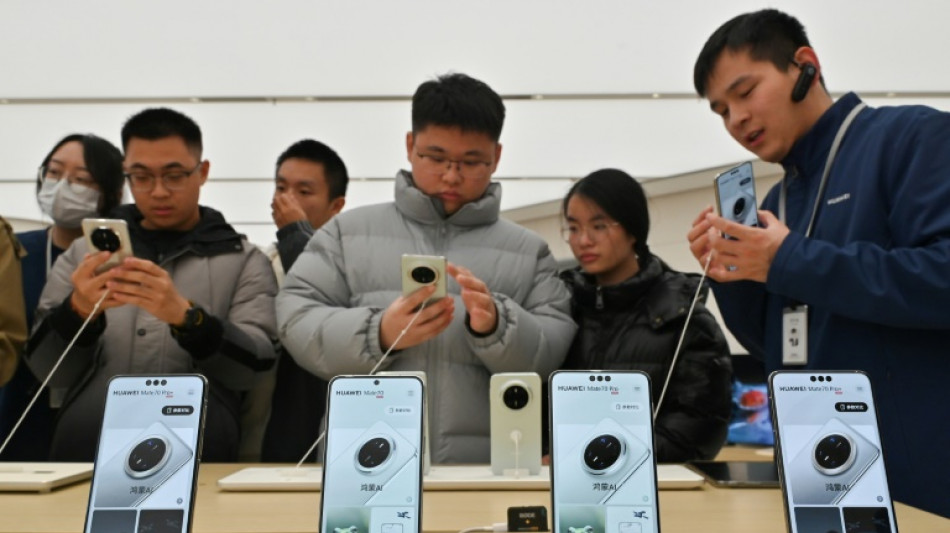
China curbs exports of key chipmaking components to US / Photo: ADEK BERRY - AFP

China curbs exports of key chipmaking components to US

Beijing said Tuesday it would restrict exports to the United States of some key components in making semiconductors, after Washington announced curbs targeting China's ability to make advanced chips.

Text size:

Among the materials banned from export are metals gallium, antimony and germanium, Beijing's commerce ministry said in a statement that cited "national security" concerns.

Exports of graphite, another key component, will also be subject to "stricter reviews of end-users and end-uses", the ministry said.

"To safeguard national security interests and fulfil international obligations such as non-proliferation, China has decided to strengthen export controls on relevant dual-use items to the United States," Beijing said.

"Any organisation or individual in any country or region violating the relevant regulations will be held accountable according to the law," it added.

In its own latest curbs, Washington on Monday announced restrictions on sales to 140 companies, including Chinese chip firms Piotech and SiCarrier, without additional permission.

They also impact Naura Technology Group, which makes chip production equipment, according to the US Commerce Department.

The move expands Washington's efforts to curb exports of state-of-the-art chips to China, which can be used in advanced weapons systems and artificial intelligence.

The new US rules also include controls on two dozen types of chip-making equipment and three kinds of software tools for developing or producing semiconductors.

Beijing swiftly vowed to defend its interests, saying the United States "abuses export control measures" and has "hindered normal economic and trade exchanges".

- 'Weaponised' trade -

And on Tuesday, China said Washington had "politicised and weaponised economic, trade and technological issues" as it unveiled its own export curbs.

The moves also restrict the exports of "dual-use items to United States military users or for military purposes", Beijing said.

China accounts for 94 percent of the world's production of gallium -- used in integrated circuits, LEDs and photovoltaic panels -- according to a report by the European Union published this year.

For germanium, essential for fibre optics and infrared, China makes up 83 percent of production.

Beijing last year had already tightened restrictions on exporters of the metals, requiring them to provide information on the final recipient and give details about their end use.

But the curbs unveiled Tuesday now ban them outright.

It had also previously restricted curbs on exports of certain types of graphite --also key to making batteries for electric vehicles.

"The move is clearly a retaliatory strike at the US," Chong Ja Ian, an associate professor of political science at the National University of Singapore, told AFP.

"Should these back and forth curbs affect trade for third parties, this can create some trade and supply chain disruption—as well as associated inflationary pressures," he said.

K.Yamaguchi--JT