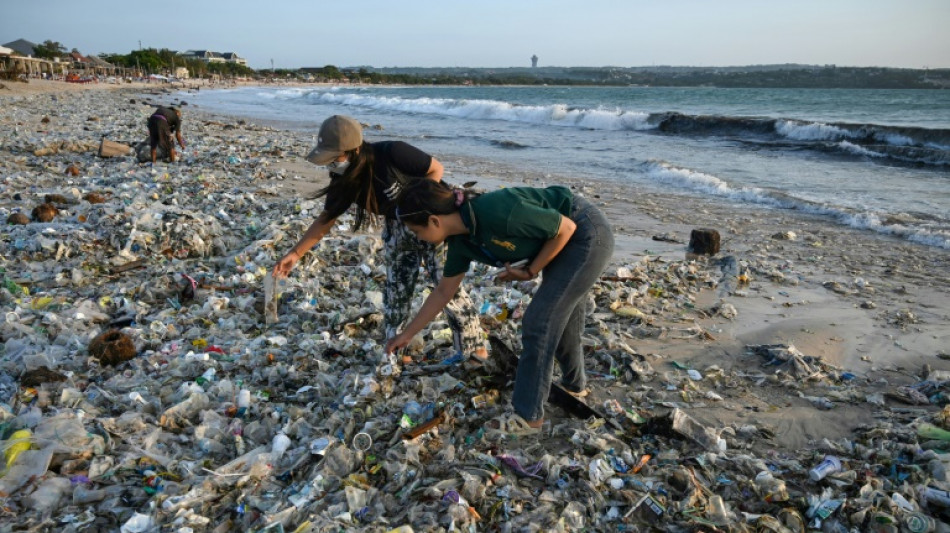
Plastic pollution talks: the key sticking points / Photo: SONNY TUMBELAKA - AFP

Nations gathered in Busan, South Korea have a week to agree the world's first treaty to curb plastic pollution, a gargantuan challenge given the major divisions that remain.
Here is a look at the key sticking points:
Consensus or majority
Divisions between nations are so deep that they have not yet agreed on how any decision will be adopted -- by consensus or majority vote.
Consensus is the standard for many UN agreements, but it has also hamstrung progress on other accords, notably climate.
To avoid gumming up discussions, negotiations are proceeding without resolving this question.
But that creates something of a landmine that could detonate at any point during the talks, particularly if countries feel they are losing ground, warned Bjorn Beeler, executive director of the International Pollutants Elimination Network.
"Because of the consensus decision-making process, the oil states could still blow up the potential final deal," he told AFP.
Production
The resolution that kicked off the talks urged a treaty that would "promote sustainable production and consumption of plastics".
But what that means is a key point of difference among negotiators.
Some countries want the treaty to mandate a reduction of new plastic production, and the phase-out of "unneccessary" items, such as some single-use plastics.
They note many countries already limit items like plastic bags or cutlery.
But other nations, led by some oil-producing states like Russia and Saudi Arabia, have pushed back against any binding reduction call.
They insist nations should set their own targets.
Saudi Arabia, representing the Arab group of nations, warned in its opening statement against "imposing rigid and exclusionary policies to address complex global issues".
They urged members to focus on a treaty "that balances environmental protection with economic and social development".
'Chemicals of concern'
The alliance of countries called the High Ambition Coalition (HAC), led by Rwanda and Norway, is pushing for specific measures on so-called chemicals of concern.
These are components of plastic that are known or feared to be harmful to human health.
The HAC wants "global criteria and measures" for phasing out or restricting these chemicals.
But some countries also reject that approach.
And lists are also firmly opposed by the chemical and petrochemical industry, which points to an array of existing international agreements and national regulations.
"A new global agreement to address plastic pollution should not duplicate these existing instruments and voluntary efforts," warned the International Council of Chemical Associations.
The auto industry says any broad-stroke bans could affect its ability to comply with safety regulations.
Finance
Implementing any treaty will cost money that developing countries say they simply do not have.
India insists the treaty should make clear that compliance "shall be linked to provision of the incremental cost" and backs the creation of a dedicated multilateral fund for the purpose.
That position may struggle to gain traction, particularly after the hard-fought battle at COP29 climate talks to extract more finance from developed countries.
But that is unlikely to sway countries advocating for the funds.
Developed countries "have historically benefited from industrial activities related to plastic production", noted Saudi Arabia, speaking for the Arab group.
They "bear a greater responsibility in providing financial and technical support as well as capacity-building for developing countries".
Globally binding or nationally determined?
Will the treaty create overarching global rules that bind all nations to the same standards, or allow individual countries to set their own targets and goals?
This is likely to be another key sticking point, with the European Union warning "a treaty in which each party would do only what they consider is necessary is not something we are ready to support".
On the other side are nations who argue that differing levels of capacity and economic growth make common standards unreasonable.
"There shall not be any compliance regime," reads language proposed for the treaty by Iran.
Instead, it urges an "assessment committee" that would monitor progress but "in no way" examine compliance or implementation.
M.Matsumoto--JT