Germany dodges recession but inflation rises sharply / Photo: JENS SCHLUETER - AFP/File

Germany dodged a technical recession after posting surprise growth in the third quarter, official data showed Wednesday, but the rare good news for Europe's largest economy was tempered by a sharp uptick in inflation.
German gross domestic product expanded 0.2 percent quarter-on-quarter, federal statistics office Destatis said in preliminary data, thanks to higher government spending and household consumption.
The figure defied expectations, and the government of Chancellor Olaf Scholz had braced for another slight drop in GDP after output already fell in the second quarter.
Economy Minister Robert Habeck said the quarter-on-quarter expansion was a "ray of hope" for the German economy, which has been battered in recent years by high energy costs, cooling exports and increased Chinese competition.
"The economy is proving more robust than previously forecast and the technical recession expected by many has not materialised," Habeck was quoted as saying by German media.
A technical recession is defined as two consecutive quarters of contraction.
Germany's performance helped lift the wider eurozone economy, which on Wednesday reported forecast-beating growth of 0.4 percent over the July-September period.
LBBW analyst Elmar Voelker said although it was "too early to speak of a positive trend reversal" for Germany, it was "encouraging that private consumption is showing the first signs of recovery".
The news for Germany wasn't all good however as Destatis revised downwards its figure for the second quarter, saying GDP shrank by 0.3 percent instead of the previous estimate of a 0.1-percent decline.
German inflation also sprang a negative surprise, climbing back up to two percent in October after falling to a more than three-year-low of 1.6 percent in September.
The uptick "shows that inflationary pressure in Germany is still very much alive and kicking," said ING economist Carsten Brzeski.
- Manufacturing slump -
The headwinds plaguing the German economy, particularly surging energy costs due to Russia's war in Ukraine, have taken a heavy toll on the country's crucial industrial sector.
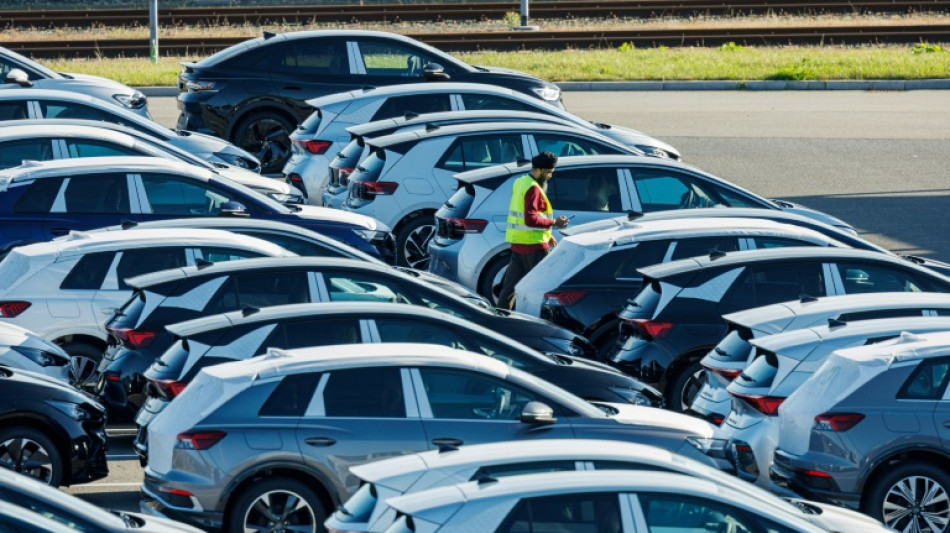
Nowhere has the manufacturing downturn been more visible than in Germany's flagship auto sector.
Europe's biggest carmaker Volkswagen reported a sharp fall in third-quarter net profits Wednesday and warned of an "urgent need" to cut costs to boost its competitiveness.
Volkswagen is considering closing at least three German plants and slashing tens of thousands of jobs, labour leaders told employees this week, as the company confronts stiff Chinese competition especially in electric vehicles.
Volkswagen, BMW and Mercedes-Benz all lowered their annual outlook in September, citing falling Chinese demand.
- Government under pressure -
Long-standing structural challenges have deepened Germany's woes, including complex bureaucracy, under-investment in infrastructure, an ageing workforce and a costly green energy transition.
Pressure has mounted on Scholz to take action, but his fragile three-party coalition is at odds over how best to turn the economic tide.
Habeck, from the Greens party, last week proposed a multi-billion-euro investment bonanza to help German business, but the idea was shot down by hawkish Finance Minister Christian Lindner from the liberal FDP.
Lindner is a staunch defender of Germany's constitutionally enshrined debt limits and has resisted calls from other coalition members to loosen the rules.
The International Monetary Fund has waded into the debate, with its European head Alfred Kammer on Tuesday saying Germany needed structural reforms as well as public infrastructure investments.
To achieve this, he told the Sueddeutsche newspaper, "the debt brake can be relaxed".
Germany was the only major advanced economy to shrink in 2023 and the government has previously said it expects another mild contraction in 2024.
But it now sees a recovery starting in 2025, when easing inflation and higher wages are expected to further bolster consumption.
T.Ikeda--JT