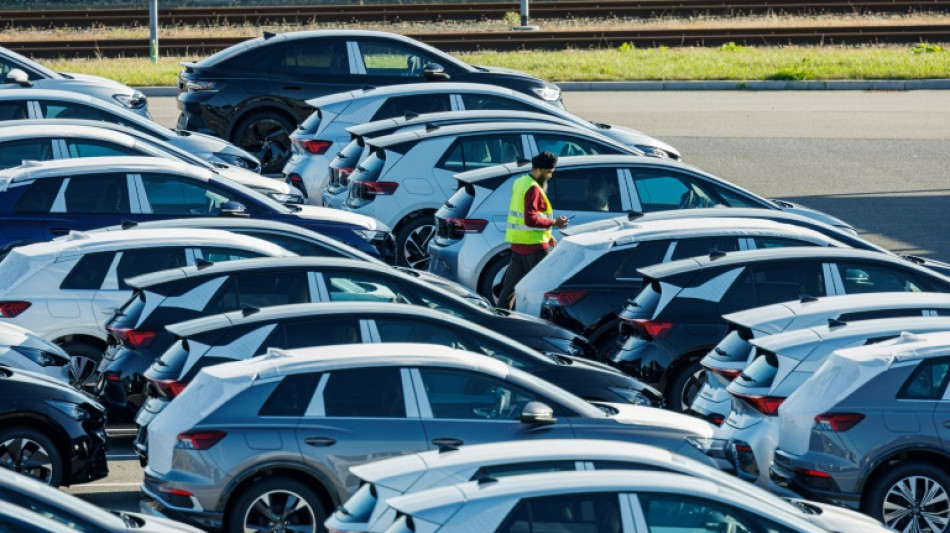
Germany dodges recession, posts surprise growth on spending boost / Photo: JENS SCHLUETER - AFP/File

The German economy unexpectedly grew in the third quarter as domestic spending increased, official data showed Wednesday, defying expectations of a slowdown that would have tipped the European giant into a technical recession.
Gross domestic product expanded 0.2 percent quarter-on-quarter, federal statistics office Destatis said in preliminary data, on the back of rising government spending and household consumption.
The government had been expecting "a renewed slight decline" after output fell in the second quarter.
But Germany -- which has been stuck in stagnation in recent years as it battles high energy costs, cooling exports and increased Chinese competition -- narrowly avoided entering a technical recession defined as two consecutive quarters of contraction.
It wasn't all good news however, as Destatis revised downwards its figure for the second quarter, saying the economy contracted by 0.3 percent instead of the previous estimate of a 0.1-percent decline.
The third-quarter figure was "a positive surprise" after months of gloomy indicators, said LBBW analyst Elmar Voelker.
While it was "too early to speak of a positive trend reversal", he said, it was "encouraging that private consumption is showing the first signs of recovery -- thanks to falling inflation".
Other major European economies were also publishing third-quarter GDP data Wednesday, with Germany now likely to boost the eurozone figure.
France's economy expanded by 0.4 percent thanks in large part to the Olympic Games, while Spanish GDP expanded 0.8 percent.
- Manufacturing slump -
The headwinds plaguing the German economy, particularly surging energy costs due to Russia's war in Ukraine, have taken a heavy toll on the country's crucial industrial sector.
Nowhere has the manufacturing downturn been more visible than in Germany's flagship auto sector.
Europe's biggest carmaker Volkswagen reported a sharp fall in third-quarter net profits Wednesday and warned of an "urgent need" to cut costs to boost its competitiveness.
Volkswagen is considering closing at least three German plants and axeing tens of thousands of jobs, labour leaders told employees this week, as it confronts stiff Chinese competition especially in electric vehicles.
Volkswagen, BMW and Mercedes-Benz all lowered their annual outlook in September, citing falling Chinese demand.
- Government under pressure -
Long-standing structural challenges are adding to Germany's woes, including complex bureaucracy, under-investment in infrastructure, an ageing workforce and a costly green energy transition.
Pressure has mounted on Chancellor Olaf Scholz to take action, but his fragile three-party coalition is at odds over how best to turn the economic tide.
Economy Minister Robert Habeck, from the Greens party, last week proposed a multi-billion-euro investment bonanza to help German business.
But the idea was shot down by hawkish Finance Minister Christian Lindner from the liberal FDP.
Lindner is a staunch defender of Germany's constitutionally enshrined debt limits and has resisted calls from other coalition members to loosen the rules.
The International Monetary Fund has waded into the debate, with its European head Alfred Kammer on Tuesday saying Germany needed structural reforms as well as public infrastructure investments.
To achieve this, he told the Sueddeutsche newspaper, "the debt brake can be relaxed".
Germany was the only major advanced economy to shrink in 2023 and the government has previously said it expects another mild contraction in 2024.
But it sees a recovery starting in 2025, when easing inflation and higher wages are expected to bolster consumption.
German inflation slowed to 1.6 percent in September, the lowest level since 2021. October's inflation figure is due later on Wednesday.
Unemployment meanwhile was stable in October at 6.1 percent, separate data showed.
Y.Kimura--JT