China's second-generation factory owners go digital to combat challenges / Photo: Hector RETAMAL - AFP

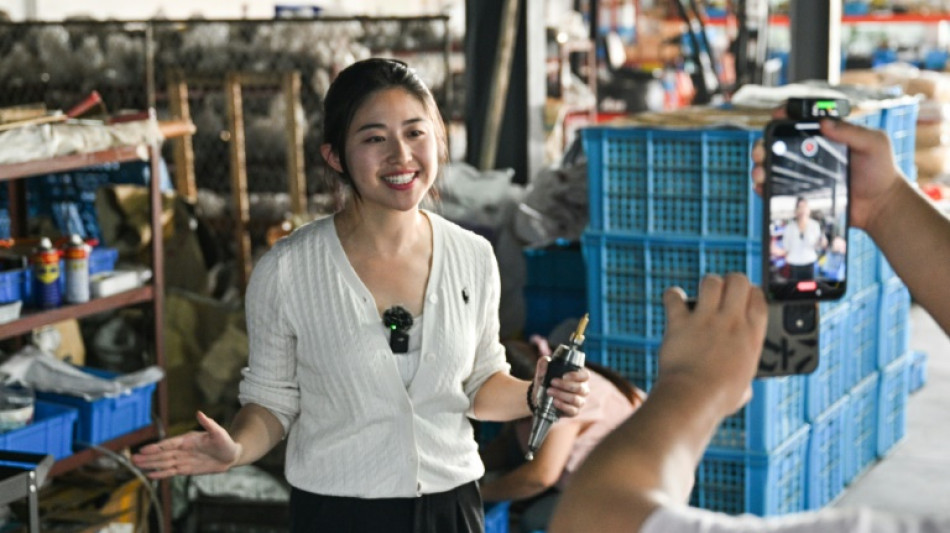
Dressed in a pristine white knit top, Robyn Qiu cut an incongruous figure in her parents' dusty, hangar-like metal hardware factory in eastern China as she gestured excitedly while an assistant filmed her on a smartphone.
The 29-year-old is one of many second-generation factory owners fighting to elevate the country's manufacturing sector, pitting digital native skillsets against the rising costs and geopolitical tensions pushing clients abroad.
Qiu said she grew up with "the noise of machines running day and night", but working in manufacturing was not always her first choice.
When Qiu was a child, her parents encouraged her to aim for a white-collar office job far from the dust and din of the factory floor.
"Even when they were starting the factory, their goal for me, their expectation for me is to really get a good education and break out of the cycle of farmers," Qiu said of her parents, who come from agricultural communities.
But after years spent working in consulting, the Yale-educated Qiu now feels she has "this very strong responsibility to give back to manufacturing".
Qiu has set up a marketing business that directly connects factories with foreign audiences, through videos posted on Instagram and TikTok, which in China can only be accessed using a VPN.
It's a stark contrast from the way earlier generations conducted business, often with many middlemen and at the mercy of major buyers.
In her videos, a cheerful Qiu speaks in fluent English, narrating as she buys street snacks in Shanghai or listing China's key manufacturing zones while walking along a factory assembly line.
- Manufacturing woes -
Qiu's parents, who founded the factory in the 1990s, were part of a massive wave of entrepreneurship that marked the first decades of China's reform and opening up, when the country transformed into the world's factory -- and eventually, its second largest economy.
However, rising wages in China and geopolitical tensions with trade partners including the United States have made alternative locations such as Cambodia and Bangladesh increasingly attractive to clients.
The Qius lost major customers in the 2010s after refusing an offer to move their production to Cambodia.
Flagging domestic demand in recent years has further weighed on the sector, with the official factory activity index in China contracting for five months in a row since May.
The Qius have adapted -- they recently purchased more advanced equipment to automate more of the manufacturing process.
They are also experimenting with making their own products, laser levels for construction use, rather than only making parts for clients.
Qiu said she sees the supply chain as a pyramid, with international brands at the top and raw material suppliers at the bottom.
"China is in the middle," she said. And now, "either we go up or we will go down".
- Being seen -
Rose Law, the daughter of a cosmetics factory owner in southern Guangdong province, echoed many of Qiu's thoughts, telling AFP her personal goals include "being able to have a more positive impact on the industry".
She is overseeing the development of product brands for the family business —- a step up the supply chain from originally making other brands' goods.
Law runs her own shampoo brand, with packaging and formulas inspired by traditional Chinese herbal remedies.
"In my parents' generation, all industries were new, and everyone in various sectors was competing from a similar starting line," Law told AFP.
Now, she sees creating brand loyalty rather than remaining an anonymous supplier as a way to keep orders stable and profitable.
"In a market with oversupply, being seen and trusted is extremely important," she said -- and social media is an important way to gain that crucial visibility.
- Online success -
Qiu said the reaction to her videos has been "amazing", with more than 500 buyers contacting her since May this year, and more than 150,000 users following her Instagram page.
Her online success is mirrored by other "Changerdai", the Chinese name for second-generation factory owners -- a play on "Fuerdai", a phrase used to describe often idle scions of generational wealth.
Changerdai content has gone viral both at home and abroad, albeit sometimes as inadvertent memes.
On Instagram, Guangzhou-based LC Sign has drawn half a million followers through videos in which a man, "Tony", shows off LED signs and does impressions of former US president Donald Trump.
On domestic platforms, a six-episode short video drama called "The Empire of Towel" -- made by a towel factory Changerdai -- has billions of views.
Nowadays, "if you want to do marketing, you want to get people's attention, you have to invest in short videos", said Qiu.
T.Maeda--JT