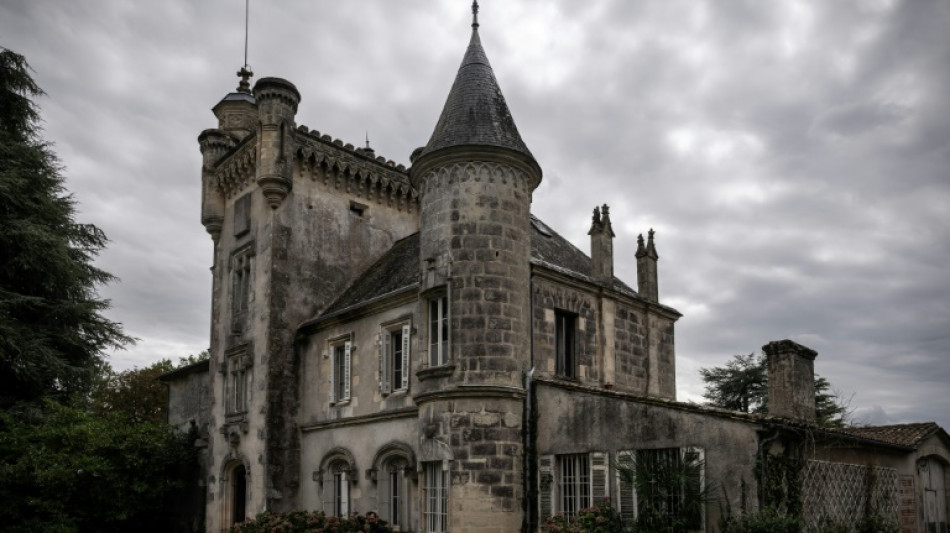
End of golden era for Chinese investors in Bordeaux wine / Photo: Philippe LOPEZ - AFP

After over a decade of snapping up Bordeaux wine estates, buying into a dream of elegant living in France and good earnings in their home market, many Chinese investors are now selling up.
Capital controls back home, softening Asian demand for wine and the underestimated costs of running French estates have combined to push the once-enthusiastic buyers from China towards the exit.
Chateau Latour Laguens in 2009 was among the first Bordeaux vineyards to be bought by a Chinese company, convinced its wines would bring in handsome dividends on China's domestic market.
More than 200 other estates in southwestern France followed.
Owner Daisy Haiyan Cheng, heir to the Longhai International group, was originally full of ideas for the neo-Medieval building –- a tasting room, a boutique, luxury guest rooms.
Today Chateau Latour, with its rising damp and its bat colony -– the only occupants -- is up for auction. The starting price, without the vines, is just 150,000 euros ($162,000).
Other estates have recently lost their Chinese owners too.
In May, the French authorities confiscated nine chateaux acquired in the 2010s by Chinese magnate Naijie Qu, founder of the Haichang conglomerate, after he was convicted of corruption.
In 2022, the chateaux of Golden Rabbit, Imperial Rabbit, Great Antilope and Tibetan Antilope disappeared from the Bordeaux map.
The four estates –- thus named by owner Chi Keung Tong, much to the ire of people in Bordeaux -– reverted to their original French titles when the head of Hong Kong's SGV Wines sold them back to French investors.
Many other chateaux are up for sale for peanuts, explained Li Lijuan, an estate agent and Asian market specialist at Vineyards-Bordeaux.
She said Beijing's decision to impose strict controls on capital had dealt a blow to a market already undermined by an overproduction of Bordeaux wine.
"Chinese people can't invest abroad any more because their money is stuck in China," said Li.
- False expectations -
About 50 Bordeaux chateaux are currently up for sale, she said.
Other disappointed owners are waiting for the market to pick up so they can offload their investments.
Buyers are so scarce that some chateaux are selling for less than half their purchase price.
False expectations have also scuppered the Chinese dream.
"Some investors bought into the French art of living," said Li.
"They bought a beautiful building, way cheaper than a flat in Hong Kong or Shanghai. But they didn't think about the financial stability of the estates or investments for the future," she said.
There are other misconceptions too, according to Safer Locale, a company that helps buyers access property in rural France.
Some Chinese investors, more used to family-run vineyards back home, "underestimated the costs" of running a big French estate and "overestimated the possibilities" of selling expensive-to-produce wines in China's already crowded domestic market.
"Their economic model was to buy bottom-of-the-range estates, hoping for an immediate return by producing wine at less than five euros and selling via their own distribution networks for 20, 40 or even 100 euros a throw," surmised Benoit Lechenault, head of BNP Paribas subsidiary Agrifrance.
While that tactic may have worked for some in the past, it is no longer the case.
Since Covid, China's domestic wine consumption has nosedived, falling by a quarter in 2023 alone, according to the International Organisation of Vine and Wine.
Then there are climatic factors in France such as hail and mildew, which have dampened the enthusiasm of recent investors, perhaps unaware that it takes several years to start making any money.
"Europeans reason in generations. Chinese investors think in terms of five-year cycles, after which it's quite normal to sell," said Hong Kong financier Hugo Tian.
- Long-term project -
Li agreed, noting the additional complications posed by "different business cultures" and "never-ending changes of management".
One technical manager, who preferred not to give his name, told AFP that he had only met his former boss "once in the space of four years" and had been bombarded with "impossible demands" that "didn't take into account the lifecycle of the vine".
Some major Chinese investors are here to stay, however.
Jack Ma, the billionaire founder of Chinese e-commerce group Alibaba, has spent millions on restructuring a Sours estate in Entre-Deux-Mers.
Hong Kong businessman Peter Kwok meanwhile has taken a longer view by restructuring the vineyards and the edifices on his seven once-dormant estates, one of which produces a rare Saint-Emilion Grand Cru Classe.
Hong Kong businessman Tian, whose Chateau Fauchey produces high-end Cadillac Cotes de Bordeaux, is also staying.
He said he was counting in "the medium to long term" on the more refined palate of younger Chinese consumers "looking for natural or organic wines rather than prestigious crus".
"New Chinese investors will come in a few years," he predicted.
"They'll be more rational and more reasonable."
M.Sugiyama--JT