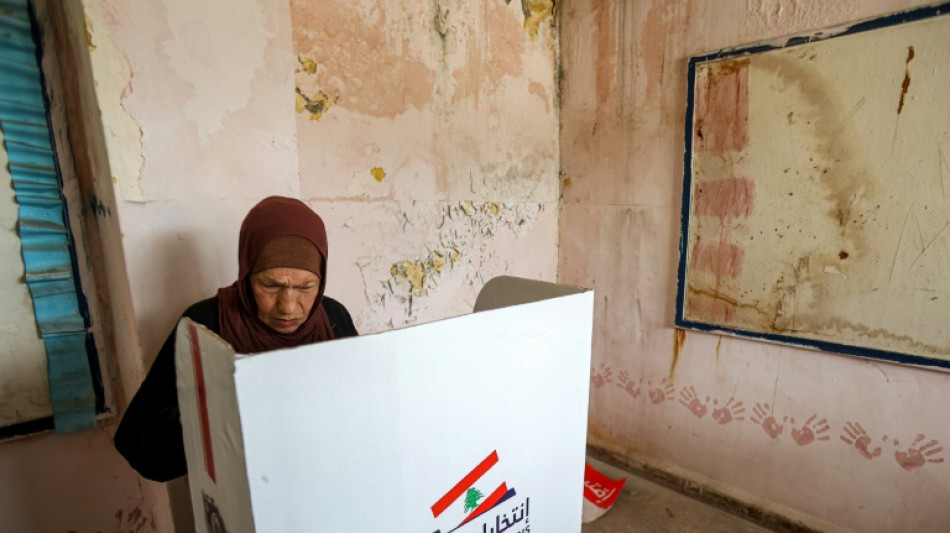
Lebanon vote weakens Hezbollah bloc as reformists book gains / Photo: Anwar AMRO - AFP

An election in crisis-hit Lebanon appears to have dealt a setback to the biggest bloc, led by the Iran-backed Shiite Muslim Hezbollah party, and boosted reformists, provisional results showed Monday.
Counting was ongoing and official results were only available for 78 of the 128 seats up for grabs by 10:00 pm (1900 GMT), fuelling opposition fears of foul play in some of the closest races.
Turnout was low in the general election Sunday, the first since the Mediterranean country was plunged into a deep economic crisis that has stoked popular fury with the hereditary and graft-tainted ruling class.
Some polling centres lacked electricity, forcing voters to use their phone lights to cast their ballots, in a reflection of Lebanon's most painful crisis since the 1975-1990 civil war.
Final results, now expected on Tuesday, will show whether Hezbollah, a political and military movement seen as a state within a state, and its allies can keep an actionable majority in Lebanon's parliament.
Hezbollah, considered a "terrorist" organisation by many Western countries, has so far retained all its seats, but its Christian allies, President Michel Aoun's Free Patriotic Movement (FPM), suffered losses.
The Lebanese Forces (LF) of former warlord Samir Geagea, which has strong ties with Saudi Arabia, won several new seats and should emerge as the largest Christian party.
Hezbollah MP Mohammed Raad warned opponents Monday against becoming "shields for the Israelis", raising fears of unrest as the group's rivals appeared to make gains.
"We accept you as opponents in parliament, but we will not accept you as shields for the Israelis," Raad said in televised remarks.
- 'Frustration' -
New opposition candidates also made advances, pushing forward the agenda of a cross-sectarian protest movement that erupted in late 2019 against the ruling elite.
Whatever the final election outcome, observers expect months of haggling over the next government line-up and the election of the speaker, and more political paralysis at a time when Lebanon needs an IMF bailout.
Election turnout was just 41 percent -- eight points lower than in 2018 -- suggesting that the traditional sectarian parties that have shared power like a cartel for three decades failed to mobilise their supporters.
"Abstention is partly linked to frustration with the political class and the feeling that the economic situation will not change," said Lebanese analyst Karim Bitar.
Turnout was particularly low in Sunni Muslim areas, after former premier Saad Hariri triggered a de facto boycott in his community by pulling out of the elections.
Some of the politicians most reviled by the reform camp suffered stinging losses, including several MPs who had traditionally represented the interests of neighbour and former occupying force Syria.
New opposition parties produced a strong showing in various parts of the country. While the reformists struggled to unite ahead of the vote, they could end up holding enough seats to leave them in an unprecedented king-making position.
Analyst Ziad Majed said that the economic context could play in favour of reformists who will for the first time be pushing from within parliament, not just as outsiders.
"This will create political and popular pressure for reformists and forces of change to cooperate," he said.
- 'New start' -
The election was held two years after Lebanon defaulted on its debt and as the currency has lost 95 percent of its value.
The other major cataclysm suffered by Lebanon was the August 2020 Beirut port explosion that killed more than 200 people, injured thousands and devastated swathes of the city.
Political heavyweights across the party spectrum have obstructed any meaningful investigation into the blast.
Scuffles and cases of voter intimidation were reported on polling day, although Interior Minister Bassam al-Mawlawi insisted Monday when announcing partial results that their number was "very low".
Tension was high in some constituencies where opposition candidates who looked to be squeezing into parliament suspected traditional parties of attempting to cook the results.
The outcome of the vote could have an impact on a presidential election due later this year.
President Aoun, 88, has long been expected to be succeeded by his son-in-law, FPM leader Gebran Bassil -- but Bassil's bid suffered a massive blow with the surge of the Lebanese Forces.
Marc Saad, an LF spokesman, voiced optimism about the coming electoral battle for the head of state.
"We can say that the Lebanese people have punished the governing parties and have aligned with us, expressing their will for a new start in governance," he said.
S.Suzuki--JT