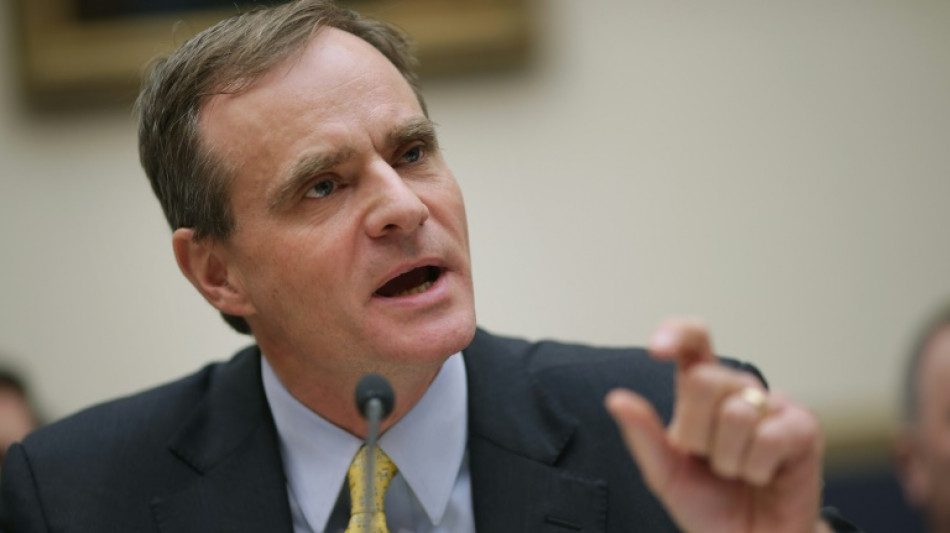
Don't let tech gurus decide the future: Nobel winner Simon Johnson / Photo: CHIP SOMODEVILLA - GETTY IMAGES NORTH AMERICA/AFP/File

Should our future by decided by the bosses of big tech firms? For Nobel economics prize winner Simon Johnson, giving too much power to a handful of billionaires will come at the expense of public interest.
The British-American economist who teaches at MIT also stressed that the development of artificial intelligence (AI) should benefit less qualified workers.
Automation and its impact upon jobs is one of Johnson's favourite elements in the relationship between democracy and economic prosperity, the subject which won him the Nobel alongside Turkish-American economist Daron Acemoglu and British-American James Robinson.
AFP spoke with Johnson by telephone and the interview has been edited for length.
Your work looks at the link between democratic institutions and economic progress, but in Western nations many are turning to populist movements as they feel they are missing out on growth. How do you explain this?
I was actually in France during your recent elections... I'm not an expert on France, but from those conversations and my direct observation it seems to me that even in more prosperous parts of France... people are disappointed, they're frustrated, they feel that democracy was not delivered...
So this failure to deliver results to people is a problem, and yes, of course we have to address it, and we have to address it by creating more good jobs, and that's the fundamental foundation of everything. A job where your productivity is higher, your pay is higher, and your working conditions and living conditions are better than they were in the past, or better than it was for your parents... And if any system makes reasonable promises on such things and fails to deliver, yeah, I think you should expect some disappointment and some blowback.
Will AI raise the productivity and the wages of low-skilled workers, or will it become a way, what we call excessive automation, where you basically fire the workers from your grocery store, replace them with self-checkout kiosks?
Who profits from AI in that case? Better-educated workers?
Let's be entirely honest... AI is mostly beneficial for the big tech companies. In any moment like this, the people who envisage technology, the vision that shapes technology is absolutely decisive. And these people, of course, at the moment are regarded as the heroes. But I think we have to ask, should we put so much power in the hands of one or two or three or a small number of men?
Don't let the big tech gurus dominate what gets developed and how it's used and how it impacts jobs... You will get their vision of the future. And for their wealth, not for you, not for your people, not for your community...
Is more regulation of Big Tech needed?
The business model of Meta (Facebook and Instagram) and Alphabet (Google) and a few other companies, it's driven by digital advertising. The way digital advertising works is it grabs your attention, it makes you upset, it manipulates your emotions. This is bad for mental health, it's very bad for children, by the way, and it's terrible for democracy, because what they want is to get you really worked up and angry at other people and shouting at them and behaving in a way that ... everybody would not behave in person. So we should come to realise that digital advertising is like tobacco and junk food.
I'm not proposing to ban it, I don't think that would work, but it should be taxed heavily. Anyway, our (with Daron Acemoglu) proposal is for a pretty high tax on digital advertising, and that would generate about $200 billion in additional revenue for the United States, which is a significant amount of money... We would suggest that, you know, Congress could put some of this tax money into mental health, including children's mental health.
And in any case, pushing these companies to change their business model and rely less on digital advertising would be good for many, on many fronts, but including on the democracy front... We've got to de-escalate, we've got to de-polarize, we've got to go back to finding common ground.
S.Yamamoto--JT