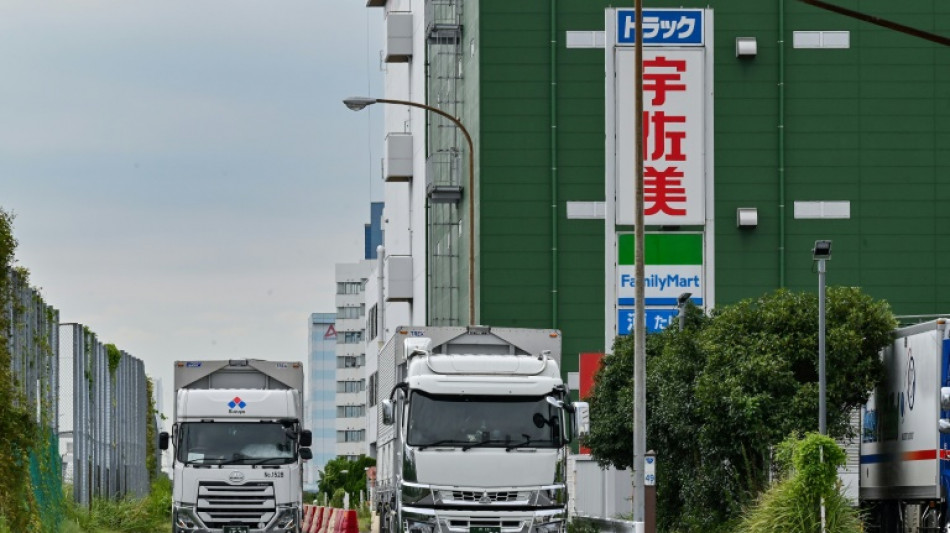
New rules drive Japanese trucking sector to the brink / Photo: Richard A. Brooks - AFP

Fujio Uemura has to rest after driving fish all night to Tokyo, under new rules that trucking firms and experts say are crippling Japan's logistics sector and risk pushing up prices for consumers.
The regulations are aimed at easing the stress of the badly paid hard slog of trucking, and making it more attractive to young people in ageing Japan, where some 90 percent of goods are transported by road.
"Before, I'd drive as long as I could before taking a break," said Uemura after his 1,000-kilometre (620-mile) journey from Oita in southern Japan with his load of fresh fillets.
"Long hours don't bother me. It's my job," the slim 59-year-old told AFP after leaping athletically down from the cab of his refrigerated 10-tonne vehicle.
Since April, truck drivers' annual overtime has been capped at 960 hours, or 80 hours per month on average, alongside new rules including on break stops.
Previously, there was no effective limit and many drivers worked around the clock to expand their meagre take-home pay.
But it can be a lonely and unhealthy life, with long, irregular hours on the road contributing to high rates of heart disease and strokes.
Despite its importance to the world's fourth-biggest economy, the trucking industry occupies a weak position in Japan's economic hierarchy.
Truck drivers generally work 20 percent longer than the average worker but earn around 10 percent less, or around 4.5 million yen ($30,000) per year. Almost one in five works 60 hours a week or more.
- 'Urgent issue' -
Most of Japan's roughly 63,000 trucking businesses are small players with 10 or fewer vehicles, and even before the new rules most struggled.
They survived by cutting prices or offering free loading and unloading, often by hand. Drivers frequently wait for hours at no extra cost to customers.
But the new rules are the final straw, said Haruhiko Hoshino, a senior official at the Japan Trucking Association.
"Reducing drivers' work hours means turning down jobs. Turning down jobs means that items will not be delivered," Hoshino told AFP.
Without meaningful reforms Japan by 2030 will lack the capacity to move as much as 34 percent of its domestic cargo, according to a study often cited by the government.
"The government is tackling this issue with all of its strength," transport minister Tetsuo Saito said last month, calling it an "urgent issue".
The effects were already visible with reports of airports struggling to secure enough aviation fuel earlier this year and fruit and vegetables arriving late.
Firms have teamed up to share lorries, an unthinkable step before the new rules, while dairy companies are looking at standardising containers.
The government's answer to what has been dubbed the "2024 Problem" is for companies to cut trucking firms some slack and not to insist on discounts and freebies.
- 'We are the victims' -
But ultimately the answer is for users and ordinary consumers to pay higher prices, said Hiroaki Oshima, professor at Ryutsu Keizai University.
This could be a headache for Japan's new Prime Minister Shigeru Ishiba after elections on October 27.
His predecessor Fumio Kishida suffered from poor popularity in part because of inflation squeezing incomes.
"In the end, who, right now, should pay for their fair share? I believe it's the society, it's those who send and receive cargos, it's consumers," said Oshima, who is also a senior advisor at NX Logistics Research Institute and Consulting.
Uemura used to spend mornings collecting fish products at various places in his home region and brought them to Tokyo on his own.
Now his employer Portline Service sends separate drivers for the pick-ups before Uemura drives off for Tokyo in the afternoon.
Portline's boss Katsuya Doi said this costs him an additional 1.3 million yen ($8,750) or more every month.
"We are the victims. It should not be just us or our clients who have to bear the cost," he told AFP.
Doi is working with rival firms to share assignments, negotiate fee increases and host public seminars to encourage consumer awareness.
Nonetheless, Uemura's 35-year-old son is taking to the wheel after quitting shipbuilding.
"I told him that this is not a job that lets you sleep a lot," Uemura said with a chuckle.
"You earn more with your hard work."
Y.Kimura--JT