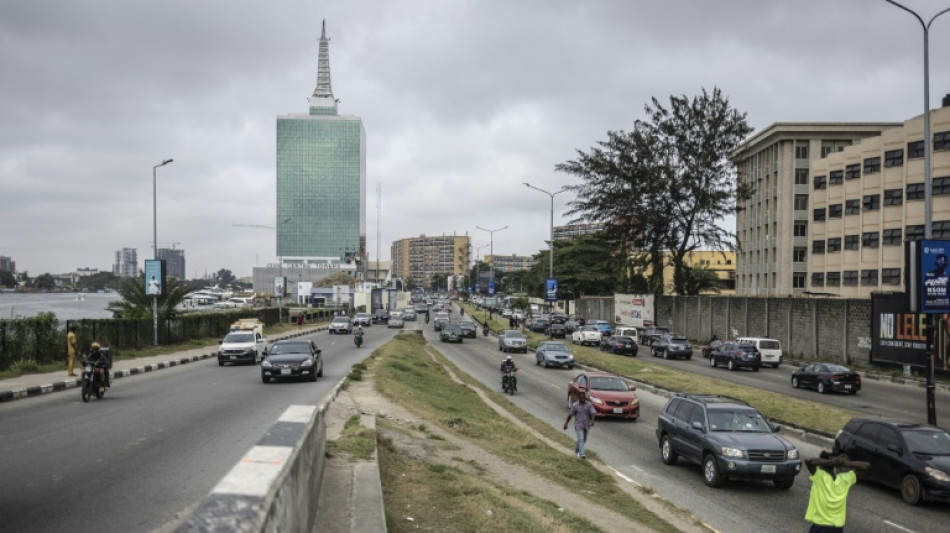
Nigerians sacrifice cars as cost of living crisis worsens / Photo: OLYMPIA DE MAISMONT - AFP

Nigeria's economic crisis and soaring petrol prices forced Bolaji Emmanuel to give up his driver and his Honda Pilot utility vehicle, as he struggles with spiking living costs.
Emmanuel is not alone. Many in Africa's most populous country are abandoning their cars as the costs strain disposable income.
The price of petrol has risen more than fivefold since President Bola Tinubu took office in May 2023.
"I parked it at my son's house. I use public transport now," Emmanuel, a 72-year-old retired health worker, told AFP. "It is not convenient, but it is what the economy demands."
Since coming to power, Tinubu has ended a costly fuel subsidy and freed up the naira currency, in reforms that government officials and analysts say will revive the economy and attract investors.
But in the short term, Nigeria has seen one of its worst crises in decades with inflation at a three-decade high.
A litre of petrol sold for around 195 naira just before Tinubu took office. The price rose to at least 998 naira ($0.61) per litre in Lagos and 1,030 naira in the capital, Abuja, at the beginning of October. It can go for as much as 1,300 naira elsewhere.
Inflation reached an almost three-decade high of 34.19 percent in June. It has since slowed to 32.7 percent in September.
The slump in purchasing power is piling more hardship on locals, with more than 40 percent of the population living in poverty, according to the World Bank. That figure is expected to rise in 2024 and 2025, before it stabilises in 2026.
The Nigerian middle class, which made up about 20 percent of the population in 2020, now readily sacrifices the comfort of private cars for survival.
Car dealers in Lagos and Abuja told AFP that they had seen more and more people trading their fuel-guzzling cars and sports utility vehicles (SUVs) for more efficient vehicles to cut costs.
"People are actually selling their big cars these days," Maji Abubakar, a car dealer in Abuja, told AFP. "The problem is that even if you put them on the market, there isn't much demand for them."
"It has been more than a year since I sold a car with an eight-cylinder engine, and the major reason is the price of petrol," he added.
With fewer cars on the road, even the notorious Lagos traffic, known as "go-slow", has thinned out.
- Used or Chinese cars, bicycles -
Elijah Bello, a tech entrepreneur in the southern state of Ogun, has looked for a buyer for his Lexus RX 350 SUV for months.
He has since bought a smaller, energy-saving Toyota Corolla to replace it.
The trend, which began last year, "will intensify" and "we will see fewer cars on the roads", said Bunmi Bailey, head of research at SBM Intelligence risk consultancy.
Bailey can fill his small car for 55,000 naira. "I can use it for two weeks for my normal home-to-work movement," he told AFP, while his larger car consumes 110,000 naira worth of petrol in just eight days.
The market for new cars has dropped by 10 to 14 percent in the last year, said Kunle Jaiyesinmi, deputy director at the Lagos-based CFAO Group, which specialises in automobile distribution.
"An SUV that sold for 40 to 45 million naira ($24,000 to $27,000) about two years ago, for now, if you want to negotiate the price, you see that it is within the range of 95 or 100 million ($57,000 to $60,000)," Jaiyesinmi told AFP.
But unyielding inflation and high exchange rates are steering more middle-class people away from used Japanese- and American-brand cars, toward increasingly popular Chinese-made ones.
Some are turning to bicycles, despite the lack of appropriate infrastructure in cities like Lagos, where car crashes are common.
"Sure, we notice (a rise in) cycling... for months since the fuel hike," said Femi Thomas, head of FT Cycle Care, a Lagos-based organisation that promotes cycle use.
Food delivery platform Glovo said it had recorded a growing interest in bicycle deliveries among its riders.
About 20 percent of orders are delivered by bike, Chidera Akwuba, the group's public relations manager in Nigeria, told AFP.
K.Hashimoto--JT