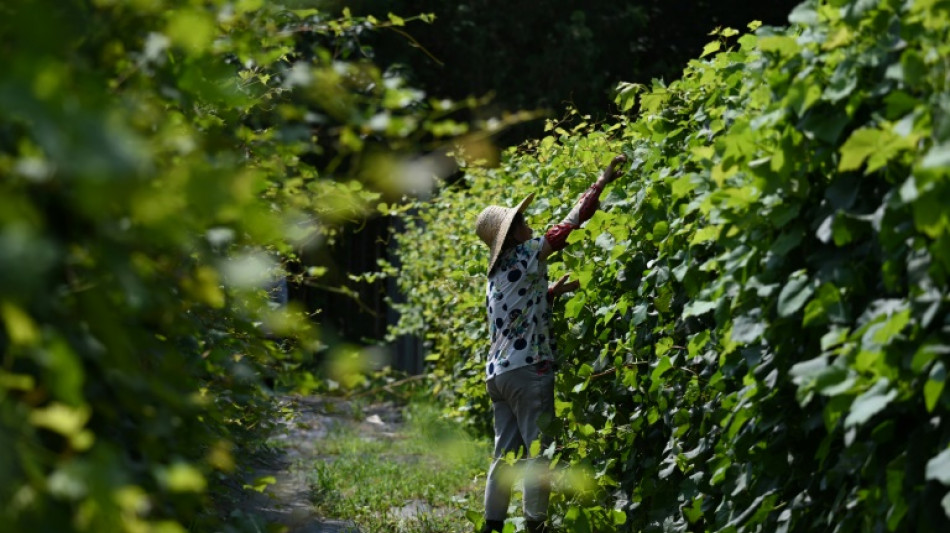
China wine industry looks to breed climate resilience / Photo: GREG BAKER - AFP

At a laboratory in Beijing, purple and green hybrid-species grapes are laid out on a board for testing, part of the strategy China's nascent wine industry is using to try to combat climate challenges.
Scientists are using genetics and artificial intelligence to address imperfect weather conditions, as well as anticipate future problems that might be wrought by rising global temperatures.
"In China, since we have a quite young industry, we don't have many clear observations about the effect of climate change," Dai Zhanwu, a professor at the Chinese Academy of Sciences (CAS), told AFP.
"But globally... there are many clearly observed impacts."
The world's wine production dropped 10 percent last year mostly because of "extreme environmental conditions" such as droughts and fires, according to a leading industry body.
Scientists say climate change driven by greenhouse gas emissions is making extreme weather more frequent and intense.
Global warming is also affecting grape quality, a recent review in science journal Nature said, meaning "the suitability of current winegrowing areas is changing, and there will be winners and losers".
Many Chinese wineries are determined to overcome those challenges.
"(Producers) are consulting us to see what will happen in the next decades, what they should do to be prepared," said Dai, whose work also involves collaboration with European institutions.
- Climate instability -
Solutions are sought both in the sterile calm of CAS laboratories and in the dusty fields of wine-producing areas like northern Ningxia.
There, temperatures in winter drop so low that vines have to be buried.
Producers told AFP they were already seeing the effects of a hotter world.
"They really fear it," said Ningxia-based researcher Liang Yuwen.
"From the point of view of a cultivator, the most feared thing is instability of climate, like sudden cooling, like hail, like extremely cold weather."
Liang and others told AFP harvests were starting earlier because of climate conditions.
Award-winning winemaker Zhang Jing said she has noticed the effect of warmer temperatures on her grapes.
"When the climate is suddenly hot, the grapes ripen too fast... The accumulation of sugar is too high, but the acidity is too low. This imbalance is a huge challenge," she said.
Zhang and others said they were experimenting with cultivation practices, and even considering starting vineyards in cooler locations, such as mountainous Yunnan and Tibet.
Dai's team in Beijing are using mathematical and climate modelling to try to predict where future growing regions might be.
"We want to know if we plant some vineyards in a given position, whether that position will keep the sustainability in the context of climate change, so what will happen in the next 10, 30 or 50 years," said Dai.
- Creating hybrids -
The most ambitious strategies involve developing new hybrid grape varieties that are more resistant to inclement weather.
In Beijing, Dai and his colleagues are delving into grape DNA, trying to understand the roles specific genes play in factors like colour, aroma and drought resistance.
Each year, the lab has the potential to produce around 20,000 new genotypes through crossbreeding, all of which must be evaluated.
Previously this was done manually, but now scientists use AI image recognition software to record aspects like colour, shape and size in seconds, cutting the time needed to identify candidates for further cultivation.
Promising strains are tested in the field.
At an experimental CAS vineyard in Ningxia, researcher Xie Jun showed AFP around rows of hybrid vines, their bunches of fruit protected by mesh bags to keep away pests.
"(The point is) to cross the good traits of the parent vines. So for instance, the father plant's cold resistance and drought resistance might be better, and then for the mother plant, the fruit quality might be better," he said.
As climate change impacts grape quality, "existing varieties will not be able to meet the standards of the raw materials needed for winemaking".
"Hybrids are what they need," he said.
- 'Chinese characteristics' -
There are already registered Chinese hybrids used in winemaking, the best known being Beihong and Beimei.
They were developed by crossing a cold-resistant native wild vine, Vitis amurensis, with better-tasting European species.
The resulting plants can resist temperatures lower than minus 20 degrees Celsius (minus 4 Fahrenheit), so do not need to be buried in winter.
That has saved Jiuxi, a hybrid-using winemaker Liang works with, a lot of money.
Sipping on its wine Dream Joy, a semi-sweet red, Liang said confidence in hybrid grapes' quality was growing.
"(Producers now) feel that this variety will certainly be able to make a wine with Chinese characteristics," he said.
While in the past hybrids were not thought to make particularly good drinking -- a "prejudice", said Dai -- they are now more widely used.
"With the challenge of climate change, I think during the last 10 years, even in Europe, they changed their mind," Dai said.
H.Takahashi--JT