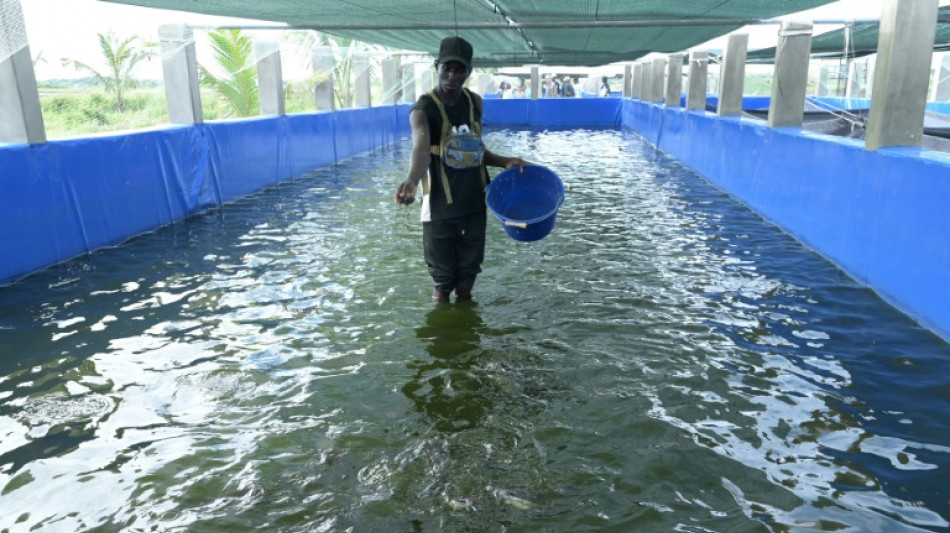
Senegal looks to aquaculture as fish stocks dwindle / Photo: SEYLLOU - AFP

The Senegalese town of Kayar sits on the doorstep of the vast Atlantic Ocean, but it is a farm located further inland that provides part of its fish production.
The farm's pioneering founder, Khadidiatou Sar Seck, began the project around 15 years ago in the West African country, where fishing is a key part of the national identity.
Fish accounts for over 70 percent of household protein intake, and the fishing industry provides around 600,000 direct and indirect jobs in a population of 18 million people.
But a resource that once seemed inexhaustible is becoming increasingly scarce due to overfishing, illegal catches and global warming.
The volume of catches by traditional wooden fishing canoes plunged by 58 percent between 2012 and 2019, according to the Environmental Justice Foundation (EJF).
For Senegalese faced with a high cost of living and widespread unemployment, prices are rising and an essential foodstuff is becoming increasingly unaffordable.
Hardly a day goes by without reports of a migrant boat leaving, being intercepted or capsizing on the perilous route between Senegal and Spain's Canary Islands.
Many who board the boats are fishermen or those living along the Atlantic coast, which is heavily reliant on the industry.
Like its predecessors, the new government has vowed to promote fish farming and attract industry investment.
- Untapped potential -
"Our objective is for aquaculture to make a major contribution to the country's marine production and to help achieve food sovereignty," fisheries minister Fatou Diouf said at a conference on sustainable aquaculture in the capital Dakar in September.
President Bassirou Diomaye Faye has made food sovereignty a policy priority since coming to power in March.
Despite its immense potential, Africa accounts for only around 1.9 percent of global aquaculture production, according to a 2024 report by the UN's Food and Agriculture Organization (FAO).
Asia accounts for 91.4 percent.
Aquaculture has long been practised in Senegal but has always struggled to take off.
The country created a dedicated agency in 2006 but the practice still supplies barely one percent of the country's overall aquatic produce.
For Seck, standing next to pools teeming with catfish and tilapia, the difficulty is that Senegalese people do not know the product, and finding quality varieties is difficult.
Feed for farmed fish has to be imported and is expensive, access to land is challenging and marketing is complicated, she added.
Seck sells her products directly to individuals, wholesalers and fishmongers.
But the director of the national aquaculture agency, Samba Ka, has big ambitions for the industry.
"Anything is possible if investment and partners follow suit," he said.
"We need everyone to get involved, to organise fairs and culinary workshops, to invite chefs, so that people know that this is something that can be eaten and that is good for health and nutrition."
- 'No more fish' –
The national agency hopes to produce 65,000 tonnes of farmed fish in 2032 and create around 50,000 jobs.
In a vast hangar around 100 kilometres (60 miles) southeast of Dakar, Demba Diop specialises in the production of young fish destined for farming.
He had to "start from scratch" using his own funds to set up the farm, as banks knew little about the business, he said.
Other barriers include the cost of feed and the availability of good quality young fish, both of which have to be imported from Europe.
At Dakar's bustling Soumbedioune market, fishermen hauling their colourful wooden vessels onto shore had mixed reactions to the prospects for aquaculture.
"We have enough fish in our seas, but unfortunately it's the foreign trawlers that deprive us of it," said Olivier Gomes, 36, who ruled out turning to fish farming.
Gomes said that he feared price competition from farmed fish. He was considering heading to Europe to make more money.
But Alioune Badara, a 54-year-old former fisherman who lived in Europe for a few years before returning to Senegal, said he was tempted by the change.
"Today, there are no more fish in the sea. If someone can help me financially with fish farming, I'm very interested," he said.
H.Takahashi--JT