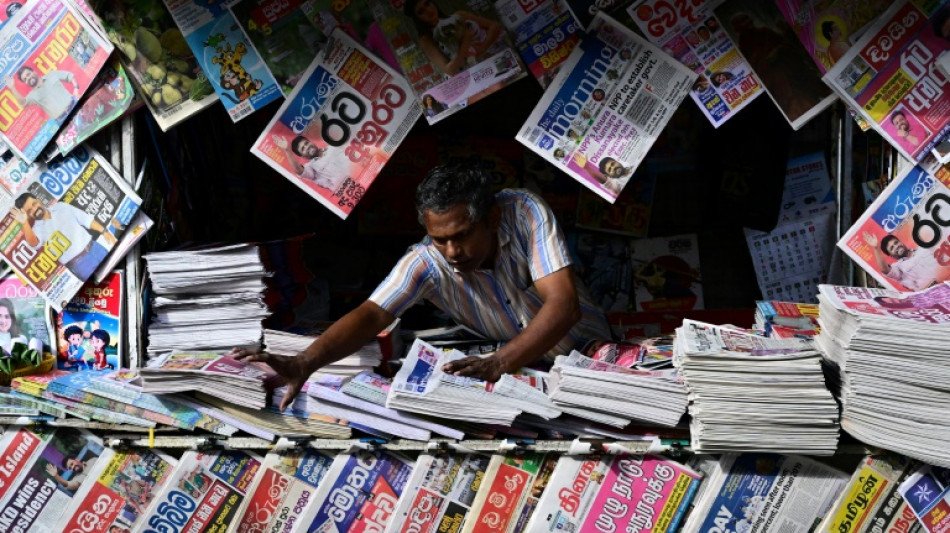
'Broken' news industry faces uncertain future / Photo: Ishara S. Kodikara - AFP

From disinformation campaigns to soaring scepticism, plummeting trust and economic slumps, the global media landscape has been hit with blow after blow.
World News Day, taking place on Saturday with the support of hundreds of organisations including AFP, aims to raise awareness about the challenges endangering the hard-pressed industry.
- 'Broken business model' -
In 2022, UNESCO warned that "the business model of the news media is broken".
Advertising revenue -- the lifeline of news publications -- has dried up in recent years, with Internet giants such as Google and Facebook owner Meta soaking up half of that spending, the report said.
Meta, Amazon and Google's parent company Alphabet alone account for 44 percent of global ad spend, while only 25 percent goes to traditional media organisations, according to a study by the World Advertising Research Center.
Platforms like Facebook "are now explicitly deprioritising news and political content", the Reuters Institute's 2024 Digital News Report pointed out.
Traffic from social to news sites has sharply declined as a result, causing a drop in revenue.
Few are keen to pay for news. Only 17 percent of people polled across 20 wealthy countries said they had online news subscriptions in 2023.
Such trends, leading to rising costs, have resulted in "layoffs, closures, and other cuts" in media organisations around the world, the study found.
- Eroding trust -
Public trust in the media has increasingly eroded in recent years.
Only four in 10 respondents said they trusted news most of the time, the Reuters Institute reported.
Meanwhile, young people are relying more on influencers and content creators than newspapers to stay informed.
For them, video is king, with the study citing the influence of TikTok and YouTube stars such as American Vitus Spehar and Frenchman Hugo Travers, known for his channel HugoDecrypte.
- Growing disinformation -
The advent of artificial intelligence (AI) has renewed concerns about disinformation -- rife on social platforms -- as the tool can generate convincing text and images.
In the United States, partisan websites masquerading as media outlets now outnumber American newspaper sites, the research group NewsGuard, which tracks misinformation, said in June.
"Pink slime" outlets -- politically motivated websites that present themselves as independent local news outlets -- are largely powered by AI. This appears to be an effort to sway political beliefs ahead of the US election.
As part of a national crackdown on disinformation, Brazil's Supreme Court suspended access to Elon Musk's X, formerly known as Twitter.
The court accused the social media platform of refusing to remove accounts charged with spreading fake news, and flouting other judicial rulings.
"Eradicating disinformation seems impossible, but things can be implemented," Reporters Without Borders (RSF) editorial director Anne Bocande told AFP.
Platforms can bolster regulation and create news reliability indicators, like RSF's Journalism Trust Initiative, Bocande said.
- Alarming new player -
AI has pushed news media into unchartered territory.
US streaming platform Peacock introduced AI-generated custom match reports during the Paris Olympics this year, read with the voice of sports commentator Al Michaels -- fuelling fears AI could replace journalists.
Despite these concerns, German media giant Axel Springer has decided to bet on AI while refocusing on its core news activities.
At its roster, which includes Politico, the Bild tabloid, Business Insider and Die Welt daily, AI will focus on menial production tasks so journalists can dedicate their time to reporting and securing scoops.
In a bid to profit from the technology's rise, the German publisher as well as The Associated Press and The Financial Times signed content partnerships with start-up OpenAI.
But the Microsoft-backed firm is also caught in a major lawsuit with The New York Times over copyright violations.
- 'Quiet repression' -
With journalists frequently jailed, killed and attacked worldwide, "repression is a major issue," said RSF's Bocande.
A total of 584 journalists are languishing behind bars because of their work -- with China, Belarus and Myanmar the world's most prolific jailers of reporters.
The war in Gaza sparked by Palestinian militant group Hamas's October 7 attack on Israel has already left a "terrible" mark on press freedom, Bocande added.
More than 130 journalists have been killed by Israeli airstrikes since October 7, 2023, including 32 while "in the exercise of their duties".
She said a "quiet repression" campaign is underway in countries around the world, including in democracies -- with investigative journalism hampered by fresh laws on national security.
M.Saito--JT