Israeli economy struggles under weight of Gaza war / Photo: JACK GUEZ - AFP

Nearly a year of war in Gaza has battered Israel's economy, and poverty is now threatening communities including in areas far removed from the fighting against Hamas.
Mass protests against Prime Minister Benjamin Netanyahu's controversial judicial reforms had already weakened Israel's economy prior to the Hamas attack on October 7.
But it was dealt a major blow by the impact of the worst attack in its history, and the war that has followed.
"The Israeli economy may be solid, but it is struggling to withstand this war that has lasted too long," said economist Jacques Bendelac, who warned of possible recession should fighting persist.
After shrinking by 21 percent in the fourth quarter of 2023, Israeli GDP rebounded by 14 percent in the first three months of 2024, according to official data.
But growth then turned sluggish in the second quarter at 0.7 percent.
The three main ratings agencies have downgraded Israel's debt.
Fitch predicted in August that the Gaza war -- already the longest since the war that led to Israel's creation -- could stretch into 2025.
"There are risks of it broadening to other fronts," Fitch said.
The focus of the war has in recent days shifted to northern Israel, with Hamas ally Hezbollah battling Israeli forces across the border.
Israel's credit ratings remain high, but top officials have nevertheless blasted the agencies' moves.
Netanyahu has insisted that the economy is "stable and solid" and will improve when the war ends.
- Projects on pause -
Israel's two main growth drivers are tech, which is relatively insulated from the war, and weapons, for which the war is a boon.
But the remaining economic engines of tourism, construction and agriculture "are dying out one after the other", said Bendelac, professor emeritus at the Hebrew University of Jerusalem.
Israel stopped issuing work permits for Palestinians after the October 7 attack, creating damaging labour shortages, according to Kav LaOved, an Israeli labour rights organisation.
Before the war, some 100,000 such permits boosted manpower in the construction, agriculture and industrial sectors, with tens of thousands of Palestinians also working illegally inside Israel.
Kav LaOved says only 8,000 Palestinian workers have been exempted from the entry ban to work in factories deemed essential.
In economic hub Tel Aviv, construction work is on pause, with skyscrapers and transport projects left half-finished.
Tourism has also plummeted since October 7, with the war driving away holidaymakers and religious pilgrims.
From January to July, Israel welcomed 500,000 tourists -- a quarter of the number for the same period the previous year, the tourism ministry said.
With no clients, 47-year-old Hilik Wald gave up his job as a freelance guide in Jerusalem, which had earned him an average of 18,000 Israeli shekels ($4,755) monthly.
He now works part-time on the information desk of a train station.
For nearly six months, the father of two received government assistance to supplement his wage, but he is no longer eligible.
"I hope the war will be over soon," said Wald.
- Long war, slow rebound -
Over the past two decades, Israel grew "on credit consumption, and in crisis situations many families can no longer repay their loans", according to Bendelac.
High living costs combined with an economic slowdown will "inevitably result in an increase in poverty", he said.
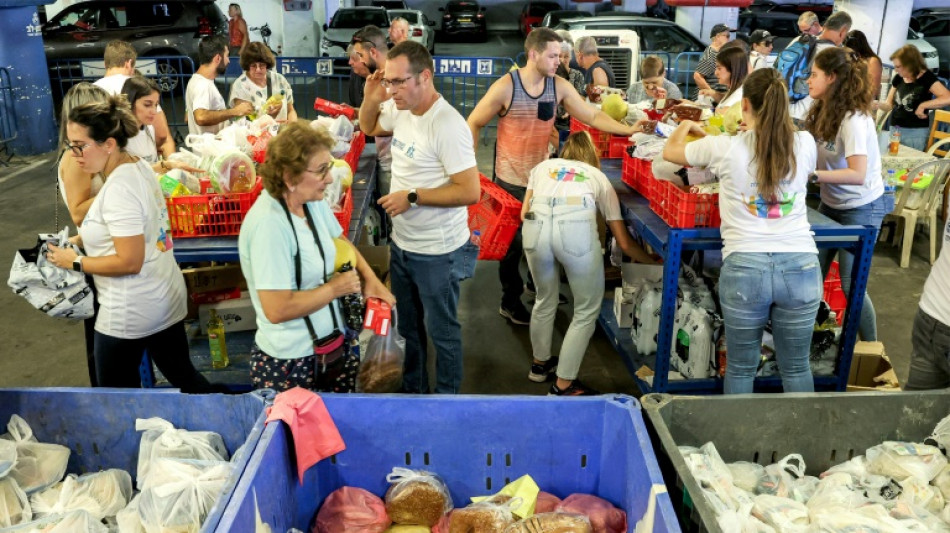
Humanitarian organisations in Israel are already reporting a greater need for their services, with new faces appearing in food distribution queues.
At a shopping centre parking lot in Rishon Lezion, a coastal city in central Israel, the NGO Pitchon-Lev, or "Open Heart", offers free baskets of fruit, vegetables and meat twice a week.
Since the war began "we have more than doubled our activities", said founder Eli Cohen, noting that the organisation supports nearly 200,000 families nationwide.
New beneficiaries include "young people, families whose husbands are reservists, many people who were former donors and all those who were evacuated from their homes", Cohen said of those displaced by border clashes between Israel and Lebanon-based Hezbollah.
As for recovery prospects, Bendelac said "there is always a very strong restart of the economy" whenever war ends.
But, he added, "the longer this war lasts, the slower and more difficult the restart will be".
K.Yamaguchi--JT