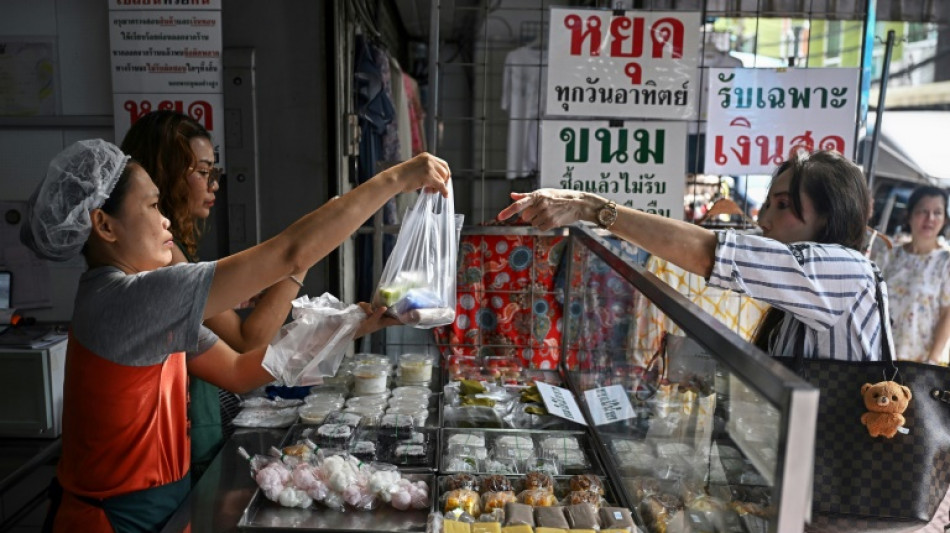
'Easy, convenient, cheap': how single-use plastic rules the world / Photo: Lillian SUWANRUMPHA - AFP

Each year the world produces around 400 million tonnes of plastic waste, much of it discarded after just a few minutes of use.
Negotiators hope to reach the world's first treaty on plastic pollution this year, but across five very different countries, AFP found single-use plastic remains hugely popular as a cheap and convenient choice, illustrating the challenges ahead:
Bangkok
On a Bangkok street lined with food vendors, customers line up for Maliwan's famed traditional sweets.
Steamed layer cakes -- green with pandan leaf or blue with butterfly pea -- sit in clear plastic bags alongside rows of taro pudding in plastic boxes.
Each day, the 40-year-old business uses at least two kilos of single-use plastic.
"Plastic is easy, convenient and cheap," said 44-year-old owner Watchararas Tamrongpattarakit.
Banana leaves used to be standard, but they are increasingly expensive and hard to source.
They are also onerous to use because each one must be cleaned and checked for tears.
It "isn't practical for our pace of sales", said Watchararas.
Thailand started limiting single-use plastic before the pandemic, asking major retailers to stop handing out bags for free.
But the policy has largely fallen by the wayside, with little uptake among the country's street food vendors.
Thailand produces two million tons of plastic waste a year, according to the country's Pollution Control Department.
The World Bank estimates 11 percent goes uncollected, and is burned, disposed of on land or leaks into rivers and the ocean.
Watchararas tries to consolidate purchases into fewer bags and said some customers bring their own reusable containers and totes.
But Radeerut Sakulpongpaisal, a Maliwan customer for 30 years, said she finds plastic "convenient".
"I also understand the environmental impact," the bank worker said.
But "it's probably easier for both the shop and the customers".
Lagos
In the Obalende market at the heart of Nigeria's economic capital Lagos, emptied water sachets litter the ground.
Each day, Lisebeth Ajayi watches dozens of customers use their teeth to tear open the bags of "pure water" and drink.
"They don't have the money to buy the bottle water, that's why they do the pure water," said the 58-year-old, who sells bottles and bags of water, soap and sponges.
Two 500-millilitre sachets sell for between 50 to 250 naira (3-15 US cents), compared to 250-300 naira for a 750-ml bottle.
Since they appeared in the 1990s, water sachets have become a major pollutant across much of Africa, but they remain popular for drinking, cooking and even washing.
Some 200 firms produce the sachets in Lagos, and several hundred more recycle plastic, but supply vastly outstrips capacity in a country with few public wastebins and little environmental education.
Lagos banned single-use plastic in January, but with little impact so far.
The United Nations estimates up to 60 million water sachets are discarded across Nigeria every day.
Rio
Each day, vendors walk the sands of some of Rio de Janeiro's most beautiful beaches, lugging metal containers filled with the tea-like drink mate.
The iced beverage, infused with fruit juice, is dispensed into plastic cups for eager sun worshippers dotted along the seafront.
"Drinking mate is part of Rio de Janeiro's culture," explained Arthur Jorge da Silva, 47, as he scouted for customers.
He acknowledged the environmental impacts of his towers of plastic cups, in a country ranked the fourth-biggest producer of plastic waste in 2019.
But "it's complicated" to find affordable alternatives, he told AFP.
The tanned salesman said mate vendors on the beach had used plastic for as long as he could remember.
He pays a dollar for a tower of 20 cups and charges customers $1.80 for each drink.
Bins along Rio's beaches receive about 130 tons of waste a day, but plastic is not separated, and just three percent of Brazil's waste is recycled annually.
Evelyn Talavera, 24, said she does her best to clean up when leaving the beach.
"We have to take care of our planet, throw the garbage away, keep the environment clean."
Plastic straws have been banned in Rio's restaurants and bars since 2018, and shops are no longer required to offer free plastic bags -- though many still do.
Congress is also considering legislation that would ban all single-use plastic.
Paris
In France, single-use plastic has been banned since 2016, but while items like straws and plastic cutlery have disappeared, plastic bags remain stubbornly common.
At Paris' Aligre market, stalls are piled with fruit, vegetables and stacks of bags ready to be handed out.
Most are stamped "reusable and 100-percent recyclable", and some are described as compostable or produced from natural materials.
But experts have cast doubt on the environmental relevance of some of these claims.
Vendor Laurent Benacer gets through a 24-euro ($26) box of 2,000 bags each week.
"In Paris, everyone asks for a bag," he told AFP.
"I'd stopped, but my neighbours continued, so I had to restart."
There are alternatives like paper bags, but some customers are simply not convinced.
"Plastic bags remain practical, so everything doesn't spill everywhere," insisted 80-year-old customer Catherine Sale.
Dubai
At the Allo Beirut restaurant in Dubai, plastic containers are piled high, waiting to be filled and delivered across the city.
"We receive more than 1,200 orders a day," said delivery manager Mohammed Chanane.
"We use plastic boxes because they are more airtight, and better preserve the food," he said.
With few pedestrians and an often-scorching climate, many of Dubai's 3.7 million residents rely on delivery for everything from petrol to coffee.
Residents of the United Arab Emirates have one of the highest volumes of waste per capita in the world.
And single-use plastic accounts for 40 percent of all plastic used in the country.
Since June, single-use plastic bags and several similar items have been banned. Polystyrene containers will follow next year.
Allo Beirut is considering using cardboard containers, a move customer Youmna Asmar would welcome.
She admitted horror at the build-up of plastic in her bins after a weekend of family orders.
"I say to myself, if all of us are doing this, it's a lot."
burs/sah/sco
M.Saito--JT