Iran two years after Mahsa Amini: persecution and defiance / Photo: - - UGC/AFP

Persecution of bereaved relatives. Impunity for perpetrators. Rampant executions and infighting among the opposition.
A bleak picture confronts opponents of Iran's clerical authorities two years after a protest movement erupted that they hoped would be a turning point in the four-and-a-half-decade history of the Islamic republic.
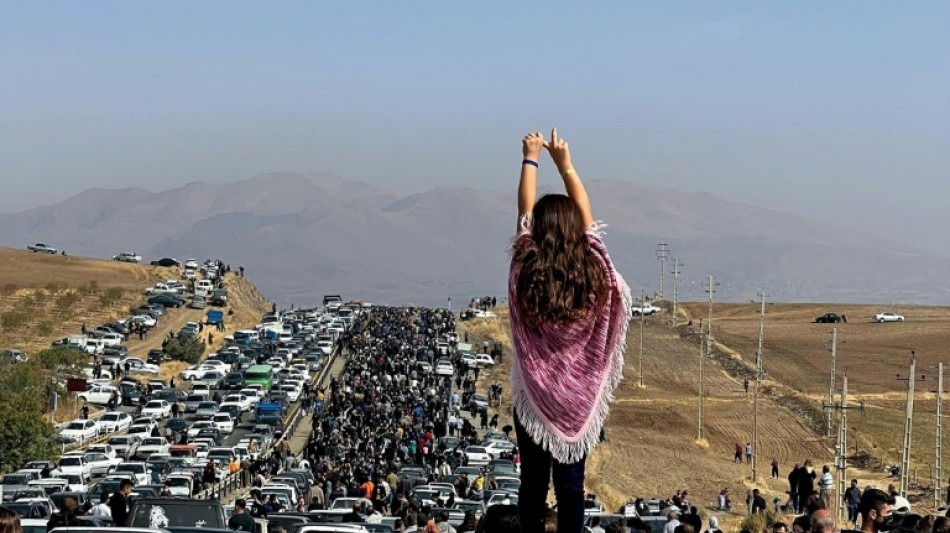
Activists and exiles still hope that the protests sparked by the September 16, 2022 death in custody of Mahsa Amini -- an Iranian Kurd arrested for allegedly violating the dress code for women -- left an indelible mark on Iran and that her tragic death aged 22 was not in vain.
The women-led protests that broke out after Amini's death, challenging not only the rule of the obligatory headscarf that has been a key pillar of the regime but also the very existence of the clerical-based system, rattled Iran's leadership over autumn and winter 2022-2023.
But they were crushed and defeated in a crackdown Amnesty International said saw security forces use assault rifles and shotguns against protesters.
Human rights groups say at least 551 people were killed. Thousands more were arrested, according to the United Nations.
Iran has executed 10 men in cases related to the protests, the latest being Gholamreza Rasaei who was hanged in August after being convicted of killing a Revolutionary Guard.
Activists said his confession was obtained under torture.
"Countless people in Iran are still reeling from the consequences of the authorities' brutal crackdown," said Amnesty's deputy regional director for the Middle East and North Africa, Diana Eltahawy.
- 'Brutalising twice over' -
According to Human Rights Watch (HRW), family members of dozens of people killed, executed or imprisoned during the protests have been arrested on trumped up charges, threatened or harassed.
"Iranian authorities are brutalising people twice over: executing or killing a family member and then arresting their loved ones for demanding accountability," said HRW's acting Iran researcher, Nahid Naghshbandi.
Among those jailed is Mashallah Karami, father of Mohammad Mehdi Karami who was executed in January 2023 aged just 22 in a case related to the protests.
Mashallah Karami, who had campaigned for his son's memory, was sentenced to six years in jail in May and then in August to another term of almost nine years.
Meanwhile, the authorities are enforcing the wearing of the headscarf with a vengeance. Its abolition was a key demand of the protesters, and the authorities had initially given grounds for hope of a more lenient policy.
Security forces are implementing the so-called "Nour" ("Light") plan to enforce the rule, with a "visible increase of security patrols on foot, motorbikes, car and police vans in public spaces", according to Amnesty.
Women in Iran have long regarded their vehicles as a safe space, but they have been increasingly targeted there, often with facial recognition technology, rights groups say. Cars can be impounded as punishment.
UN experts said Iran has "intensified" the repression of women, also resorting to "beating, kicking, and slapping women and girls".
Amnesty has highlighted the case of 31-year-old Arezou Badri, who it says was left paralysed after police shot her in her car in northern Iran in July, in an incident related to the dress code.
Even though a UN fact-finding mission in March found that many of the violations in the crackdown amount to crimes against humanity, not one official has been brought to account.
- 'Not going back' -
Yet observers outside Iran insist that while the crackdown has allowed the clerical authorities under supreme leader Ayatollah Ali Khamenei to restore order, Iranian society has changed forever.
"Many young women remain defiant," said a co-founder of the US-based Abdorrahman Boroumand Center for Human Rights in Iran, Roya Boroumand.
"Two years after the protests, the Islamic Republic's leadership has neither restored the status quo ante nor regained its lost legitimacy."
Rights groups said August's execution of Gholamreza Rasaei showed no let-up in Iran's use of the death penalty under new President Masoud Pezeshkian, who was elected in July after predecessor Ebrahim Raisi died in a helicopter crash.
The Amini protests have exposed deep divisions within the opposition, with no unified group emerging to champion the protesters' demands.
Abroad, attempts at finding harmony between disparate groups of monarchists, nationalists and liberals have collapsed amid acrimony.
The protest movement "shook the Iranian regime to the core and further affirmed just how deeply disillusioned Iranians have been with the status quo", said Arash Azizi, visiting fellow at Boston University and author of a book titled "What Iranians Want".
"But the movement also showed the absolute bankruptcy of the opposition alternatives to the regime."
He added: "I still believe Iran is not going back to pre-2022 and, within the next few years, the Islamic Republic will likely see some fundamental shifts."
Y.Mori--JT