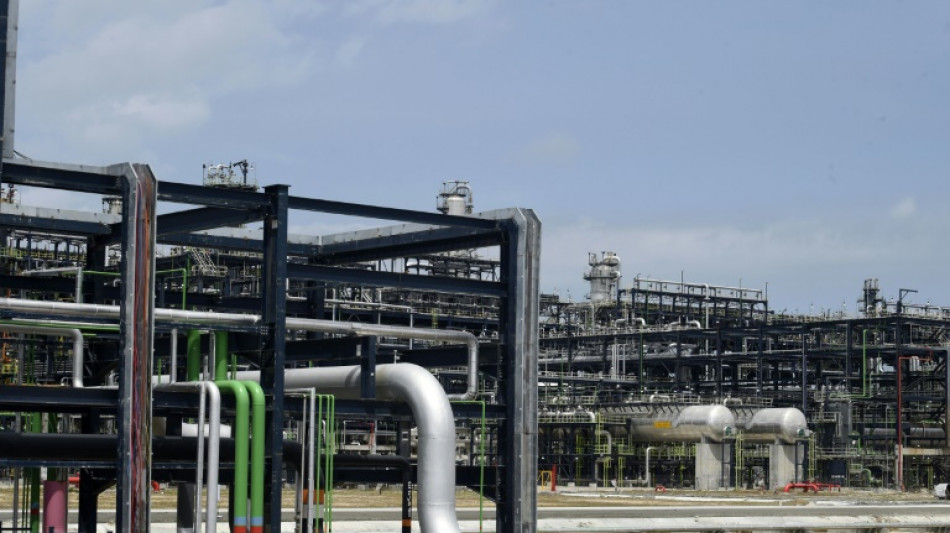
Nigeria's Dangote refinery caught between promise and reality / Photo: Pius Utomi EKPEI - AFP/File

When will gasoline from Nigerian tycoon Aliko Dangote’s mega-refinery finally flood the home market? That's the question Nigerians are asking as Africa’s most populous country battles chronic petrol shortages.
Dangote -- again ranked Africa’s richest man by Forbes this year -- says he is awaiting the green light from the state-run Nigerian National Petroleum Company (NNPC), the only entity that buys gasoline for the domestic market.
The national oil company has talked about a date of September 15.
The mammoth plant, the continent’s largest refinery, with a full capacity of 650,000 barrels per day, is supposed to be an economic gamechanger by covering all domestic fuel needs.
The refinery in Lekki on the outskirts of the economic capital, Lagos, faced multiple start-up delays but was inaugurated in May last year.
It has promised to resolve the Nigerian contradiction that sees Africa's largest oil producer and an OPEC member having to rely on costly gasoline imports to keep cars running because of a lack of refineries.
Yet, as the deadline for Dangote fuel to reach market approaches, optimism appears to be fading.
Just as Nigerians were already struggling with high living costs, they were hit with a surprise 45-percent increase in petrol prices by the state-run company.
NNPC did not respond to an AFP request for comment.
"These are policy issues that have to be jointly agreed between us and NNPC," a Dangote spokesman said, about talks on getting the fuel to market.
"For now, let's keep our fingers crossed."
- 'Market realities' -
The other big question is how much Dangote’s petrol will cost Nigerians.
"The issue of pricing is the biggest elephant in the room," analyst Ayotunde Abiodun of Nigerian firm SBM Intelligence said.
"Many Nigerians reasonably expect that the Dangote refinery's supply of refined products should come at a cheaper price," he added, pointing to the refinery theoretically cutting out import costs.
But "market realities" such as "global oil prices, the cost of oil supply and refining margins" make that unlikely, at least in the short term, he said.
Dangote must also cover production costs and repay the debt used to build the giant refinery.
It "will most likely prioritise markets where it can make higher profit margins" and sell some gasoline outside the country, Abiodun said.
When he came to power in May 2023, President Bola Ahmed Tinubu officially ended the costly fuel subsidy that had kept petrol prices low for decades.
Investors welcomed the reform but the price of petrol for Nigerians then tripled.
The NNPC has admitted continuing to subsidise petrol, an untenable situation for a company with debt of $6 billion.
To cover its costs, Dangote would have to sell its petrol to the NNPC at the international market price, "around 1,100 naira", according to Ademola Henry Adigun, of AHA Consultancies.
"The government will have to pay the difference between this price and the price at the pump" unless it increases the fuel price again, Adigun said.
But that would be very difficult for the population and could cause "riots", he added.
- Monopoly? -
"It is not guaranteed" that the launch of Dangote gasoline will end shortages, SBM's Abiodun cautioned.
He said NNPC -- which is the "sole intermediary between the Dangote refinery and the Nigerian fuel market" -- faces "a lot of inefficiencies" that have questioned its competence.
It might not be able to guarantee a continuous supply of crude to the refinery, which "would force Dangote refinery to import crude" that is more expensive, he said.
Dangote could then favour selling on foreign markets to ensure better margins, he added.
Nigerian oil production has declined in recent years to less than 1.2 million barrels per day in 2023 -- a far cry from the government target of two million barrels per day.
The issue of crude oil supply to the mega-refinery has already been the subject of tensions between Dangote and the Nigerian authorities.
Dangote has criticised the NNPC for not providing necessary quantities, forcing him to turn to international companies that sell a barrel of crude for $3 to $4 more than the national company.
Oil traders, meanwhile, fear that Dangote will create a monopoly where it is the only source of petrol, undermining their businesses.
Dangote's spokesman dismisses such a situation arising.
"Any attempt to disrupt a system that has worked in a certain way for a very long time was always going to meet significant resistance from those benefiting from that system," Clementine Wallop of Horizon Engage consultancy said.
But, in the meantime, many Nigerian drivers still face an hours-long wait to fill up their tanks.
K.Yamaguchi--JT