Power struggle: Serbia eyes nuclear energy to fuel future / Photo: Vladimir Zivojinovic - AFP

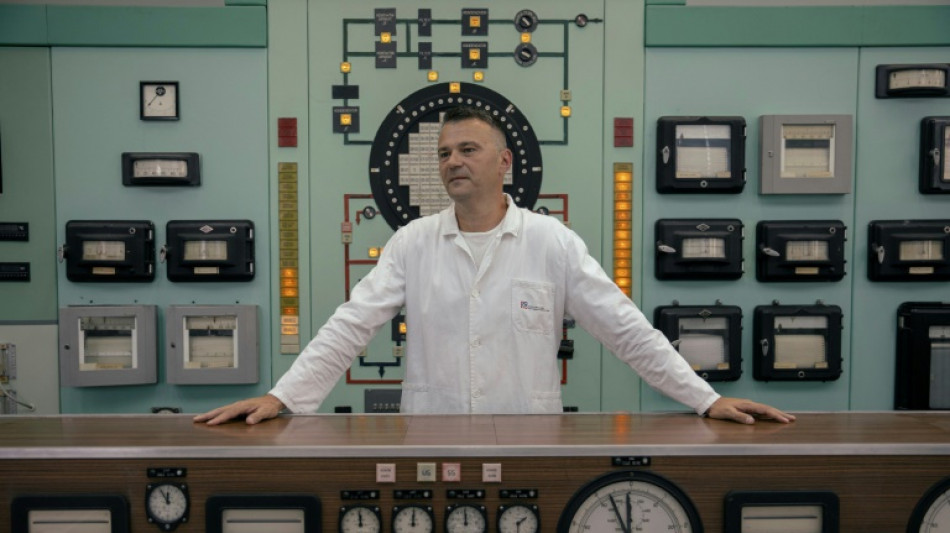
Time stands still at Serbia's Vinca nuclear facility, where the decommissioned Yugoslav-era reactor is a testament to the fears generated by the controversial energy source.
For decades, the research reactor and the surrounding facility have been stuck in another era. But a new push to revitalise Serbia's stalled nuclear energy sector may see the country embrace the technology again.
Three years after the 1986 Chernobyl disaster in Ukraine, then Yugoslavia shuttered its nuclear programme and shut down its lone reactor in Belgrade's suburbs.
Serbia has long relied on its plentiful sources of cheap coal to power its economy, even as it blackened its skies with the capital Belgrade regularly ranked as one of the most polluted cities during the winter.
It has come at a cost.
Nearly 70 percent of Serbia's electricity comes from coal-fired power plants, which caused an estimated 15,000 deaths in 2021 alone linked to pollution, according to a report by the European Environment Agency.
Facing a 2050 EU deadline to transition away from coal, officials are now considering whether to lift the long-standing ban on building nuclear power plants in the Balkan country.
In late August, Serbia's Ministry of Mining and Energy opened public consultations for proposed changes to the country's energy law, which includes lifting the moratorium on nuclear power.
- Nuclear neighbours -
The facility at Vinca is a reminder of what could have been.
An antique phone sits next to an emergency button used to manually activate the safety system amid a sea of analogue glass dials that once measured the pulse of the reactor and its surroundings.
Visitors to the facility must still adhere to strict controls when entering the reactor's hall, which scientists today use mostly for educational purposes.
For proponents of nuclear power, Serbia stands at a crossroads.
"When considering whether to say 'yes' or 'no' to a nuclear power plant, we must be aware that nuclear power plants surround us," Dalibor Arbutina, director of Public Company Nuclear Facilities of Serbia (NFS), told AFP.
Arbutina points to the use of nuclear power by many of Serbia's neighbours, including Hungary which has an active reactor just 80 kilometres (50 miles) from its northern border.
"We are in the same risk zone as Hungary, Romania and Bulgaria, but they benefit from their nuclear plants, while we get nothing," Arbutina added.
But going nuclear will be a long and costly process, with a government study saying a cautious estimate for the launch of a new nuclear facility would likely take up to two decades.
"It is a painful transformation that Serbia will have to undergo," said Slobodan Bubnjevic from the Institute of Physics at the University of Belgrade.
The process of reversing the ban alone will likely be lengthy and require navigating complex political bureaucracy.
- 'Indefinitely' -
Serbian President Aleksandar Vucic remains a firm advocate for shifting to nuclear energy and frequently cites the exponential strain on the current grid by the adoption of new technologies.
"Having in mind that artificial intelligence time is coming, having in mind the fact that we'll have to have 90-95 percent of electric cars here... the consumption of electricity will increase significantly," Vucic told AFP, saying transitioning to nuclear energy sources would be critical.
"Otherwise, we won't have enough electricity," he argued.
During a visit by French President Emmanuel Macron last month, Serbia signed a raft of agreements, including a letter of engagement to assess the potential for developing a civilian nuclear programme.
A survey published by the Serbian-based think-tank, New Third Way, said one-third of the people it polled remained opposed to nuclear power, while roughly the same number supported it, with the others largely undecided.
The study also found that 64 percent of respondents agreed that Serbia should gradually phase out the use of coal.
"I would say (nuclear) is a brilliant way to produce electricity and everything else -- as long as it's not misused," Rada Spica Gajic, a 47-year-old Belgrade resident, told AFP.
On the other hand, Sava Medan, 60, said he would likely worry about the handling of nuclear waste produced by the process.
Professor Bubnjevic agreed.
"Once you initiate the chain reaction and expose the fuel to the process it undergoes in the reactor, from that moment onward, you must manage the nuclear waste indefinitely," said Bubnjevic.
K.Yamaguchi--JT