The Japan Times - State oil company’s 'financial strain' compounds Nigeria’s fuel shortage

EUR -
AED 4.032571
AFN 71.373431
ALL 89.824837
AMD 395.60372
ANG 1.965943
AOA 1008.005338
ARS 1757.28327
AUD 1.654392
AWG 1.979226
AZN 1.863333
BAM 1.957431
BBD 2.211242
BDT 137.674702
BGN 1.94735
BHD 0.414045
BIF 3298.748314
BMD 1.098045
BND 1.417081
BOB 13.014843
BRL 6.293224
BSD 1.097915
BTN 101.439513
BWP 15.695076
BYN 3.297747
BYR 21521.678537
BZD 2.20804
CAD 1.563638
CDF 2503.542384
CHF 0.915319
CLF 0.028936
CLP 1138.738187
CNY 7.31792
CNH 7.313522
COP 3877.075486
CRC 487.408298
CUC 1.098045
CUP 26.348952
CVE 110.356943
CZK 24.453127
DJF 195.502881
DKK 7.474243
DOP 65.694733
DZD 150.594205
EGP 60.169777
ERN 16.470672
ETB 179.467321
FJD 2.521983
FKP 0.838049
GBP 0.837451
GEL 2.84345
GGP 0.838049
GHS 12.949789
GIP 0.838049
GMD 81.255412
GNF 9737.112362
GTQ 8.393993
GYD 229.651331
HKD 8.60558
HNL 29.513589
HRK 7.501804
HTG 144.040005
HUF 371.996173
IDR 20186.840347
ILS 3.635248
IMP 0.838049
INR 101.599947
IQD 1664.386664
IRR 2143776.59504
ISK 136.992552
JEP 0.838049
JMD 173.754762
JOD 0.778487
JPY 174.815875
KES 143.086578
KGS 96.024082
KHR 4465.822325
KMF 493.021818
KPW 988.240725
KRW 1475.387923
KWD 0.343282
KYD 0.914962
KZT 502.798901
LAK 24759.628197
LBP 98314.909926
LKR 365.594591
LRD 180.050007
LSL 19.325601
LTL 3.242241
LVL 0.664196
LYD 7.106921
MAD 10.984251
MDL 20.20083
MGA 4968.139147
MKD 61.559475
MMK 2305.794678
MNT 3963.811163
MOP 8.863384
MRU 44.728265
MUR 51.487554
MVR 16.953723
MWK 1903.686034
MXN 21.591844
MYR 4.518891
MZN 69.62153
NAD 19.325601
NGN 1496.064137
NIO 40.403662
NOK 10.70508
NPR 162.303221
NZD 2.004585
OMR 0.422203
PAB 1.097915
PEN 3.805771
PGK 4.948122
PHP 70.005825
PKR 303.508164
PLN 4.478337
PYG 7027.855176
QAR 4.002134
RON 5.339462
RSD 117.677158
RUB 90.208529
RWF 1622.55181
SAR 4.120306
SBD 8.97889
SCR 15.140759
SDG 660.444616
SEK 11.207365
SGD 1.41681
SHP 0.838746
SLE 25.254995
SLL 23025.454946
SOS 627.42273
SRD 41.039458
STD 22727.310899
STN 24.520429
SVC 9.606003
SYP 14276.779163
SZL 19.320096
THB 37.367019
TJS 10.155361
TMT 3.843157
TND 3.329774
TOP 2.643829
TRY 55.64628
TTD 7.450207
TWD 36.202151
TZS 2953.760332
UAH 49.501141
UGX 4725.93736
USD 1.098045
UYU 44.487064
UZS 13171.974077
VES 1011.717087
VND 28365.242898
VUV 134.026558
WST 3.094829
XAF 655.957
XAG 0.026326
XAU 0.000306891737
XCD 2.967521
XCG 1.978648
XDR 0.776375
XOF 655.957
XPF 119.331742
YER 259.799634
ZAR 19.226547
ZMK 9883.722302
ZMW 22.863048
ZWL 353.569985
SSP 6341.699795
MXV 2.41636
  • RYCEF

    0.1000

    19.81

    +0.5%

  • VOD

    -0.2500

    16.33

    -1.53%

  • CMSC

    -0.2800

    20.12

    -1.39%

  • RBGPF

    -2.0000

    65

    -3.08%

  • RIO

    -0.2500

    94.16

    -0.27%

  • BTI

    -1.2000

    54.85

    -2.19%

  • NGG

    -0.3000

    74.94

    -0.4%

  • GSK

    -0.3500

    49.35

    -0.71%

  • BCE

    -0.4200

    20.14

    -2.09%

  • CMSD

    -0.3400

    19.93

    -1.71%

  • BP

    -0.9100

    43.52

    -2.09%

  • RELX

    0.1700

    33.24

    +0.51%

  • BCC

    -0.6200

    75.97

    -0.82%

  • AZN

    -1.9400

    164.21

    -1.18%

  • JRI

    0.0000

    10.77

    0%

State oil company’s 'financial strain' compounds Nigeria’s fuel shortage
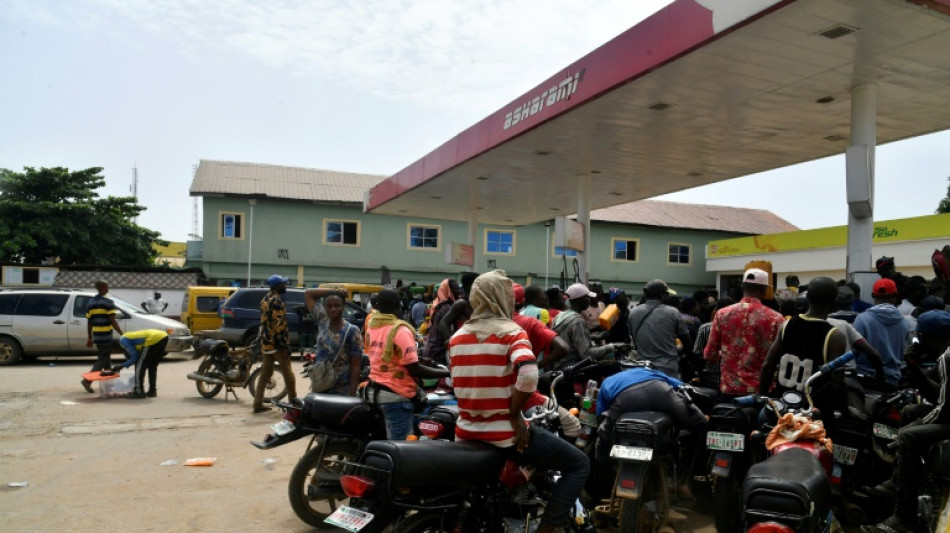
State oil company’s 'financial strain' compounds Nigeria’s fuel shortage / Photo: PIUS UTOMI EKPEI - AFP

State oil company’s 'financial strain' compounds Nigeria’s fuel shortage

Weeks of fuel scarcities in Nigeria are compounding a cost-of-living crisis, with the state-run oil company acknowledging "financial strain" was hampering supplies.

Text size:

Olufemi Soneye, a spokesman for government-controlled Nigerian National Petroleum Company Limited (NNPCL), blamed the lingering scarcity on financial issues, in a statement at the weekend.

Nigeria, a major African oil producer, often sees sporadic fuel shortages that cause long lines at NNPCL-run petrol stations that sell fuel at cheaper prices than private operators.

"This financial strain has placed considerable pressure on the company and poses a threat to the sustainability of fuel supply," Soneye said in the statement.

It comes after NNPCL declared a record profit of 3.3 trillion naira (about $2 billion) last month and an initial public denial of its huge debt burden.

As well as vehicles, most households in Nigeria rely on petrol and diesel to power their generators as the public power supply is unreliable and prone to blackouts.

Though an OPEC oil producer, Nigeria imports most of its fuel needs because it has very little working refining capacity.

Africa's most populous country is already struggling under higher living costs after government reforms to end a fuel subsidy and free the naira currency drove a spike in inflation.

"The fuel scarcity is really hard," Ismael Abdullai, 36, a delivery bike rider for a food delivery company, told AFP. "We look, but you always have to look harder to see fuel."

Fuel scarcities have been more frequent since President Bola Tinubu removed the costly fuel subsidies that saw the government pay billions of dollars a year to keep the price of petrol artificially low.

Its price has since more than tripled in some states, with a knock-on effect on food and transport costs.

"The cost of transportation is now very high due to the hike in the price of fuel," a video editor Hogan Samuel told AFP.

"I spent 1,100 naira ($0.70) to get to the office this morning instead of the usual 750 naira."

- 'Long queues' -

Many stations were shuttered on Monday morning in parts of the commercial capital Lagos. Long lines formed at those that were selling, causing traffic jams.

"We would queue from 6:00 am and still not get fuel until 12:00 or 1:00 pm or 2:00 pm," Sola Adewusi, a 36-year-old private driver told AFP. "It is because of our leaders, they are bad."

Drivers looking to save as much as 15,000 naira on a full tank form longer queues at NNPC filling stations where it is sold at the cheapest rate of 560 naira for a litre. But it goes for as much as 950 naira elsewhere.

"Most of us like to buy at NNPC because of the difference in the price between the NNPC and the private fuelling stations," Abdullai said.

The junior oil minister Heineken Lokpobiri told an energy labour summit in Nigeria’s capital Abuja last week that NNPCL needed to hike the price of petrol it sells to independent marketers, claiming that the current price of 600 naira was fuelling the smuggling of the product out of the country.

"The situation does not make us happy," a painter Uzochukwu Christian told AFP in Abuja. "Government should help us."

S.Yamada--JT