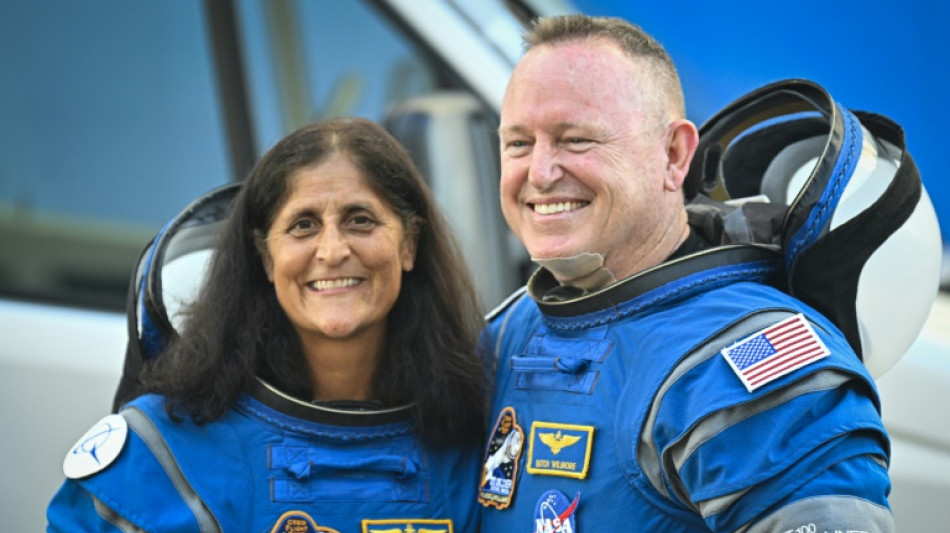
Flawed Boeing mission to return to Earth with rival SpaceX / Photo: Miguel J. Rodriguez Carrillo - AFP/File

Two US astronauts who arrived at the International Space Station aboard Boeing's Starliner will have to return home with rival SpaceX, NASA said Saturday, in a fresh public relations blow to the crisis-hit aviation giant.
The return of Barry "Butch" Wilmore and Sunita "Suni" Williams has been delayed for weeks by thruster malfunctions of the Boeing spacecraft and NASA administrator Bill Nelson announced they will come back to Earth in February, while Starliner will return uncrewed.
"A test flight, by nature, is neither safe, nor routine. The decision to keep Butch and Suni aboard the International Space Station and bring the Boeing Starliner home uncrewed is the result of our commitment to safety," Nelson told reporters. "Our core value is safety."
A statement from NASA said the new approach would allow the space agency and Boeing to continue gathering data on Starliner when it flies home "while also not accepting more risk than necessary for its crew."
The development creates yet another headache for Boeing, as the two astronauts will have to spend a total of eight months in orbit, not the eight days as originally planned.
But Nelson seemed to go out of his way to say the space agency had not lost confidence in Boeing and planned to continue working with it so the space agency will have two vehicles capable of ferrying astronauts to and from the ISS.
He said he was "100 percent sure Boeing will launch Starliner again with a crew on board."
In a statement, Boeing said it "continues to focus... on the safety of the crew and spacecraft" and is preparing Starliner "for a safe and successful uncrewed return."
- Return on hold -
After years of Starliner development delays, the spacecraft had finally lifted off in early June carrying the two veteran astronauts to the ISS.
But on June 6, as Starliner was approaching the space station, "NASA and Boeing identified helium leaks and experienced issues with the spacecraft reaction control thrusters," the space agency said.
Amid intense efforts to diagnose the problem and try to craft a fix -- including tests both on the ground and in flight -- NASA had to put the astronauts' return on indefinite hold.
The big concern was that Starliner might not have the propulsive power to wrest itself out of orbit and begin the descent toward Earth.
NASA officials met before their announcement Saturday, finally agreeing on the highly unusual option of bringing the astronauts back from the flying laboratory not on their own craft, but aboard a previously scheduled SpaceX vehicle in February.
"It was just too much risk with the crew," said senior NASA official Steve Stich, with Norm Knight, another agency official adding that the astronauts "support the agency's decision fully, and they're ready to continue this mission on board ISS."
Under the new plan, the SpaceX Crew-9 mission will take off in late September, but carrying only two passengers instead of the originally planned four.
NASA and SpaceX are already working to reconfigure seats on the Crew-9 Dragon, "and adjusting the manifest to carry additional cargo, personal effects, and Dragon-specific spacesuits for Wilmore and Williams," the space agency said.
Before the SpaceX launch, an uncrewed Starliner will first have to head back earthward, ensuring SpaceX will have a docking port on the ISS.
It will remain moored to the ISS until its scheduled return in February, bringing back its own crew members plus their two stranded colleagues.
- Boeing vs SpaceX -
The approach represents a further blow to the already tarnished image of US giant Boeing, whose airplane arm has been beset in recent years with concerns about safety and quality control.
Ten years ago, following the retirement of the Space Shuttle, NASA ordered new vessels from both Boeing and SpaceX that could ferry astronauts to and from the ISS.
With two such vehicles available, NASA reasoned, there would always be a backup in case one of the two experienced problems.
But Elon Musk's SpaceX beat Boeing to the punch and has been the lone vehicle used to taxi astronauts for the past four years.
This year's crewed Starliner flight, which followed years of delays and disappointments during the craft's development, was meant to be a last test of the vehicle before it enters regular operations.
NASA has said the astronauts on the ISS have plenty of supplies, are trained for extended stays and have plenty of experiments to conduct.
S.Yamamoto--JT