Turkey inflation spirals to nearly 70 percent / Photo: Ozan KOSE - AFP/File

Turkey's official inflation rate spiralled to nearly 70 percent in April, data showed on Thursday, posing a huge challenge to President Recep Tayyip Erdogan, whose unconventional economic policies are often blamed for the economic turmoil.
The consumer price index rose by 69.97 percent year-on-year in April compared with 61.14 percent in March, the national statistics agency said.
Erdogan insists that sharp cuts in interest rates are needed to bring down soaring consumer prices, flying in the face of economic orthodoxy.
The collapse of the lira has pushed up the cost of energy imports and foreign investors are now turning away from the once-promising emerging market.
Russia's invasion of Ukraine and the coronavirus pandemic have exacerbated the energy price spikes and production bottlenecks.
Turkey's annual inflation rate -- the highest since Erdogan's ruling AKP party rose to power in 2002, is largely linked to his unconventional economic thinking, analysts say.
Erdogan has put pressure on the nominally independent central bank to slash interest rates.
In April, the bank kept its benchmark interest rate steady for the fourth consecutive month, bowing to the pressure despite high inflation.
The biggest price increases in April were for the transport sector, standing at 105.9 percent, while the prices of food and non-alcoholic drinks jumped 89.1 percent.
- 'Spectacular failure' -
"True it's about food and energy price increases but also the spectacular failure of monetary policy in Turkey," Timothy Ash, emerging markets strategist at BlueBay Asset Management, said in a note to clients.
"Low interest rates cause inflation. Period. Fact. The reality," he said, accusing Erdogan of "trying to re-write economics to say the opposite which is the economics equivalent of calling the earth flat."
Treasury and Finance Minister Nureddin Nebati on Monday brushed aside concerns, saying that the current inflationary trend was fleeting and would "not spread over the long term and be permanent".
"We will increase the welfare and purchasing power of our citizens over the past level," he said.
At a bazaar in an Istanbul neighbourhood on the European side, shoppers vented their anger over soaring prices.
"People are starving! I feel ashamed when I am shopping," Rita Ezel, a retired woman, told AFP.
"My monthly pension vanishes in 10 days."
Another retiree, Seckin Gozuyasli, said: "The prices change on a weekly basis. Milk, cheese, meat, everything, detergent, everything you can imagine is so expensive now."
She blamed the "wrong economic policies" as well as Turkey's playing home to 3.6 million Syrians who fled the war back home for surging prices.
-'We barely make ends meet'-
Turkey has cut taxes on some goods and offered subsidies for electricity bills for vulnerable households but even this has failed to stem inflation.
"I am a seller at the bazaar for 35 years now. In the past, one person in the family would work and we could get by. Now in my home four of us work and we hardly make ends meet," he complained as he was tidying his vegetable stalls.
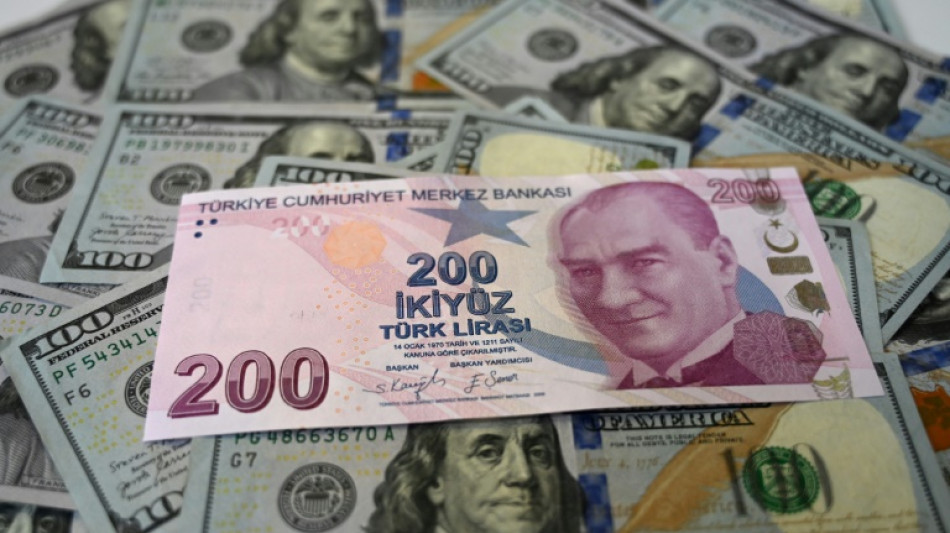
The Turkish currency lost 44 percent of its value against the dollar last year and more than 11 percent since the start of January, making the cost of imported goods and fuel very expensive.
Erdogan's government has responded by using state banks to buy up liras in a bid to cut the currency's losses.
There is also speculation that the central bank sells dollars to stem the lira's slide.
The former deputy general manager of Turkey's state bank Ziraat shared information he received from banking circles, Turkish media reported.
"The central bank sells $2.5-3 billion a week through public banks," he was quoted as saying this week.
Jason Tuvey, emerging markets economist at the London-based Capital Economics, predicted that inflation would hover around the current high rates for much of this year.
He said there were "no signs that policymakers are about to shift tack and hike interest rates as they remain wedded to the 'new economic model'," of the government.
Erdogan, who faces a crucial presidential vote next year, has also shifted policy to mend broken alliances with cash-rich Gulf states to draw financial support.
Last week, he visited Saudi Arabia in a bid to reset relations that had been strained since the 2018 killing of Riyadh critic journalist Jamal Khashoggi in the kingdom's consulate in Istanbul.
Erdogan said his government agreed with Saudi Arabia to "reactivate a big economic potential".
T.Sasaki--JT