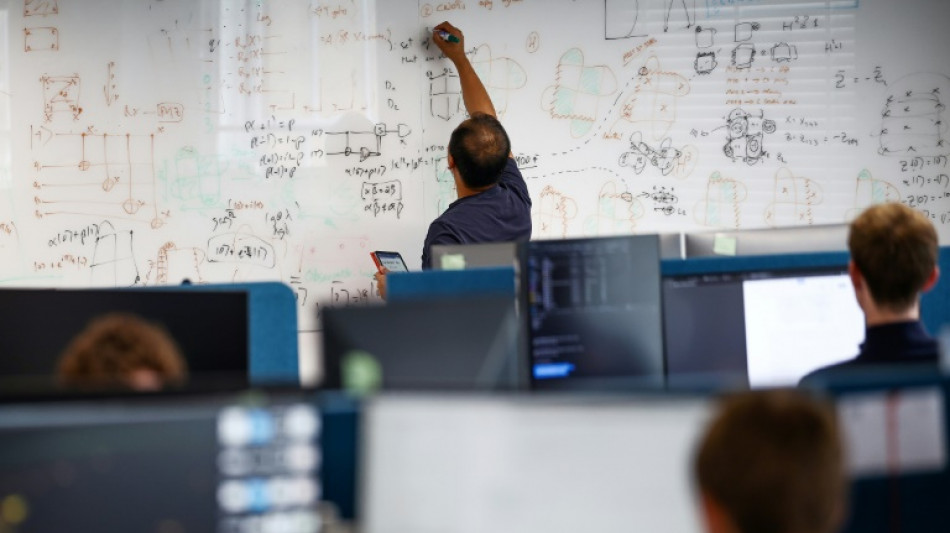
After AI, quantum computing eyes its 'Sputnik' moment / Photo: HENRY NICHOLLS - AFP

Quantum computing promises society-changing breakthroughs in drug development and tackling climate change, and on an unassuming English high street, the race to unleash the latest tech revolution is gathering pace.
The founder of Cambridge-based Riverlane, Steve Brierley, predicts that the technology will have its "Sputnik" breakthrough within years.
"Quantum computing is not going to be just slightly better than the previous computer, it's going to be a huge step forward," he said.
His company produces the world's first dedicated quantum decoder chip, which detects and corrects the errors currently holding the technology back.
Building devices "that live up to the technology's incredible promise requires a massive step change in scale and reliability, and that requires reliable error correction schemes", explained John Martinis, former quantum computing lead at Google Quantum AI.
In a sign of confidence in Riverlane's work and the sector in general, the company announced on Tuesday that it had raised $75 million in Series C funding, typically the last round of venture capital financing prior to an initial public offering.
"Over the next two to three years, we'll be able to get to systems that can support a million error-free operations," said Earl Campbell, vice president of quantum science at Riverlane.
This is the threshold where a quantum computer should be able to perform certain tasks better than conventional computers, he added.
Quantum computers are "really good at simulating other quantum systems", explained Brierley, meaning they can simulate interactions between particles, atoms and molecules.
This could open the door to revolutionary medicines and also promises huge efficiency improvements in how fertilisers are made, transforming an industry that today produces around two percent of global CO2 emissions.
It also paves the way for much more efficient batteries, another crucial weapon in the fight against climate change.
- 'Exquisite control' -
The amount of information that quantum computers can harness increases exponentially when the machine is scaled up, compared with conventional computers.
"I think most people are more familiar with exponential after Covid, so we know how quickly something that's exponential can spread," said Campbell, inside Riverlane's testing lab, a den of oscilloscopes and chipboards.
In traditional computers, data is stored in bits, and each bit can take a value of 0 or 1, much like a light-switch can be 'on' or 'off'.
One bit can therefore represent two states, such as black or white.
Quantum bits, or 'qubits', are more like dimmer switches, and one of them can store all values between 0 and 1, meaning all colours of the spectrum can be represented on one qubit.
But there is a catch. The strangeness of quantum behaviour means that the values have to be read many times and processed by complex algorithms, requiring "exquisite control" of the qubits.
The qubits are also highly susceptible to errors generated by noise, and the solution to this problem is the "key to unlocking useful quantum computing", said Brierley.
Tech giants such as Google, IBM, Microsoft and Amazon are all investing huge sums in generating qubits, and in trying to reduce errors, either through shielding the hardware or by combining qubits and then using algorithms to detect and correct mistakes.
- 'Super exciting' -
"This is like the way an SSD (memory) card works. It's built out of faulty components with active error correction on top," said Brierley.
All of which increases the number of components required and time taken to execute individual operations.
"We definitely won't be using quantum computers to send email," explained Brierley.
Those drawbacks grow at a steady rate as the computer gets larger, whereas the benefits increase on an upward curve, explaining why they work better on larger, more complex tasks.
"And this means that we'll be able to solve problems which would otherwise be unsolvable," said Brierley.
While today's quantum computers can only perform around 1,000 operations before being overwhelmed by errors, the quality of the actual components has "got to the point where the physical qubits are good enough," said Brierley.
"So this is a super exciting time. The challenge now is to scale up... and to add error correction into the systems," he added.
Such progress, along with quantum computing's potential to crack all existing cryptography and create potent new materials, is spurring regulators into action.
"There's definitely a scrambling to understand what's coming next in technology. It's really important that we learn the lessons from AI, to not be surprised by the technology and think early about what those implications are going to be," said Brierley.
"I think there will ultimately be regulation around quantum computing, because it's such an important technology. And I think this is a technology where no government wants to come second."
Y.Kato--JT