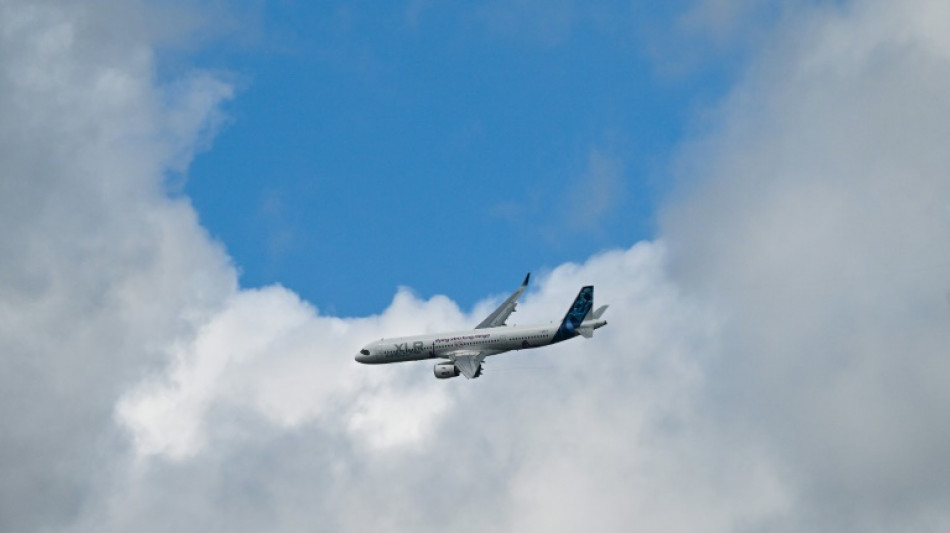
Airbus and Boeing supremacy secure despite turbulence / Photo: JUSTIN TALLIS - AFP/File

Boeing's safety troubles and the Airbus scramble to ramp up production should have left a gap for smaller rivals to challenge their dominatiion of the commercial airliner market.
Yet the American and European giants face little near term threat to their lock on the medium and long-range aircraft markets, industry experts say, as the barriers to entry are too high for China's COMAC or Brazil's Embraer.
COMAC did not bother to bring its new C919, its first entry into the key single-aisle medium-range aircraft segment, to this week's Farnborough airshow, Europe's top aviation industry gathering.
Airbus and Boeing meanwhile added more than 260 planes to their massive order books of nearly 15,000 aircraft.
This despite the fact that an airline that orders a medium-range Airbus A320 or Boeing 737 MAX today will likely have to wait until the end of the decade to receive the plane. Both companies face supply chain and other problems that have hampered efforts to step up production.
In the coming two decades airlines are estimated to need 42,000 new aircraft to rejuvenate their fleets with models that guzzle less fuel and emit less CO2, as well as to meet an expected doubling of global air traffic.
"A significant narrow-bodies deficit remains through 2028 for the A320 family and longer for the 737 MAX," said Richard Evans, an analyst at aviation sector data firm Cirium.
Narrow-body or single-aisle aircraft are the workhorses of the commercial aviation industry, each carrying between 175 and 250 passengers on medium-range flights.
Despite the opening in the most popular commercial aircraft segment, it will not be easy for COMAC or Embraer to profit from the opportunity.
- Certification hurdle for COMAC -
COMAC's C919 has begun commercial flights in China. A state-owned firm, COMAC has nearly 1,200 orders for the jet, almost exclusively from Chinese airlines.
Beijing wanted the plane to reduce China's reliance on foreign technology and to gain a foothold in the global aircraft market. However, the plane has to date only been certified for use in China and production remains low-scale.
Without certification from the Federal Aviatioin Authority in the United States and the European Union Aviation Safety Agency (EASA) the two major markets remain closed to the C919.
"Chinese airlines are the target market for the C919," said Pascal Fabre, an aerospace industry expert at AlixPartners consultancy.
He said there are too many barriers, including political, for major Western airlines to add it to their fleet.
COMAC sent a C919 to the Singapore airshow in February. The firm's small stand at Farnborough featured only small models of the jet.
Airbus and Boeing still expect COMAC to become a rival.
"We do take COMAC as a serious competitor," said Christian Scherer, who heads Airbus's commercial aircraft division.
But not immediately, as they believe the C919 does not offer airlines anything new compared with Airbus and Boeing aircraft.
"There is no differentiation, there's no new value being brought to the market, which tells you that COMAC is really still trying to accede to a market that remains largely influenced by Airbus and Boeing," he added.
The development of the technologies for the next generation of aircraft, which Airbus and Boeing have a lead on, are "big barriers to entry", said Scherer.
- Huge development costs -
Brazil's Embraer is already an established player in the market for smaller, regional aircraft.
For Fabre at AlixPartners, Embraer has the technical know-how to develop a medium-range plane that could compete with Airbus and Boeing.
The problem is money.
"The market capitalisation of the company is around five billion dollars. The development of a new commercial airliner, even for Embraer, is at least that level, so they need partnerships," said Fabre.
The risk of a company overstretching itself with the development of an aircraft is real.
Canada's Bombardier developed its C-Series aircraft to occupy the space between small regional aircraft and the Airbus A320 and Boeing 737 planes. It entered service in 2016 but the company could not cope with financial pressure and was split apart, with Airbus acquiring the plane which it rebaptised the A220.
Embraer, which produces the E2 that is just smaller than the A220, held talks with Boeing to sell its commercial aircraft business but the US company withdrew in 2020 during the Covid pandemic.
Since then Embraer has preferred to improve its existing aircraft.
"It takes seven, eight years to launch an aircraft. And we have to manage this technology transition" towards more sustainable fuels, the company's chief executive Gomes Neto recently told the trade magazine Aviation Week.
"We don't want to put the company at risk."
H.Hayashi--JT