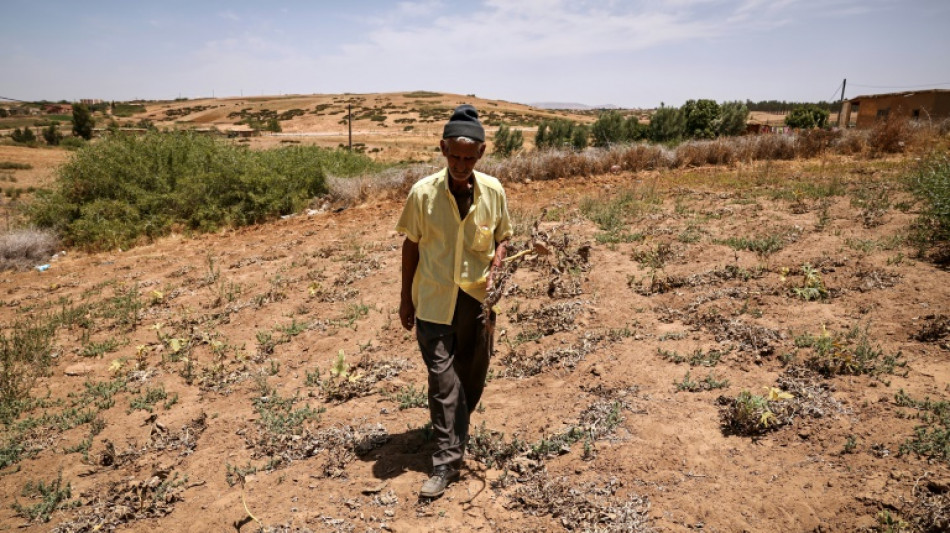
Crucial farm jobs dry up in drought-stricken Morocco / Photo: FADEL SENNA - AFP

In a sun-baked village north of Morocco's capital Rabat, Mustapha Loubaoui and other itinerant workers wait idly by the roadside for farm work made scarce by a six-year drought.
Loubaoui, 40, rode his combine harvester for 280 kilometres (175 miles) hoping to pick up work in what previously had been the booming agricultural village of Dar Bel Amri.
His day-long journey was for nothing. Now Loubaoui fears he will end up like the roughly 159,000 Moroccan agricultural workers who, official figures say, have lost their jobs since early last year.
"Work has become hard to come by because of drought," Loubaoui told AFP.
Large areas of the Mediterranean have been under "alert drought conditions", a phenomenon even more pronounced in Morocco and its neighbours Algeria and Tunisia, according to the European Drought Observatory's latest analysis.
In Morocco, a lack of water threatens the viability of the important agriculture sector, which employs around a third of the working-age population and accounts for 14 percent of exports.
More than one third of Morocco's total cultivated area lies unused because of drought.
The area is now about 2.5 million hectares compared to four million prior to the onset of severe water scarcity, according to figures given by Agriculture Minister Mohammed Sadiki.
And as the arable land shrank, so did employment.
The North African kingdom's unemployment rates rose to a record 13.7 percent in the first quarter of 2024, said the High Planning Commission (HCP), the government's statistical body.
It said 1.6 million of Morocco's 37 million people are out of work and stressed that "the labour market continues to endure the effects of drought".
- 'At the mercy of climate change' -
Among the people behind the statistics is Chlih El Baghdadi, a farmer who lives near Dar Bel Amri.
His grain harvest suffered a major loss from drought, leaving him sitting at home rather than working his fields.
He and his five children now depend financially on his wife, who is employed at a larger farm near the city of Meknes, about 70 kilometres from their village.
Such operations, whose yield is mainly for export, have survived the drought because of their water-hungry irrigation systems employed under the "Green Morocco Plan" (PMV) launched in 2008.
Since then, agricultural revenues doubled from 63 billion dirhams to 125 billion dirhams ($12.5 billion) in 10 years, according to official data.
Another programme, "Generation Green 2020-2030", aims to enhance Morocco's sustainable agriculture in light of climate challenges.
It targets a doubling of agricultural exports to reach 60 billion dirhams by 2030.
Yet despite the initiatives, climate change-driven unemployment has not eased.
"We have modern and sophisticated agriculture, but it only spans around 15 percent of cultivatable areas," said Abderrahim Handouf, a researcher and agricultural engineer.
The "majority of farmers remain at the mercy of climate change" and other economic sectors are "not able to accommodate them," he added.
-'Employment is the weak spot'-
The kingdom has striven to develop its industrial and service sectors over the past two decades, hoping to create more jobs, but these have not compensated for climate-linked unemployment.
Cars, for example, topped Morocco's exports last year with a record value of more than 141 billion dirhams.
But the industry "only creates up to 90,000 jobs per year" while there are 300,000 job seekers, Moroccan industry minister Ryad Mezzour said in May.
"Employment is the weak spot of the economic system," he said in a radio interview.
Facing criticism, Prime Minister Aziz Akhannouch told parliament last month that "drought has become reality".
He announced the expected creation of 140,000 new jobs as part of investment deals worth 241 billion dirhams in fields including renewable energy, telecommunication, tourism and health.
But the numbers were far from the million jobs he had promised to create by 2026.
For farmers like Benaissa Kaaouan, 66, it's too late. He said he would have walked away from agriculture if he had learned another skill.
Now he stands in the middle of his zucchini fields in Dar Bel Amri, most of them sun-spoiled.
"There's no life without rain," Kaaouan said ruefully.
T.Kobayashi--JT