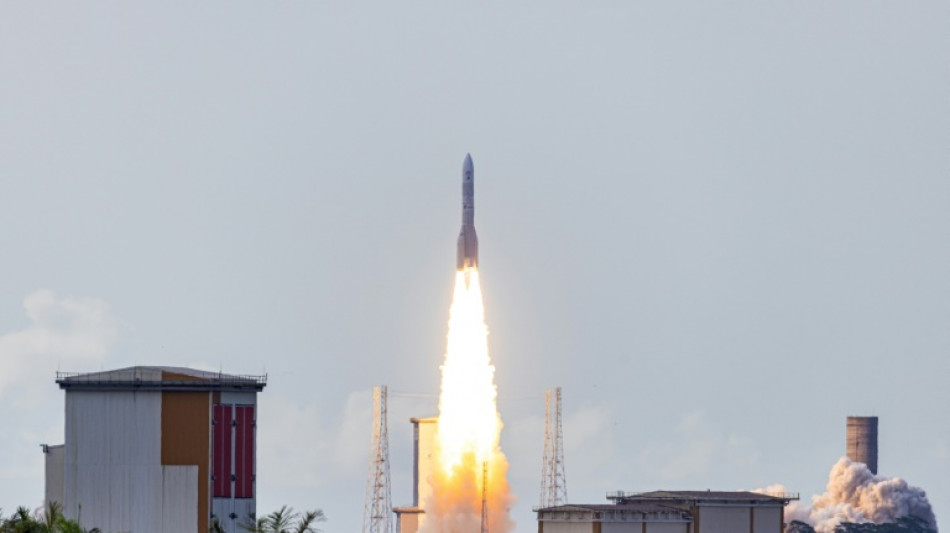
Europe's Ariane 6 rocket successfully launches for first time / Photo: jody amiet - AFP

Europe's new Ariane 6 rocket successfully blasted off for the first time on Tuesday, releasing satellites into orbit and restoring the continent's independent access to space.
The much-delayed inaugural flight of the European Space Agency's most powerful rocket yet launched from Europe's spaceport in Kourou, French Guiana at 4pm local time (1900 GMT).
After an hour-long delay, caused by a small problem that was noticed in the morning, the rocket lifted off into clear skies.
The crew in the Jupiter control room, located 17 kilometres (10 miles) from the launch site, portrayed calm at first.
Then head of operations Raymond Boyce announced "propulsion nominal", meaning that the launch was going as planned.
Applause rang out in the room.
Even louder applause came a little over an hour after liftoff when the rocket successfully delivered microsatellites into orbit.
ESA chief Josef Aschbacher said the successful launch marked a "historic day" for Europe.
NASA chief Bill Nelson on X welcomed the "giant leap forward" for the ESA.
But the launch will not be considered complete until the reusable Vinci engine in the rocket's upper stage has fallen back into Earth's atmosphere.
This is expected around three hours after liftoff.
- 'Magical' -
Ariane 6's first launch, which was originally planned for 2020, means that Europe again has a way to launch its own satellites and missions into space.
Since the last flight of its workhorse predecessor, Ariane 5, a year ago, Europe has had to rely on rivals such as Elon Musk's US firm SpaceX.
The flight was carrying a payload of university microsatellites, various experiments and two atmospheric re-entry capsules.
During the flight, the Vinci engine will need to ignite three times, two of which it has already carried out.
The second ignition took the rocket to an orbit where it released small satellites called "cubesats".
The final ignition will be to shoot the Vinci engine back down into the Pacific Ocean, so it does not contribute to the space debris cluttering Earth's orbit.
Successful inaugural flights are by no means guaranteed.
Historically, nearly half of the first launches of new rockets have ended in failure. That includes Ariane 5, which exploded moments after liftoff in 1996.
But out of 117 launches over nearly 20 years, only one other Ariane 5 flight completely failed.
On the other side of the world, thousands of people in the French city of Toulouse watched the lift-off on a big screen while sitting on a lawn at the Cite de l'Espace museum.
Catherine Gerard, 56, said she was delighted to witness "something a bit magical".
- Skyrocketing competition -
Space has become big business and competition is soaring, particularly from SpaceX's fully re-usable Falcon 9 rockets which now launch around twice a week.
Yet Europe has recently found itself without an independent way to give lucrative satellites a ride into space.
Russia pulled its Soyuz rockets, long used for European launches at Kourou, after Moscow invaded Ukraine in 2022.
Later that year, Europe's Vega-C light launcher was grounded after a launch failure. Ariane 6 delays compounded the crisis.
After months of analysing the rocket's inaugural launch, a first commercial flight is expected before the end of the year.
The next challenge will be to "successfully ramp up" the number of flights, ESA space transportation director Toni Tolker-Nielsen said.
Six launches are scheduled for next year, and eight for 2026.
The rocket has an order book of 29 missions, many of which are to deploy some of Amazon's Kuiper constellation of internet satellites.
ESA chief Josef Aschbacher said the decision was "difficult to understand".
Y.Mori--JT