China's adopted children return from overseas to seek their roots / Photo: Jade GAO - AFP

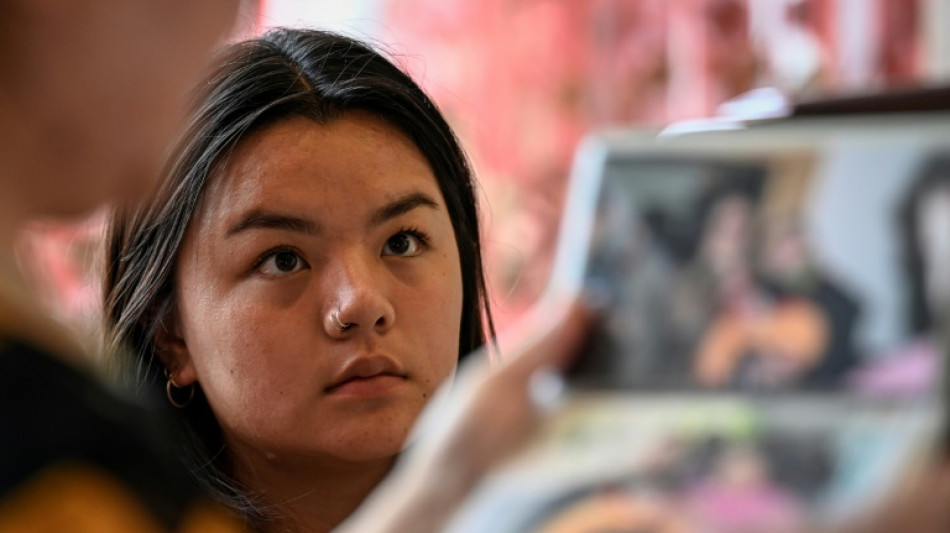
At an empty concrete lot in southwest China, Loulee Wilson scoops a handful of stones into a bag –- a memento from the site where she believes she was abandoned as a baby.
Wilson, an American college student, was born in China but given away by parents presumed fearful of violating the country's one-child policy, under which families were punished for having additional children until the strategy was ended from 2016.
Soon after her birth, she was found outside a now-demolished factory in the town of Dianjiang, brought to an orphanage and later adopted by a couple in the United States.
Now 19, she is among a growing number of Chinese adoptees returning to their birth country to trace their biological parents and understand where they came from.
"If I (find them), that would be incredible. But I don't know if I'll be able to," she told AFP.
"It'll help me to find out more of my story."
Over 82,000 children born in China have been adopted by American families since 1999, according to State Department figures –- mostly girls, owing to a Chinese cultural preference for boys.
Many were handed over in the 2000s when Beijing more tightly enforced birth restrictions and laws around overseas adoptions were comparatively lax.
As those children reach adulthood, they are creating "very, very big demand" for reunions with their birth families, said Corinne Wilson, Loulee's adoptive mother.
She is the founder of The Roots of Love, one of a cluster of organisations set up in recent years to reconnect adoptees with relatives in China.
"There is a part of them that is proud to be Chinese," she told AFP.
- Traumatic past -
In June, the Wilsons set out to search for birth families in rural Dianjiang, about 150 kilometres (93 miles) from the megacity of Chongqing.
They handed out flyers bearing Loulee's and other adoptees' names, ages and photographs, and urged people who gave away children to provide DNA samples.
Finding a match is unlikely due to patchy record-keeping, language barriers, fading memories and local vigilance against potential scams.
And some communities are wary of dredging up the traumatic past hidden among the sleepy villages and rice paddies, where birth quotas were once zealously enforced.
Under the one-child policy -- in practice, a patchwork of varying birth restrictions -- couples in Dianjiang were often permitted a second child if the first was a girl.
But officials cracked down hard on unsanctioned births, threatening to demolish homes, confiscate farm animals and impose astronomical fines, villagers told AFP.
"We were forced into it. We didn't have a choice," said carpenter Yi Enqing, 57, who hoped to track down an infant daughter put up for adoption in the early 1990s.
"I'm scared she wouldn't accept us now. She must have some resentment in her heart," he told AFP at his sawdust-caked workshop.
- Identity issues -
In one village, a middle-aged man spat into a beaker while his wife tearfully recalled a daughter they last saw as a baby in 1990.
"I've looked for so long but can't find her," she said as a Roots of Love helper carefully sealed and packaged the saliva sample.
"I never wanted to send her away," she added. The couple requested anonymity to protect their privacy.
The samples are sent to a laboratory where their DNA is extracted and compared with existing databases.
If there is a match, The Roots of Love puts long-lost relatives in touch, such as last year when twin girls reconnected with their birth mother after a nearly two-decade separation.
Reunions can trigger complex emotions for adoptees, who experts say often struggle with mental health issues around identity and racial discrimination.
"A lot of Chinese adoptees do express racial (or) cultural dissonance as a result of growing up in very homogeneous, white settings," said Grace Newton, a researcher at the University of Chicago who studies transracial and transnational adoption.
"It is losing your identity, your birth culture, your birth language, your biological family," said Cassidy Sack, an adoptee volunteer with the US-based Nanchang Project, which has matched dozens of birth families since 2018.
"That was the life you were supposed to live. And then out of your control, decisions were made for you, and you were taken to a new country."
- Baby bust -
China launched the one-child policy in 1979 amid fears its population would grow unmanageably large.
It is estimated to have prevented hundreds of millions of births, but has been condemned for enforcement that in some areas included forced contraception, abortions and sterilisations.
The policy was also blamed for driving up infanticide rates, spurring child trafficking and permanently skewing China's ratio of men to women.
It "caused serious mental trauma to many Chinese people", He Yafu, an independent demographer, told AFP.
Beijing officially eased birth restrictions from 2016, and Chinese couples have been permitted to have three children since 2021.
But the country's birth rate has continued to fall, leaving a diminishing number of young people to look after a soaring elderly population.
For the Wilsons, the search for Loulee's birth parents goes on.
"I just want them to know that I'm happy and healthy, and grateful for the life I'm living," Loulee said.
M.Fujitav--JT