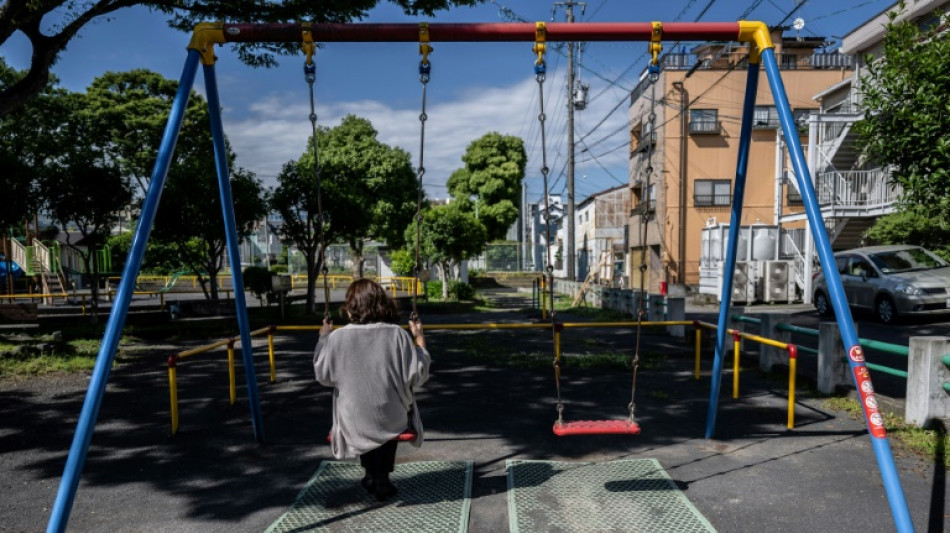
Gender gap fuels disputes as Japan gets joint custody / Photo: Yuichi YAMAZAKI - AFP

Masaki Kubota's delight at reuniting with his two sons gave way to heartbreak when the younger, two years old, stared at him uncomprehendingly as if to say: "Who are you?"
It was their first encounter since his wife left with the boys a year earlier -- the kind of painful separation that Japan's new parental custody rules aim to prevent.
The country enacted laws last month allowing joint custody after divorce, replacing a decades-old system where it was granted to only one side, and almost always to the mother.
But the change has proved polarising in a country where campaigners say sole custody acts as a bulwark against forms of domestic abuse courts may fail to recognise.
Rights groups argue that mothers who have escaped economic or psychological violence -- exacerbated by financial inequalities -- risk being dragged back into abusive relationships under joint custody.
Pressure had long been building on lawmakers, including from the United Nations, which recommended in 2019 that Japan allow joint custody "when it is in the child's best interests".
A French father's high-profile hunger strike during the Tokyo Olympics also drew global attention to the issue.
Kubota, who is not yet divorced from his estranged wife, hopes the new provision will allow them to share"important" decision-making for their children.
"It's painful -- I'm sorry I cannot be part of their lives and watch them grow," the 43-year-old told AFP.
He says his wife, who left him in 2022, felt she had been disproportionately saddled with domestic duties, but he argues that he contributed where he could.
Having sought access to his sons through the courts, Kubota sewed train and cartoon patches onto his jacket to make them smile at their reunion.
But he was devastated by his son's reaction.
"I felt like I was being erased from his memory," he said.
- 'Like a slave' -
Under the new rules, due to take effect by 2026, sole custody can be maintained in court-identified cases of domestic violence and child abuse.
Divorcing couples decide the terms of their custody under the new rules, which have critics on both sides.
Some pro-joint custody campaigners say they want clearer frameworks and for Japan to stop tolerating alleged child abductions.
On the other hand, those against it say that in Japan, whose gender wage gap of 21 percent is the worst in the G7 -- almost double that of France -- spousal abuse of less tangible forms is more widespread than commonly thought.
"Being denied money for a living" was the second-biggest divorce trigger for Japanese women in 2023, followed by "mental abuse", judicial data show.
Single mother Shiho Tanaka, 50, said her former husband talked her into quitting her full-time job then "used his financial power to treat me like a slave".
"It was an escape," she said of her decision to leave with her two toddlers, denying it constituted an abduction.
Unless Japan's deep gender imbalances are rectified, "we're nowhere near ready to even discuss joint custody," said Tanaka, now head of a group supporting single mothers.
"Mothers and children who have escaped violence might be dragged back to that abusive relationship under joint custody, because power dynamics don't easily change, even after divorce."
Another 50-year-old divorcee, who took flight with her newborn baby in 2010, said she surrendered her career after two traumatising miscarriages, only to find herself "suddenly poor" with no income of her own.
Her husband kept tabs on her receipts, gave her a meagre living allowance and banned her from using air conditioning even for the baby - in Japan's humid summer, she told AFP under anonymity.
"The free will I had always had, along with my ability to make my own choices, was no longer respected," she said.
"I felt like I had become a very weak person."
- 'Feeble' welfare provision -
Driving the inequality in part, critics say, is a long-standing tax policy disincentivising dependent spouses, usually wives, from full-time work.
Japanese husbands spend notoriously few hours on household tasks -- just 47 minutes versus 247 minutes for wives on a weekday -- preventing women from re-entering the workforce.
"The majority of women work non-regular jobs," especially after marriage and children, said Yuki Senda, a sociology professor at Musashi University.
"It's extremely difficult for them to be financially independent."
Experts caution that in other countries, joint custody can be contingent on social work interventions -- the antithesis of Japan's often hands-off approach
Measures to enforce child support payments such as through penalties are scarce in Japan, and most divorces are finalised without court involvement.
"Japan's welfare infrastructure is very feeble," which can exacerbatedomestic violence, Senda said.
Left-behind father Kubota argues that if parents like him "keep being denied chances to see their children", they lose a sense of duty, such as to pay enough child support.
"Parents feel less responsible when stripped of their authority as parents."
M.Saito--JT