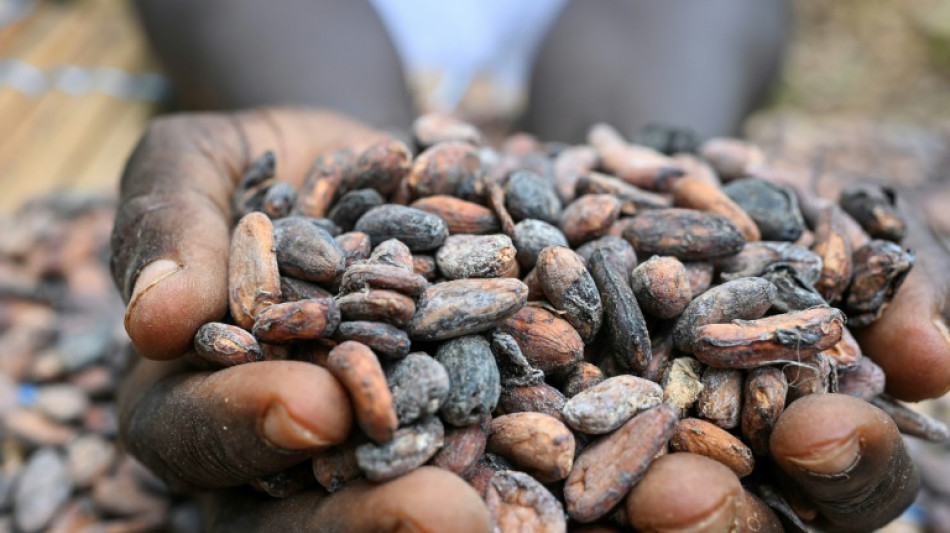
Who profits from the soaring price of cocoa? / Photo: Issouf SANOGO - AFP/File

Though cocoa prices on the financial markets have soared, the rise is benefiting cocoa growers, bean processors, speculators and chocolatiers in unequal measure.
In March, prices rocketed to more than $10,000 a tonne in New York after a poor harvest in West Africa due to a combination of bad weather conditions and disease devastating ageing plantations.
They have since fallen back from the peak, yet are still three times higher than last year.
- Wide gaps between producers -
In Ivory Coast and Ghana, the world's largest cocoa producers, prices are set by the authorities in October on the basis of the previous months.
But by that point the harvests "have already been largely pre-sold", said Tancrede Voituriez of the French agricultural research and cooperation organisation CIRAD.
This reduces the impact of cocoa price fluctuations -- whether upwards and downwards.
As a result, small-scale producers, who generally earn barely enough to live on, did not immediately benefit from the surge.
That said, the authorities raised the price of the intermediate crop in April by 50 percent to between $2,300 and $2,500 per tonne -- a modest rise compared to what the farmers could charge on the international exchanges.
In countries with less regulated systems, such as Cameroon, Nigeria, Ecuador and Brazil, growers managed to pocket more from the trend.
There, farmers have been allowed to sell their beans to buyers willing to approach the prices paid on the financial markets.
But that deregulated approach comes with risks of its own.
"Soaring prices have made production more attractive," David Gonzales, coordinator of the Peruvian Chamber of Coffee and Cocoa, told AFP.
The fear is that there will be an excess of cocoa in three to five years' time -- the time needed for farmers hoping to cash in to grow new trees -- causing prices to tumble back to earth.
- Middlemen in the hunt -
The major processors who grind the beans into butter, liquor or powder -- notably Switzerland's Barry Callebaut, America's Cargill, Singapore's Olam -- generally negotiate a large part of their supplies in advance.
But some contracts have not been honoured, forcing them to scour for urgently needed cocoa at high cost and in some cases to slow down production.
Barry Callebaut reported in early April that it had drawn more than usual from its cash reserves to finance bean purchases, but had enough cocoa on hand to meet demand.
Other smaller intermediaries may find it difficult to advance the funds needed to adapt to the higher prices.
Yet there is one group of middlemen who would have been delighted at the price rises.
"The smugglers would have done very nicely there," Steve Wateridge of commodity firm Tropical Research Services told AFP.
He said black marketeers could have taken advantage of the system in Ivory Coast and Ghana by buying cocoa at slightly above the fixed prices and selling the beans on the open market in Togo, Guinea, Liberia or Sierra Leone.
- Mixed fortunes on the markets -
Cocoa prices have risen because supply has fallen short of demand for the third year running, according to the International Cocoa Organization.
Investment funds that sensed the changing wind bet on higher prices, pocketing a profit in the process.
But from January onwards, prices became very erratic, even beyond the liking of funds with a taste for speculation.
Many investors withdrew from the market altogether: the number of traded contracts fell from 334,000 in mid-January to 146,000 in April, according to Saxo Bank's Ole Hansen.
"You can't blame the speculators for artificially inflating the prices," Wateridge added.
On the other hand, trading houses and chocolate makers tend to guard against price reversals by betting against the financial markets, in this case on falling prices.
After the markets proved right and prices soared, several had to bank more funds to cover their potential losses.
Others short on cash have had to abandon their bets, which technically obliges them to buy back contracts on the market.
This, in turn, automatically pushes up the price of cocoa even further.
- Chocolatiers adapt -
Given the time lag between the cocoa harvest and the production of a finished bar, the cost of chocolate on the supermarket shelves should not in theory have soared for industry giants Mars, Mondelez, Nestle, Hershey's and Ferrero.
"We are largely covered as part of our forward contracting for the remainder of the year," Nestle's chief executive Ulf Schneider confirmed in April.
But as time goes on, rising raw cocoa prices will eventually hit their bottom line.
To avoid passing on the cost to consumers already hit by soaring inflation, manufacturers could alter their recipes -- increasing the proportion of hazelnuts in Nutella, for example -- or reduce portion size.
Even for artisan chocolate makers, the cost of the raw cocoa represents only a small part of the finished product.
"There's a big margin" on chocolate bars, Sebastien Langlois, the co-founder of French Cocoa Company, told AFP, dampening the impact of soaring bean costs.
His company, which sells organic and fair-trade products, has not yet raised its prices, he added.
Y.Ishikawa--JT