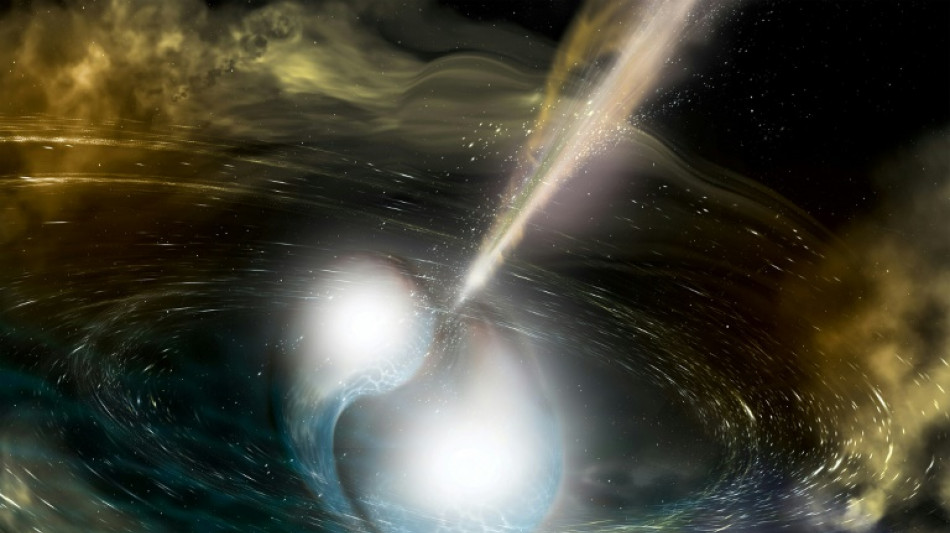
French-Chinese probe to hunt universe's biggest explosions / Photo: A. Simonnet - National Science Foundation/AFP/File

A French-Chinese telescope satellite will blast off this weekend on a mission to hunt down gamma-ray bursts, the most powerful explosions in the universe.
The light from these almighty blasts has travelled billions of light years to reach Earth, so scientists believe they could hold answers to some mysteries of the universe's youth.
But these flashes are so brief they have proved difficult to observe.
Aiming to learn more, the Space Variable Objects Monitor (SVOM) is scheduled to blast off on a Chinese Long March 2C rocket from the Xichang launch site in China's Sichuan province on Saturday.
The spacecraft, which has two Chinese and two French instruments on board, will then orbit 625 kilometres (390 miles) above Earth.
Chen Lan, an analyst specialising in China's space programme, highlighted the "political significance" of the joint mission.
During a "dark time" for relations between China and the West, the mission "shows that scientific cooperation can still be continued despite difficulties," he told AFP.
- Discovered by accident -
SVOM's mission is to use its X-ray vision to track down the source of gamma-ray bursts, which are detected in the sky around once every day.
This cosmic investigation began back in "the middle of the Cold War," said Bertrand Cordier, the chief scientist for France's contribution to SVOM.
In 1967, US satellites monitoring whether nations were complying with a nuclear test ban treaty happened to spot a brief flash of gamma rays -- which can also be produced by nuclear blasts.
"They thought they were dealing with a nuclear explosion on Earth, before realising that it came from space," Cordier told a press conference.
"Since then, we have been trying to understand the origin of these objects."
Several missions, including NASA's Swift telescope, have already shed some light on these bright enigmas.
Considered to be the most powerful events in the known universe, these bursts are flashes of the highest-energy light, which emit gamma rays and last anywhere between a fraction of a second and tens of seconds.
The explosion is followed by an "afterglow" which can last hours and "crosses the entire universe to reach us," said Susanna Vergani of the Paris Observatory.
- Clues of the early universe -
Shorter bursts are thought to be caused by massive neutron stars smashing into each other, or a neutron star being swallowed by a black hole.
Longer bursts are believed to be from some of the universe's earliest stars -- massive beasts far larger than our Sun -- going supernova.
The most distant -- and therefore earliest -- gamma-ray burst identified so far came from just 630 million years after the Big Bang, when the universe was five percent of its current age.
Gamma-ray bursts allow scientists to "investigate the distant universe," including the mysterious chemical process that birthed the first stars and galaxies, Vergani said.
But the blasts could also hold other clues to long-burning cosmic mysteries.
Because the light from these explosions traverses billions of light years, it "bears the imprint of all the gas clouds" it passed through," Vergani said.
Scientists therefore hope gamma-ray bursts could reveal the chemical elements across the universe throughout its history.
Do gamma-ray bursts pose a threat to Earth? The Milky Way is too old to be home to the huge collisions that cause the bursts, so the chance of this happening is "extremely low," Cordier said.
Earth's atmosphere should be able to shield us against blasts from farther off, he added.
Gamma-ray bursts are so brief that scientists will be in a race against time to collect data before they vanish.
As soon as SVOM detects a gamma-ray burst, it will alert a team of scientists who will be on call 24 hours a day.
In less than five minutes, a network a ground-based telescopes will swivel their gaze towards the blast, hoping to find out more.
T.Shimizu--JT