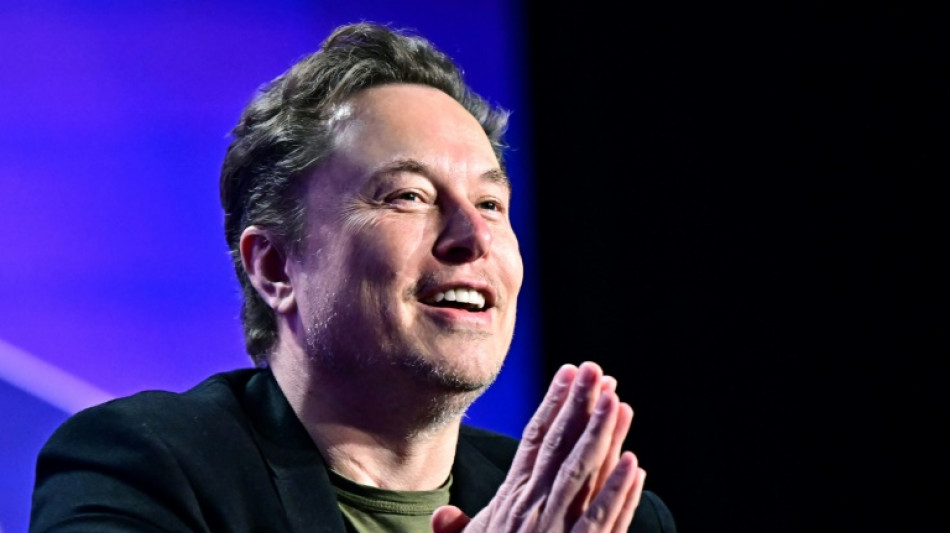
Shareholders OK with soaring executive pay in US / Photo: Frederic J. BROWN - AFP

Executive salaries at major US corporations are soaring -- but shareholders happy with stock prices and greater transparency over remuneration are not pushing back.
Between 2017 and 2023 the average annual compensation for a CEO at an S&P 500 company rose nearly 40 percent to $16.3 million, according to the consulting firm Equilar.
That compares to a 27 percent increase for the average US worker.
But shareholders do not seem to mind. Only twice this year -- or 0.5 percent of the time -- did they vote down executive pay packages proposed at annual meetings, said the business consulting firm ISS-Corporate.
In 2021 and 2022, a string of big Wall Street firms were hit with flak over juicy executive compensation, including Starbucks, JPMorgan Chase, Intel and General Electric.
"Investors are finally pushing back on massive CEO pay hikes," Time magazine wrote in June 2022. But this angry sentiment vanished as quickly as it had popped up.
"Shareholders tend to vote down plans after a poor performance or stock price performance in particular," said Kevin Murphy, a finance professor at the University of Southern California who specializes in executive pay.
The coronavirus pandemic hit the US economy and financial markets hard.
"That was sort of a funny year because we obviously had the big drop in March of 2020, the stock market crash during pandemic and for the most part, stock prices rebounded but it wasn't even across all firms," he said.
But in today's market, with stocks hitting record after record, shareholders are not in a rebellious mood.
Just last week Tesla shareholders approved a compensation package for Elon Musk of just under $50 billion.
Under the so called Dodd-Frank Act that came out of the financial crisis of 2008, companies have to submit their executive pay packages to a shareholder vote at least every three years, a practice known as "say on pay."
The votes are non-binding, but in most cases when a pay package is rejected, corporate boards back down and trim them.
The idea of "say on pay" has introduced transparency in the business world.
"So in terms of the worst practices, a lot of them have been limited. A lot of the more extreme ones," said Rosanna Landis Weaver of the shareholder advocacy group As You Sow.
"There are very few cases in recent memory in which a CEO was dismissed but walked away with an outrageously large pay package," said David Yermack, a professor of finance at New York University.
- Follow the pack -
The Dodd-Frank law also forces companies to disclose the ratio between their top executive's compensation and the median salary.
In 2023, that ratio rose to 196 times, compared to 158 times five years earlier, according to Equilar.
A study published this week by Bentley University and pollster Gallup said that 82 percent of Americans feel it is important to avoid a major pay gap between CEOs and average employees.
"The CEO-employee pay gap is a controversial issue. While high CEO salaries can attract top talent, they can also be seen as excessive," Kristina Minnick, a professor of finance at Bentley University, said as part of this study.
Still, advocates of limiting CEO pay are the minority in the broader American electorate.
Bills to this effect that were proposed in recent months by Alexandria Ocasio-Cortez or Bernie Sanders, prominent figures of the American left, have gone nowhere in the US House of Representatives.
The idea of "say on pay" has prompted many companies to turn to consulting firms to guide them on CEO pay and use benchmarks to compare their packages to those of other companies.
These advisory firms are paid by companies to which they make recommendations on whether to approve or reject CEO pay before a yearly shareholder meeting. The best known ones are Institutional Shareholder Services (ISS) and Glass Lewis.
"So the combination of having say on pay and having ISS seem so influential as a proxy advisor, has been that over the last 10 years, compensation programs have become more similar," said Marc Hodak of Farient Advisors.
Sums up Kevin Murphy, "the easiest way to not make waves is to do what everybody else is doing."
K.Yoshida--JT