The Japan Times - Frost discovered on top of giant Mars volcanoes

EUR -
AED 4.021559
AFN 71.178358
ALL 89.791427
AMD 395.362254
ANG 1.960573
AOA 1004.157082
ARS 1748.147599
AUD 1.643472
AWG 1.973819
AZN 1.865925
BAM 1.955613
BBD 2.208689
BDT 137.516871
BGN 1.942031
BHD 0.413561
BIF 3294.785437
BMD 1.095045
BND 1.414265
BOB 13.000759
BRL 6.087472
BSD 1.096595
BTN 102.037258
BWP 16.223451
BYN 3.299685
BYR 21462.890873
BZD 2.205489
CAD 1.563233
CDF 2496.704028
CHF 0.915526
CLF 0.028746
CLP 1131.381984
CNY 7.297935
CNH 7.287751
COP 3822.435061
CRC 486.853519
CUC 1.095045
CUP 26.318487
CVE 110.254474
CZK 24.461787
DJF 195.281356
DKK 7.483217
DOP 65.603737
DZD 149.524724
EGP 59.691301
ERN 16.425682
ETB 179.262785
FJD 2.511104
FKP 0.835794
GBP 0.835944
GEL 2.836595
GGP 0.835794
GHS 13.022757
GIP 0.835794
GMD 81.033753
GNF 9728.071232
GTQ 8.3842
GYD 229.3881
HKD 8.574261
HNL 29.481185
HRK 7.481312
HTG 143.886263
HUF 370.498103
IDR 20098.957009
ILS 3.64344
IMP 0.835794
INR 101.834304
IQD 1662.441282
IRR 2146470.865212
ISK 137.395775
JEP 0.835794
JMD 173.55343
JOD 0.776431
JPY 174.72002
KES 142.776369
KGS 95.762146
KHR 4458.574326
KMF 491.675792
KPW 985.541291
KRW 1460.517292
KWD 0.342443
KYD 0.913913
KZT 502.692006
LAK 24731.638796
LBP 98202.324327
LKR 365.33512
LRD 179.84283
LSL 19.034983
LTL 3.233385
LVL 0.662382
LYD 7.108321
MAD 10.990851
MDL 20.189072
MGA 4965.525926
MKD 61.549124
MMK 2299.608668
MNT 3953.112222
MOP 8.842456
MRU 44.501751
MUR 51.303294
MVR 16.867794
MWK 1901.518456
MXN 21.522794
MYR 4.512468
MZN 70.357083
NAD 19.034983
NGN 1485.484321
NIO 40.356147
NOK 10.733202
NPR 163.259413
NZD 1.998441
OMR 0.41867
PAB 1.096595
PEN 3.803637
PGK 5.018521
PHP 69.81576
PKR 303.023569
PLN 4.474082
PYG 7064.325547
QAR 3.997618
RON 5.349082
RSD 117.658767
RUB 90.061402
RWF 1620.945243
SAR 4.109958
SBD 8.954364
SCR 15.181751
SDG 658.673865
SEK 11.24196
SGD 1.413015
SHP 0.836455
SLE 25.186416
SLL 22962.559633
SOS 626.740163
SRD 40.801799
STD 22665.229983
STN 24.497661
SVC 9.595084
SYP 14237.781345
SZL 19.030183
THB 37.174645
TJS 10.176628
TMT 3.832659
TND 3.323883
TOP 2.636607
TRY 55.566772
TTD 7.44029
TWD 36.138804
TZS 2947.21862
UAH 49.374886
UGX 4731.548265
USD 1.095045
UYU 44.645738
UZS 13181.741499
VES 1008.953531
VND 28292.141839
VUV 133.121975
WST 3.108282
XAF 655.957
XAG 0.025033
XAU 0.0002996746
XCD 2.959416
XCG 1.976411
XDR 0.774254
XOF 655.957
XPF 119.331742
YER 259.091684
ZAR 19.010482
ZMK 9856.727054
ZMW 22.891814
ZWL 352.604189
SSP 6324.325587
MXV 2.407766
  • RYCEF

    0.1000

    19.81

    +0.5%

  • VOD

    -0.2500

    16.33

    -1.53%

  • CMSC

    -0.2800

    20.12

    -1.39%

  • RBGPF

    -2.0000

    65

    -3.08%

  • RIO

    -0.2500

    94.16

    -0.27%

  • BTI

    -1.2000

    54.85

    -2.19%

  • NGG

    -0.3000

    74.94

    -0.4%

  • GSK

    -0.3500

    49.35

    -0.71%

  • BCE

    -0.4200

    20.14

    -2.09%

  • CMSD

    -0.3400

    19.93

    -1.71%

  • BP

    -0.9100

    43.52

    -2.09%

  • RELX

    0.1700

    33.24

    +0.51%

  • BCC

    -0.6200

    75.97

    -0.82%

  • AZN

    -1.9400

    164.21

    -1.18%

  • JRI

    0.0000

    10.77

    0%

Frost discovered on top of giant Mars volcanoes
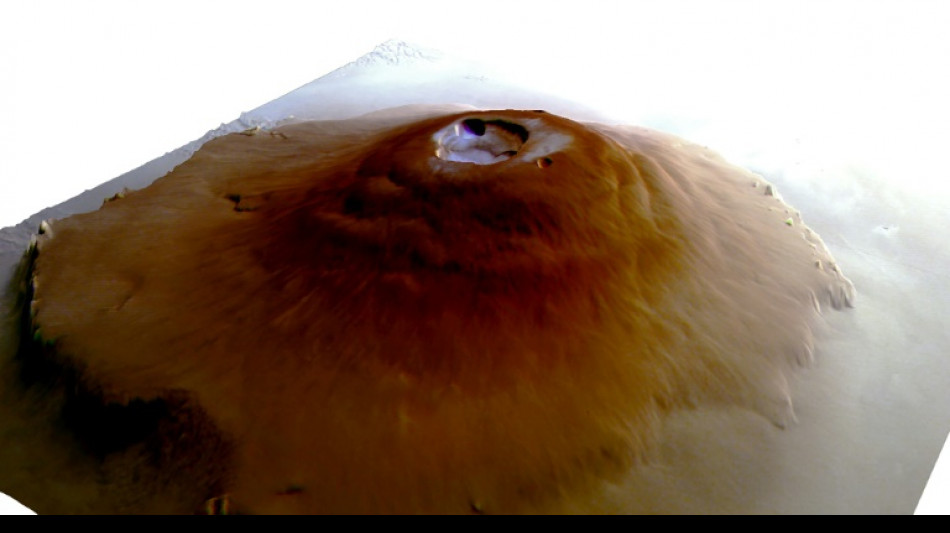
Frost discovered on top of giant Mars volcanoes / Photo: Adomas Valantinas - AFP

Frost discovered on top of giant Mars volcanoes

Early morning frost has been detected on the peaks of massive volcanoes on Mars, an unexpected discovery about the dispersal of water on Mars that could one day prove essential for human exploration, scientists said.

Text size:

The early morning frost was spotted in images taken by the European Space Agency's Trace Gas Orbiter, according to a study published in the journal Nature Geoscience on Monday.

The immense volcanoes are in the Tharsis plateau, an elevated region nearly 5,000 kilometres (3,100 miles) wide near the Martian equator.

The volcanoes have been extinct for millions of years. Among them is the largest volcano in the solar system, Olympus Mons, which is almost three times taller than Mount Everest.

The discovery came by chance -- no one expected to find frost in this region.

"We thought it was impossible for frost to form around Mars's equator," lead study author Adomas Valantinas said in a statement.

Plenty of sunshine and a thin atmosphere mean the temperature is relatively warm up there, "unlike what we see on Earth, where you might expect to see frosty peaks," the researcher at Brown University in the United States said in a statement.

There is also little water in the atmosphere near the Martian equator, making condensation less likely.

"Other space probes have observed frost but in wetter regions -- notably the northern plains," study co-author Frederic Schmidt of France's Paris-Saclay University told AFP.

The Trace Gas Orbiter, which has been orbiting Mars since 2018, was able to take images when the first rays of the Sun crossed over the tops of the volcanoes.

"We saw a shiny, blue deposit there, a particular texture that we only see in the early morning and during the cold seasons," Schmidt said.

The layer of the ice is only the thickness of a hair -- and it does not last long.

But there is about 150,000 tonnes of water -- equivalent to 60 Olympic swimming pools -- in the daily frost at the summits of volcanoes Olympus Mons, Arsia Mons, Ascraeus Mons and Ceraunius Tholus, the ESA said.

- A touch of frost -

The researchers suggested the frost is caused by a micro-climate that forms inside the calderas of the huge volcanoes.

As wind whips up the sides of the volcanoes, it brings "relatively moist air from near the surface up to higher altitudes, where it condenses and settles as frost," study co-author Nicolas Thomas explained.

"We actually see this happening on Earth and other parts of Mars," said Thomas, who works on the Trace Gas Orbiter's imaging system.

Modelling how these frosts form "could allow scientists to reveal more of Mars's remaining secrets, including where water exists and how it moves between reservoirs," the ESA said.

This may prove crucial for planned missions that could see humans set foot on Martian soil.

"We could recover water from the frost for human consumption, or launch rockets from Mars by separating the oxygen and hydrogen molecules," Schmidt said.

Mapping the location of water on Mars -- which only exists as ice or vapour -- could also be key in the search for signs of extra-terrestrial life.

Liquid water is considered one of the essential ingredients for life on other planets.

Y.Kato--JT