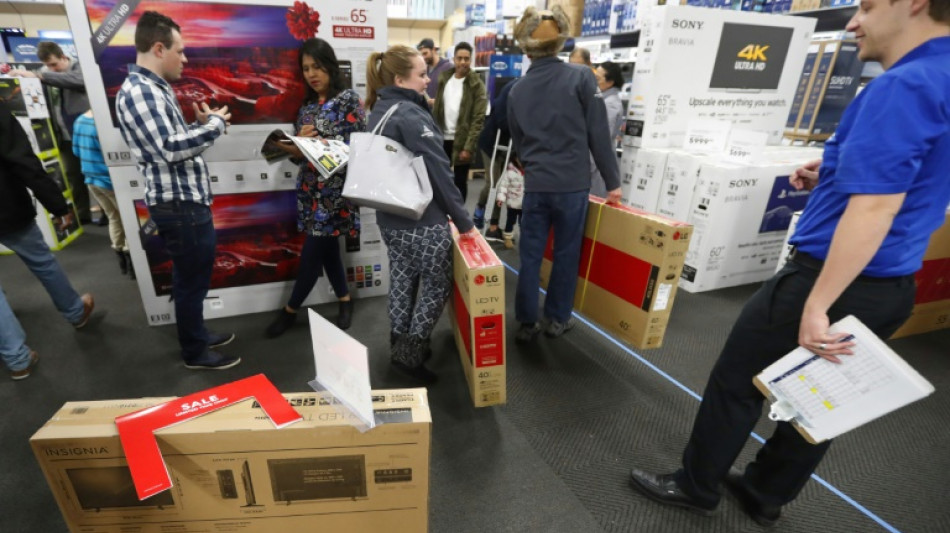
Inflation clouds 'Black Friday' kickoff of US holiday shopping season / Photo: GEORGE FREY - GETTY IMAGES NORTH AMERICA/AFP/File

Retailers unveiled a trove of fresh seasonal promotions Friday, as they try to coax sales from reticent shoppers whose holiday cheer has been tempered by inflation and worries over a softening economy.
"Black Friday," the unofficial start of the US holiday shopping season, announced itself with the annual day-after-Thanksgiving deluge of online promotions and early store openings.
But industry experts have been cautious about this year's prospects, in light of price pressures that have exacerbated concerns about an oversupply of goods.
A year ago, retailers faced product shortfalls in the wake of shipping backlogs and factory closures related to Covid-19. To avert a repeat, the industry front-loaded its holiday imports this year, leaving it vulnerable to oversupply at a time when consumers are cutting back.
"Supply shortages was yesterday's problem," said Neil Saunders, managing director for GlobalData Retail, a consultancy. "Today's problem is having too much stuff."
Saunders said retailers have made progress in reducing excess inventories, but oversupply will mean deep discounts in many categories, including electronics, home improvement and apparel.
Online shoppers spent $5.3 billion on Thanksgiving Day itself, according to an Adobe report early Friday, up 2.9 percent from a year ago.
Higher costs for gasoline and household staples like meat and cereal are a nationwide issue, and they do not burden everyone equally.
"The lower incomes are definitely hit worst by the higher inflation," said Claire Li, senior analyst at Moody's. "People have to spend on the essential items."
- Diminishing savings -
Leading forecasts from Deloitte and the National Retail Federation project a single-digit percentage rise in sales, but this is unlikely to exceed the inflation rate.
Adobe has forecast an overall holiday sales increase of 2.5 percent, less than a third of the level from last year. Besides inflation, Adobe cited higher Federal Reserve interest rates and an uptick in brick-and-mortar shopping as factors.
European countries like Britain and France have been marking Black Friday for a few years now too, but with soaring inflation, merchants there face a similar dilemma.
"Retailers are desperate for some spending cheer but the worry is that it could turn out to be more of a Bleak Friday," said Hargreaves Lansdown analyst Susannah Streeter.
US shoppers have remained resilient throughout the pandemic, often spending more than expected even when consumer sentiment surveys suggest they are in a gloomy mood.
Part of the reason has been the unusually robust state of savings, with many households banking government pandemic aid payments at a time of reduced consumption due to virus restrictions.
But that cushion is starting to whittle away. After hitting $2.5 trillion in excess savings in mid-2021, the benchmark fell to $1.7 trillion in the second quarter, according to Moody's.
Accompanying this drop has been a rise in credit card debt visible in Federal Reserve data and anecdotally described by chains that also report more purchases made with food stamps.
- Mixed picture -
Recent earnings reports from retailers paint a mixed picture on consumer health.
Target stood on the downcast side, pointing to a sharp decline in shopping activity in late October, potentially portending a weak holiday season.
The big-box chain expects a "very promotional" holiday season, said Chief Executive Brian Cornell.
"We've had a consumer who has been dealing with very stubborn inflation for quarter after quarter now," Cornell said on a conference call with analysts.
He added that customers are "shopping very carefully on a budget."
But Lowe's, another big US chain specializing in home-improvement, offered a different view, describing the same late-October period as "strong."
"We are not seeing anything that feels or looks like a trade down or consumer pullback," said Lowe's Chief Executive Marvin Ellison.
Consumers like Charmaine Taylor, who checks airline websites frequently, are staying vigilant.
Taylor, who works in child care, has had her travel plans thwarted due to exorbitant plane ticket prices -- and she is unsure of how much she can spend on family this year.
"I'm trying to give them some little gifts," she said at a park in Harlem earlier this week. "I don't know if I'll be able to. Inflation is hitting pretty hard."
S.Suzuki--JT