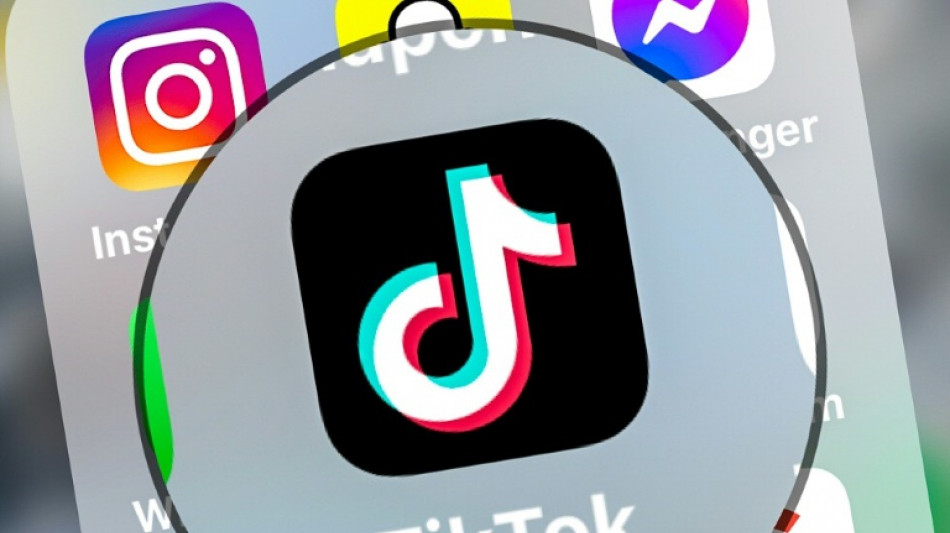
TikTok a hotbed of US election misinformation, analysts say / Photo: DENIS CHARLET - AFP/File

Election misinformation is spreading on TikTok ahead of the US midterms despite the company's policies -- and watchdogs are concerned about its effect on young voters as more Americans use the platform as a source of news.
Posts spreading unfounded claims of voter fraud, falsehoods about mail-in ballots and misleading videos about different state laws have found a home on the immensely popular app.
Perhaps more troubling: TikTok has approved paid political advertisements containing blatant misinformation, a practice the company said in 2019 it had banned.
"Hackers can easily change the election results! Don't bother voting in the midterms," says one such ad.
It was one of several created by researchers at the non-profit Global Witness and New York University to test TikTok's prohibition on paid political posts. The social media company approved 90 percent of ads the team submitted containing election misinformation.
"We were relatively shocked by that result," said Jon Lloyd, a senior advisor at Global Witness, who described TikTok as "bottom of the class" compared to other social media platforms tackling election misinformation.
Such falsehoods coincide with more than eight million young US citizens being newly eligible to vote in the November 8 elections.
TikTok's parent company, Beijing-based ByteDance, has rules aimed at limiting the spread of conspiracy theories about elections. But experts question how effective they are.
"Just because they had these policies in place, it doesn't mean that they're being enforced well," Lloyd said, arguing that TikTok's business model is based on "amplifying and driving people" towards content.
Although that criticism could be aimed at all social networks, a Pew Research Center survey found more than a quarter of Americans aged 18-29 regularly get news from TikTok -- despite a sizeable minority of videos presented in search results containing misinformation, according to media monitor NewsGuard.
The platform's powerful algorithm makes it possible for videos to quickly garner thousands of views, even without an established following.
And the sheer volume of content on TikTok makes it "more likely that users in general -- especially more young, impressionable users -- are going to come into contact with potentially divisive, polarizing, objectionable content," said Matt Navarra, a social media industry analyst and consultant based in Britain.
- Falsehoods slip through cracks -
TikTok removes content that could mislead on "civic processes, public health or safety," according to its integrity policies -- including falsehoods about voting. The platform also prohibits campaign fundraising and recently launched an in-app election center.
"We take our responsibility to protect the integrity of our platform and elections with utmost seriousness," a spokesperson for the company told AFP in an emailed statement. "We continue to invest in our policy, safety and security teams to counter election misinformation."
However, baseless claims of ballot fraud and conspiracy theories shared by midterm election candidates are still circulating. It is not the first time TikTok has been used to spread election falsehoods.
Earlier this year, influencer campaigns on the platform played a role in the Philippines' presidential contest. In Germany, accounts posed as parliament and public officials, and in Kenya, the app was a den for propaganda, hate speech and misinformation.
In the second quarter of 2022, TikTok removed 113 million videos for violating its community guidelines -- an amount that represents about one percent of all videos uploaded to the platform. A small fraction of the posts were removed for violating the company's integrity policies.
Reminded of how platforms such as Facebook have served as vectors for misinformation, including baseless claims from former president Donald Trump that the 2020 US election was "stolen" from him, analysts express little faith in TikTok's incentive and ability to address the problem.
"That a company can actually make Facebook look good when it comes to misinformation and disinformation is an amazing achievement," said NewsGuard CEO Steven Brill.
- Perfect breeding ground -
The format of TikTok posts makes it easier to create misinformation, experts say -- and harder for users to tell fact from fiction.
"It's very quick, very easy, very simple to create content and to build a substantial following," Navarra said.
Posts are short, highly edited and often contain music, captions and voiceovers that analysts say make it hard to understand nuance.
NewsGuard senior analyst Jack Brewster said the threat to the democratic process was particularly stark, given TikTok's young audience and many users' inexperience in identifying credible information.
"If young people are searching for election news on the platform, the videos are inherently short, so context is often lost," he said. "There's little to no information often about the sources."
Y.Kimura--JT