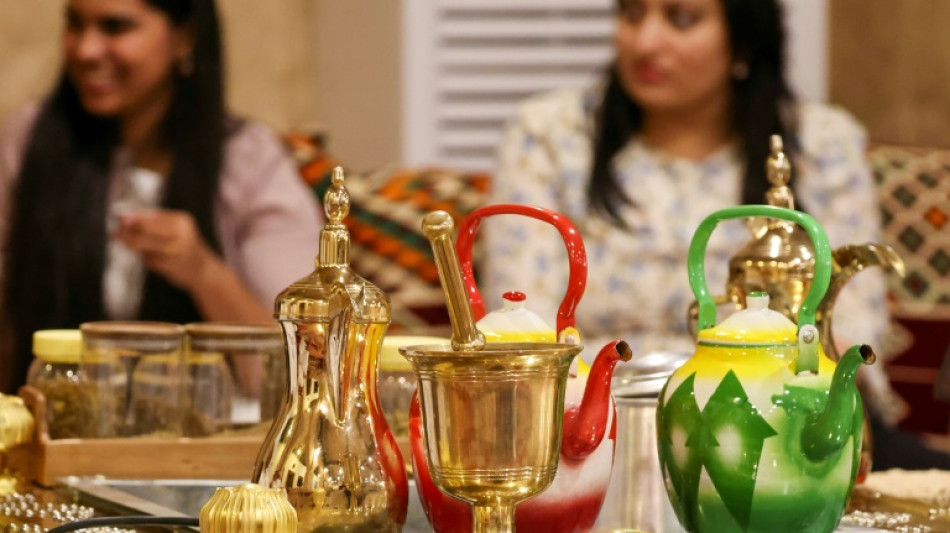
The Japan Times - Taste of Qatari hospitality: traditional Arabic coffee

EUR -
AED 4.330938
AFN 77.832669
ALL 96.602299
AMD 448.308258
ANG 2.111018
AOA 1081.405926
ARS 1712.281766
AUD 1.683491
AWG 2.122717
AZN 2.011969
BAM 1.952352
BBD 2.385487
BDT 144.854178
BGN 1.98046
BHD 0.444593
BIF 3523.311312
BMD 1.179287
BND 1.505609
BOB 8.213494
BRL 6.173331
BSD 1.184408
BTN 108.30872
BWP 15.600156
BYN 3.391411
BYR 23114.031108
BZD 2.381993
CAD 1.612735
CDF 2541.363858
CHF 0.917604
CLF 0.025732
CLP 1016.049951
CNY 8.19192
CNH 8.177927
COP 4279.633617
CRC 588.120153
CUC 1.179287
CUP 31.251113
CVE 110.070608
CZK 24.316784
DJF 210.907524
DKK 7.469871
DOP 74.866187
DZD 153.292081
EGP 55.426182
ERN 17.68931
ETB 184.766832
FJD 2.595906
FKP 0.863817
GBP 0.863125
GEL 3.178225
GGP 0.863817
GHS 12.987064
GIP 0.863817
GMD 86.679113
GNF 10400.833668
GTQ 9.08795
GYD 247.792382
HKD 9.214933
HNL 31.289151
HRK 7.535878
HTG 155.34618
HUF 380.604318
IDR 19774.289471
ILS 3.641857
IMP 0.863817
INR 106.493127
IQD 1551.553277
IRR 49677.477759
ISK 145.005151
JEP 0.863817
JMD 186.104935
JOD 0.836112
JPY 183.85502
KES 152.423113
KGS 103.128449
KHR 4772.274622
KMF 492.941585
KPW 1061.343532
KRW 1709.471372
KWD 0.362501
KYD 0.986953
KZT 598.108773
LAK 25471.016518
LBP 105583.598595
LKR 366.770704
LRD 219.701992
LSL 18.962411
LTL 3.482129
LVL 0.713339
LYD 7.482785
MAD 10.800625
MDL 20.051588
MGA 5285.631848
MKD 61.645314
MMK 2476.644764
MNT 4208.203103
MOP 9.528032
MRU 47.067395
MUR 54.117259
MVR 18.220542
MWK 2055.212701
MXN 20.433806
MYR 4.637552
MZN 75.179503
NAD 18.962572
NGN 1643.820395
NIO 43.616812
NOK 11.426404
NPR 173.429011
NZD 1.954946
OMR 0.453443
PAB 1.184408
PEN 3.989155
PGK 5.079035
PHP 69.680557
PKR 331.782131
PLN 4.222208
PYG 7875.092072
QAR 4.329654
RON 5.095662
RSD 117.416885
RUB 90.476221
RWF 1732.876805
SAR 4.422659
SBD 9.502817
SCR 16.389742
SDG 709.342365
SEK 10.551968
SGD 1.498998
SHP 0.884771
SLE 28.863016
SLL 24729.064203
SOS 677.426358
SRD 44.842382
STD 24408.866168
STN 24.476076
SVC 10.363653
SYP 13042.416233
SZL 18.967656
THB 37.188904
TJS 11.062064
TMT 4.139298
TND 3.417065
TOP 2.839441
TRY 51.295343
TTD 8.018906
TWD 37.243063
TZS 3050.273424
UAH 51.045558
UGX 4230.52861
USD 1.179287
UYU 45.948851
UZS 14479.428382
VES 438.270999
VND 30663.828412
VUV 140.969154
WST 3.21511
XAF 655.310907
XAG 0.013545
XAU 0.000239
XCD 3.187083
XCG 2.134521
XDR 0.814972
XOF 654.800579
XPF 119.331742
YER 281.112568
ZAR 18.879387
ZMK 10615.001017
ZMW 23.242951
ZWL 379.73003
  • RBGPF

    0.1000

    82.5

    +0.12%

  • GSK

    0.5500

    53.02

    +1.04%

  • BTI

    0.4050

    61.395

    +0.66%

  • SCS

    0.0200

    16.14

    +0.12%

  • NGG

    0.5800

    85.19

    +0.68%

  • RIO

    2.5800

    95.1

    +2.71%

  • AZN

    1.5700

    189.98

    +0.83%

  • RYCEF

    0.2800

    16.95

    +1.65%

  • CMSC

    0.0380

    23.768

    +0.16%

  • BCC

    1.2250

    82.975

    +1.48%

  • VOD

    0.2250

    15.135

    +1.49%

  • JRI

    0.0100

    13.16

    +0.08%

  • RELX

    -5.0850

    30.445

    -16.7%

  • CMSD

    0.0000

    24.08

    0%

  • BCE

    0.1600

    25.99

    +0.62%

  • BP

    0.1800

    37.88

    +0.48%

Taste of Qatari hospitality: traditional Arabic coffee
Taste of Qatari hospitality: traditional Arabic coffee / Photo: Karim JAAFAR - AFP

Taste of Qatari hospitality: traditional Arabic coffee

With its strong aroma of cardamom and its yellowy, tea-like consistency, Arabic coffee is a ubiquitous symbol of hospitality across Gulf countries, not least in World Cup host Qatar.

Text size:

Prepared by roasting coffee beans then boiling them with cardamom and saffron, the traditional "gahwa" is usually enjoyed in the Qatari majlis -- the all-male gathering that forms the centrepiece of social life in the country.

"I didn't know it has coffee in it," said Lanka Perera, 29, a Sri Lankan expatriate who has lived in the tiny, gas-rich Gulf emirate for three years, adding that it doesn't taste like "the coffee that we know".

As custom dictates, the hot drink is prepared in front of guests by the head of the household and served by his eldest son.

But in more recent years, the beverage has spilt beyond its traditional confines, making its way into commercial establishments and cultural houses, offering a taste of Qatari culture to residents and visitors alike.

One such independent cultural centre is Embrace Doha, where Perera attended a session on the coffee and its origins.

"Gahwa is something that we drink almost every day... we see it in our office because there are lots of Qataris, so they bring it and then we taste it," she told AFP after the session.

"But... I didn't know what's in it and the story behind it, the origin behind it," she confessed.

- Ritual and ceremony -

Since the introduction of coffee to the region around 600 years ago, it has acquired its own ritual and ceremony, now integral to the culture of the country and region.

Poured out of golden or silver "dallah" pots, it is consumed out of little cups that are only ever partially filled to avoid burning drinkers' fingers.

The coffee keeps coming until the drinker makes a certain waving gesture to indicate that he has had enough -- a vestige of an era when it was often poured by deaf servers to prevent sensitive information from leaking out of the majlis.

"For hundreds of years, the whole country has changed, but coffee hasn't," said Shaima Sherif, the director of Embrace Doha, located in the heart of the old market known as Souq Al Wakrah, south of the capital.

In 2015, an initiative by Saudi Arabia, the United Arab Emirates, Oman and Qatar saw Arabic coffee enter the UNESCO list of Intangible Cultural Heritage.

According to UNESCO, "serving Arabic coffee is an important aspect of hospitality in Arab societies and considered a ceremonial act of generosity".

Ahead of the tournament's November 20 start, Qatar is facing increased international scrutiny for its record for its treatment of women, foreign workers and the LGBT+ community.

But organisers of the first World Cup to be held in an Arab country have said fans were more concerned about Covid-era logistics and have emphasised the country's "warm hospitality" culture.

H.Takahashi--JT