Dishdasha crackdown as Omani men face fines for rogue robes

A wave of foreign imitations and alternative styles has prompted Oman to take tough action to preserve its unique national dress, threatening thousands of dollars in fines for men who wear the wrong sort of dishdasha.
Dishdashas, the long, elegant robes that are a hallmark of the Gulf sultanate, have fallen prey to rising hemlines and elaborate embroidery, with some wearers also going for multicoloured designs.
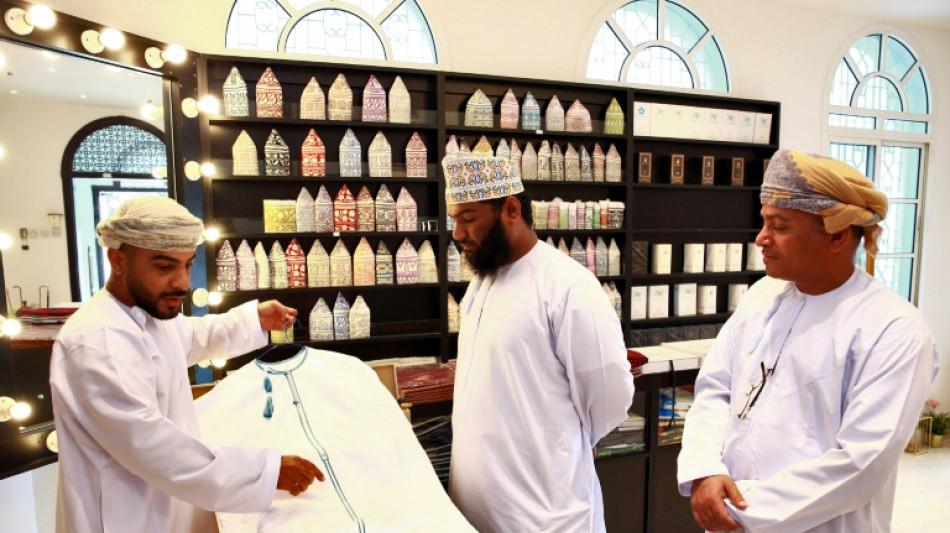
The ministry of commerce and industry said the dishdasha's design is based on "certain criteria", stipulating it should be made mostly out of cotton with embroidery only on the collar, front slit and cuffs.
"The fabric must be a single colour," a ministry official told AFP, adding that white or neutral colours were preferred.
A person or manufacturer caught violating the dress code will be fined 1,000 Omani rials ($2,600), or double that in the case of a second violation.
While similar to the ankle-length robes worn by men in neighbouring countries, Oman's dishdasha stands out with its subtle embroidery around the neckline (mahar) which continues down a front central slit (shaq) over the chest.
In other Gulf countries, including Saudi Arabia and the United Arab Emirates, the long-sleeved robe is usually plain white and worn with either a white keffiyeh headdress or a red and white chequered one.
Omani men usually wear an embroidered brimless round cap (kumma) or a turban-style headdress, known as the massar, to complete their look.
The striking ensemble is a distinctive part of life in Oman, an ancient land known for its rich heritage, scenic coasts and stunning mountains.
- 'Personal freedoms' -
In a conservative country where criticism of the authorities is rare, some in the capital Muscat said while the recent announcement could be considered an infringement on personal freedoms, they understood the need to preserve national identity.
"The decision may be good to set certain standards but conflicts with personal freedoms," said Ouahib al-Jadidi, a 36-year-old entrepreneur.
"There are men who want to wear dishdashas that match their own tastes, but this ruling will prevent them from doing so."
Nabegh al-Qarni, who owns a store that sells dishdashas and accessories for men, said modifications to the traditional dress had become noticeable.
"Among the most notable changes is the shortening of the robe or larger patterns and embroidery," the 35-year-old told AFP.
"We have also seen different colours of dishdasha, instead of the traditional white, brown or black," he said, adding that Omani society, especially the older generation, is averse to this kind of change.
The effort to preserve Omani culture in the face of evolving tastes comes as the country grapples with social and economic change, introducing measures to attract foreign investment as it attempts to reduce its reliance on oil.
These have included developing its tourism industry, as well as issuing long-term residence permits for foreigners -- who make up 40 percent of its 4.5 million population -- while reserving certain jobs for citizens.
Omani economist Khalfan al-Touqi said the dishdasha was not only symbolic of the people and their heritage but also had "great economic importance".
"Recently, many shopkeepers have been bringing in dishdashas from abroad, from China and India, which often alter the robe," he said, adding the new measures also aim to encourage retailers to buy from local factories.
S.Fujimoto--JT