The Japan Times - Reviving a traditional art form in Rwanda after genocide

EUR -
AED 4.237828
AFN 72.117878
ALL 95.257556
AMD 425.16713
ANG 2.066073
AOA 1059.311878
ARS 1663.980069
AUD 1.642611
AWG 2.079967
AZN 1.963684
BAM 1.950677
BBD 2.323318
BDT 141.798827
BGN 1.926978
BHD 0.435147
BIF 3445.648302
BMD 1.153934
BND 1.483118
BOB 7.971135
BRL 5.991243
BSD 1.153481
BTN 109.995077
BWP 15.603157
BYN 3.18606
BYR 22617.115447
BZD 2.320027
CAD 1.610212
CDF 2626.354951
CHF 0.921948
CLF 0.026884
CLP 1058.077182
CNY 7.81531
CNH 7.821356
COP 4127.265849
CRC 532.306634
CUC 1.153934
CUP 30.579263
CVE 110.37394
CZK 24.16027
DJF 205.077171
DKK 7.474282
DOP 67.216736
DZD 154.251025
EGP 59.681952
ERN 17.309017
ETB 182.581302
FJD 2.562658
FKP 0.864514
GBP 0.862738
GEL 3.057933
GGP 0.864514
GHS 13.512723
GIP 0.864514
GMD 84.236978
GNF 10128.657073
GTQ 8.792983
GYD 241.338273
HKD 9.043425
HNL 30.764389
HRK 7.537504
HTG 150.8252
HUF 355.983004
IDR 20720.047192
ILS 3.398983
IMP 0.864514
INR 110.039824
IQD 1511.654145
IRR 1586861.822829
ISK 143.410689
JEP 0.864514
JMD 182.151621
JOD 0.818118
JPY 185.06688
KES 149.272572
KGS 100.91122
KHR 4630.161962
KMF 492.729741
KPW 1038.373982
KRW 1754.620785
KWD 0.356935
KYD 0.961284
KZT 563.285544
LAK 25389.456653
LBP 103334.831036
LKR 389.320914
LRD 210.591104
LSL 19.062663
LTL 3.407269
LVL 0.698003
LYD 7.350858
MAD 10.681987
MDL 20.059492
MGA 4852.294488
MKD 61.643518
MMK 2422.308258
MNT 4129.559835
MOP 9.310728
MRU 46.301649
MUR 55.250239
MVR 17.839806
MWK 2003.230131
MXN 20.131252
MYR 4.69616
MZN 73.735767
NAD 19.051268
NGN 1569.166658
NIO 42.267968
NOK 10.978077
NPR 175.992323
NZD 1.985933
OMR 0.443682
PAB 1.15358
PEN 3.958861
PGK 5.053944
PHP 70.999299
PKR 321.197524
PLN 4.242227
PYG 7104.203521
QAR 4.206664
RON 5.238557
RSD 117.39897
RUB 83.060939
RWF 1687.052183
SAR 4.332907
SBD 9.284064
SCR 15.421802
SDG 692.940032
SEK 10.941549
SGD 1.485177
SHP 0.861529
SLE 28.444277
SLL 24197.431121
SOS 659.467143
SRD 43.242527
STD 23884.11357
STN 24.751894
SVC 10.093579
SYP 127.546797
SZL 19.062958
THB 38.006562
TJS 10.762428
TMT 4.05031
TND 3.356507
TOP 2.778397
TRY 53.224419
TTD 7.824519
TWD 36.413441
TZS 3011.7666
UAH 51.819608
UGX 4351.609229
USD 1.153934
UYU 46.697764
UZS 13876.061694
VES 654.249908
VND 30383.094373
VUV 137.646654
WST 3.169111
XAF 654.24445
XAG 0.017754
XAU 0.000273
XCD 3.118566
XCG 2.078958
XDR 0.817454
XOF 657.16547
XPF 119.331742
YER 275.386783
ZAR 19.069571
ZMK 10386.795916
ZMW 20.487372
ZWL 371.566426
  • CMSD

    -0.1300

    22.28

    -0.58%

  • RBGPF

    1.4900

    61.5

    +2.42%

  • CMSC

    -0.0500

    22.31

    -0.22%

  • BCC

    2.0400

    70.01

    +2.91%

  • JRI

    0.2600

    12.72

    +2.04%

  • RIO

    0.4900

    101.42

    +0.48%

  • NGG

    0.9100

    81.08

    +1.12%

  • BCE

    0.4000

    24.58

    +1.63%

  • GSK

    0.6100

    51.25

    +1.19%

  • BTI

    0.2600

    59.95

    +0.43%

  • RYCEF

    -0.1500

    16.37

    -0.92%

  • RELX

    0.4200

    34.94

    +1.2%

  • AZN

    1.8800

    183.43

    +1.02%

  • BP

    -1.0500

    42.67

    -2.46%

  • VOD

    -0.1400

    14.67

    -0.95%

Reviving a traditional art form in Rwanda after genocide
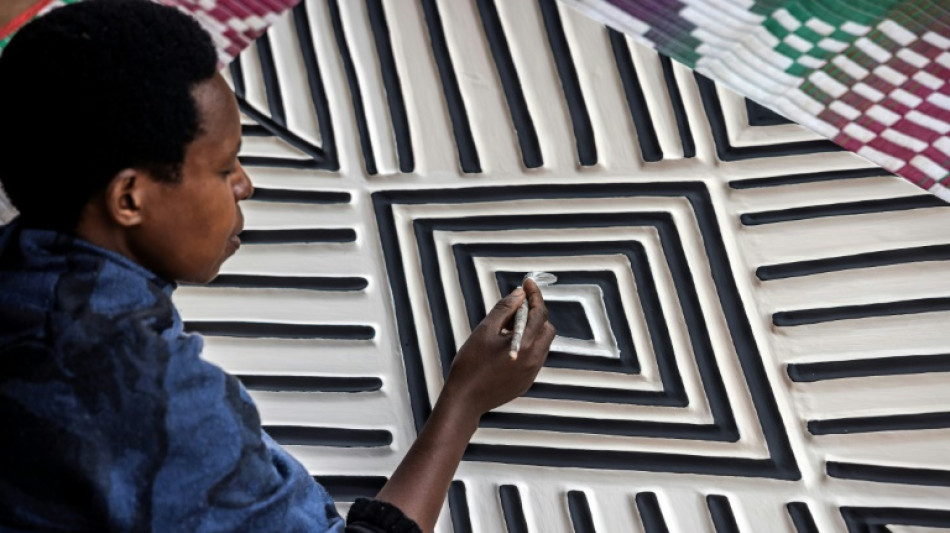
Reviving a traditional art form in Rwanda after genocide / Photo: LUIS TATO - AFP

Reviving a traditional art form in Rwanda after genocide

A 200-year-old Tutsi art form made with cow dung, Rwanda's imigongo painting tradition has experienced a revival in the Great Lakes nation three decades after the 1994 genocide, becoming a symbol of culture and unity.

Text size:

Known for its raised black and white patterns, imigongo is widely believed to have been invented by a Tutsi prince in the 19th century.

Prince Kakira mixed cow dung and ash to create a material which he used to paint three-dimensional patterns on the walls of his palace in eastern Rwanda's Gisaka kingdom.

The tradition was named after "umugongo", the Kinyarwanda word for "spine", owing to its curved lines, and became popular among rural households where women would use dung and natural pigments made with soil, clay and aloe sap to decorate their homes.

Basirice Uwamariya, founder of the Kakira Imigongo Cooperative in eastern Kirehe district, told AFP she started making art when she was 15.

But the 1994 genocide targeting the Tutsi minority nearly wiped out the tradition, with almost all 15 members of Uwamariya's cooperative killed in a bloodbath that claimed around 800,000 lives across Rwanda, including moderate Hutus.

She lost her husband and multiple relatives, leaving her to fend for herself and her two sons.

"I lived in darkness, in silence," the 53-year-old said, recalling the loneliness that pushed her to revive the cooperative in 1996 and invite other genocide survivors to join her.

Since then, imigongo has evolved.

Traditional patterns exist side by side with modern designs featuring various colours. Natural pigments have been replaced by commercial paints.

Imigongo designs have made their way to upmarket studios and fashion boutiques, adorning garments and wooden artefacts alike, with a market that includes foreigners and Rwandans.

According to Theoneste Nizeyimana, manager of Azizi Life Studio in the capital Kigali, the tradition was once largely limited to eastern Rwanda.

"But after the genocide destroyed everything... people started thinking about how they can bring back their culture. Today, imigongo is appreciated by all Rwandans, not just Tutsi," he told AFP.

"Imigongo is something that brings people together," he said, pointing out that the Kigali boutique and studio holds painting classes for students whose ages range from four to 75 years old.

It also makes business sense, he said, with its instantly recognisable patterns helping to market "made in Rwanda" designs around the world.

Y.Kato--JT