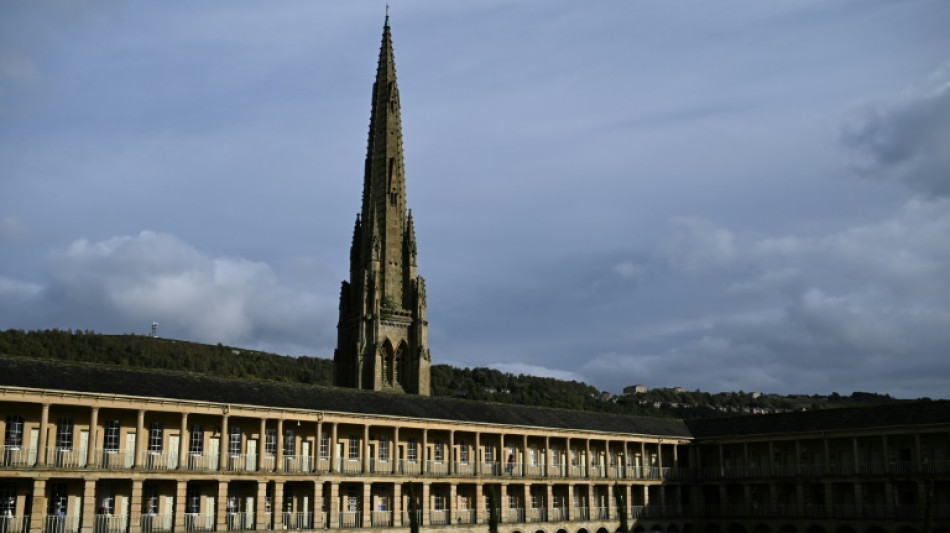
Icons of UK's industrial age enjoy cultural and economic revival / Photo: Oli SCARFF - AFP

Once the epicentre of global trade, the awe-inspiring buildings of northern England's industrial age have reinvented themselves as cultural and economic hubs feted by artists from David Hockney to Noel Gallagher and Sting.
Inspired by Renaissance figures such as the Medici family, the textile titans of 18th and 19th century Britain built monumental structures designed to stand "forever" as a testament to their power and tastes.
These industrialists combined Italian architectural flair with the natural gift of the local golden "Yorkstone" to transform the hills of West Yorkshire in particular.
But as the country's textile sector went into decline after World War II, many of these icons of Britain's heritage fell into disrepair and were demolished.
However thanks to the ambitious visions of recent custodians, others have been saved and become cultural hubs, showcasing world-class talent.
Two of the best examples are Salts Mill near Bradford -- the largest factory in Europe when it opened in 1853 -- and the Piece Hall in nearby Halifax.
In its pomp, some 5,000 workers produced miles of cloth each day at Salts Mill, but there was little interest when it went on sale in the 1980s.
Inspired by childhood memories of the mill, its grand beauty and his long-time friendship with local artist turned global star Hockney, entrepreneur Jonathan Silver hit on the unique idea to turn it into a gallery in 1987.
- 'Unheard of' -
"What he saw here was a very well looked after building... and that it was in Bradford -- it would be a perfect place to put a Hockney gallery," Silver's brother Robin, a recently retired director of the site, told AFP.
Silver, who died in 1997, had previously floated the idea with Hockney when he stayed at the artist's home in the United States.
Hockney was happy to lend paintings but thought the idea was "very odd", while members of Silver's family though he was "bonkers", recalled his brother.
"It opened up in the November, and if you think of November in a dark satanic mill, in pouring rain and fog and cold winds blowing -- nobody came in at all," he recalled.
But Silver's decision to promote the mill as a "cultural, art-based enterprise, which was unheard of in the north of England then," paid off.
Along came the culture vultures, who in turn made businesses realise the area's potential.
IT firm Pace Micro Technology moved into the mill and it now has a high-tech industry base, complemented by art exhibitions, a bookshop and diners, spurring wider local regeneration.
The mill's creator, Titus Salt, sent architects to Venice for inspiration. Robin Silver believes the structure is fundamental to its current success.
"The Victorian industrialists... actually saw it (as) 'this is a mill that's going to be here forever, so we might as well make sure that it's fit for purpose to last forever'.
The focus on enduringly attractive architecture also helped turn Halifax's Piece Hall, around eight miles (13 kilometres) to the south, into a gig venue loved by artists including Gallagher, Sting, New Order and Nile Rodgers.
- 'Magical' -
Its multi-storied arched portals resemble those in St Mark's Square, Venice, but Piece Hall was actually built in 1779 as a marketplace for local cloth-makers.
As the textile industry evolved, it became a general marketplace and event space but was rescued from demolition in the 1960s and again in the 1980s.
It wasn't until a £19 million ($23 million) facelift and the idea of its CEO Nicky Chance-Thompson to host gigs that the building recaptured its former glory.
After hosting "spectacles", US folk rocker Father John Misty became the first musician to play the venue's grand yet intimate courtyard, in 2018.
Since then, bands including Duran Duran, Boygenius and The War on Drugs have performed.
Johnny Marr, former guitarist with the Smiths, played and called it "the talk of the town", said Chance-Thompson.
"Noel Gallagher said it was his favourite gig of the summer and Nile Rodgers said 'there's something about this place that is magical'," she added.
As with Salts Mill, its emergence as a cultural centre soon attracted retail outlets and each pound invested has generated £6 in return, according to independent assessors, providing a much-needed shot in the arm for the town.
It also convinced key anchor stores such as Marks and Spencer to remain in Halifax, said Chance-Thompson.
Rock concerts may be a far cry from the creators' original vision, but Chance-Thompson "hopes they'll be pleased" as "it means that we get to preserve this wonderful building."
S.Yamamoto--JT