The Japan Times - Donated clothing worsening Kenya's plastic pollution: report

EUR -
AED 4.244679
AFN 76.884463
ALL 93.191831
AMD 421.972449
AOA 1059.869723
ARS 1724.912124
AUD 1.6354
AWG 2.081886
AZN 1.966206
BAM 1.955209
BBD 2.320998
BDT 142.646882
BHD 0.434569
BIF 3450.157113
BMD 1.155801
BND 1.476654
BOB 13.69586
BRL 5.875747
BSD 1.152352
BTN 109.656854
BWP 15.554298
BYN 3.431363
BYR 22653.692413
BZD 2.317599
CAD 1.612515
CDF 2614.996978
CHF 0.934118
CLF 0.026812
CLP 1055.246154
CNY 7.798879
CNH 7.793437
COP 3649.648544
CRC 523.841657
CUC 1.155801
CUP 30.628717
CVE 110.23168
CZK 24.254187
DJF 205.207971
DKK 7.47562
DOP 67.269666
DZD 152.922776
EGP 57.293846
ERN 17.33701
ETB 185.995679
FJD 2.552644
FKP 0.857003
GBP 0.856685
GEL 3.016621
GGP 0.857003
GHS 13.522912
GIP 0.857003
GMD 84.945873
GNF 10120.940719
GTQ 8.792342
GYD 241.087126
HKD 9.068233
HNL 30.886664
HRK 7.535359
HTG 150.674455
HUF 363.218435
IDR 20574.407074
ILS 3.467228
IMP 0.857003
INR 110.044414
IQD 1509.543707
IRR 1589861.560911
ISK 142.614473
JEP 0.857003
JMD 183.004683
JOD 0.819461
JPY 182.465669
KES 148.856198
KGS 101.074744
KHR 4680.585188
KMF 492.370809
KRW 1629.805632
KWD 0.35675
KYD 0.96031
KZT 540.07675
LAK 26018.135435
LBP 103193.107569
LKR 386.523165
LRD 207.997128
LSL 18.721141
LTL 3.412778
LVL 0.699133
LYD 7.329784
MAD 10.739954
MDL 20.038943
MGA 4917.513571
MKD 61.511407
MMK 2426.660491
MNT 4156.088844
MOP 9.311885
MRU 46.324997
MUR 54.084519
MVR 17.857278
MWK 1998.196
MXN 19.811636
MYR 4.721676
MZN 73.861472
NAD 18.721141
NGN 1573.958077
NIO 42.407181
NOK 10.983967
NPR 175.450966
NZD 1.96296
OMR 0.442316
PAB 1.152352
PEN 3.90252
PGK 5.092461
PHP 70.290014
PKR 319.921597
PLN 4.298989
PYG 6851.928851
QAR 4.212427
RON 5.248837
RSD 117.304542
RUB 94.335971
RWF 1694.487803
SAR 4.328192
SBD 9.322337
SCR 16.700252
SDG 694.055348
SEK 10.962537
SGD 1.477805
SLE 28.431255
SOS 658.600923
SRD 43.76612
STD 23922.739558
STN 24.492597
SVC 10.082952
SZL 18.717342
THB 38.10705
TJS 10.630487
TMT 4.05686
TND 3.385377
TRY 55.150643
TTD 7.810639
TWD 37.274683
TZS 3055.431805
UAH 51.610999
UGX 4292.702434
USD 1.155801
UYU 46.385979
UZS 13781.834132
VES 873.510657
VND 30287.177696
VUV 137.028419
WST 3.15963
XAF 655.758782
XAG 0.018109
XAU 0.000266
XCD 3.123609
XCG 2.076872
XDR 0.815553
XOF 655.758782
XPF 119.331742
YER 275.513155
ZAR 18.664712
ZMK 10403.585552
ZMW 21.750425
ZWL 372.167332
  • CMSC

    0.0240

    21.744

    +0.11%

  • BCC

    2.3400

    86.6

    +2.7%

  • JRI

    0.1500

    12.81

    +1.17%

  • CMSD

    -0.1600

    21.82

    -0.73%

  • BCE

    -0.0200

    22.75

    -0.09%

  • GSK

    0.7900

    52.96

    +1.49%

  • BTI

    0.6000

    59.33

    +1.01%

  • RBGPF

    0.7600

    70.5

    +1.08%

  • RIO

    1.4500

    101.1

    +1.43%

  • VOD

    0.1900

    16.19

    +1.17%

  • RYCEF

    0.2300

    20.85

    +1.1%

  • RELX

    0.0485

    35.52

    +0.14%

  • BP

    -0.6000

    41.63

    -1.44%

  • AZN

    1.4100

    161.42

    +0.87%

  • NGG

    0.4700

    80.88

    +0.58%

Donated clothing worsening Kenya's plastic pollution: report
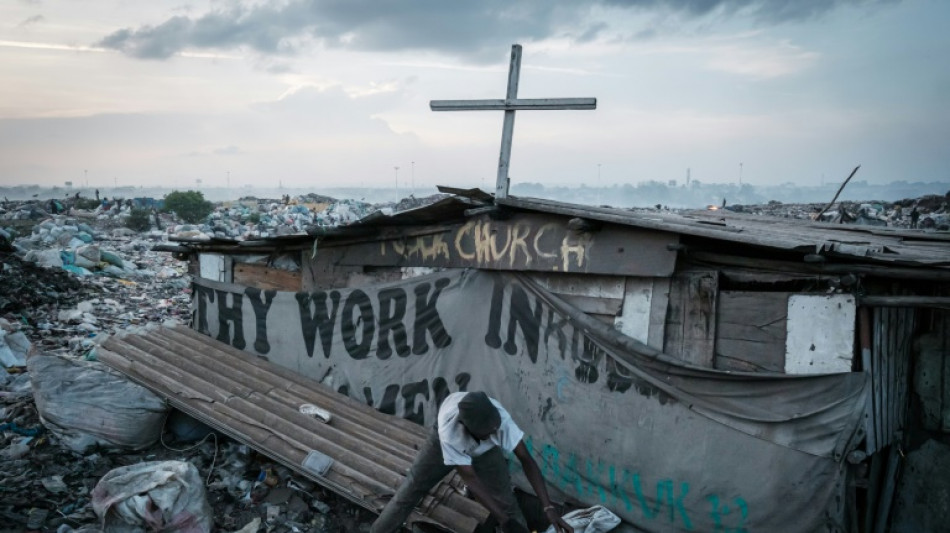
Donated clothing worsening Kenya's plastic pollution: report / Photo: YASUYOSHI CHIBA - AFP

Donated clothing worsening Kenya's plastic pollution: report

One third of all second-hand clothing shipped to Kenya in 2021 was "plastic waste in disguise", creating a slew of environmental and health problems for local communities, a new report said Thursday.

Text size:

Every year, tonnes of donated clothing is sent to developing countries, but an estimated 30 percent of it ends up in landfills -- or flooding local markets where it can crowd out local production.

A new report shows that the problem is having grave consequences in Kenya, where some 900 million pieces of used clothing are sent every year, according to the Netherlands-based Changing Markets Foundation.

Much of the clothing shipped to the country is made from petroleum-based materials such as polyester, or are in such bad shape they cannot be donated.

They may end up burning in landfills near Nairobi, exposing informal waste pickers to toxic fumes. Tonnes of textiles are also swept into waterways, eventually breaking down into microfibres ingested by aquatic animals.

"More than one in three pieces of used clothing shipped to Kenya is a form of plastic waste in disguise and a substantial element of toxic plastic pollution in the country," the report said.

The research was based on customs data as well as fieldwork by non-profit organisation Wildlight and the activist group Clean Up Kenya, which conducted dozens of interviews.

Some of the clothing items were stained with vomit or badly damaged, the report found, while others had no use in Kenya's warmer climate.

"I have seen people open bales with skiing gear and winter clothes, which are of no use to most Kenyans," Betterman Simidi Musasia, Clean Up Kenya founder, told AFP.

- 'Enormous waste problem' -

Between 20 and 50 percent of all donated clothing was not of a sufficient quality to be sold on the local secondhand market, the report found.

Unwearable items might be turned into industrial wipes or cheap fuel for peanut roasters, swept into the Nairobi river, scattered around the market or sent to immense plastic graveyards outside the capital, such as the Dandora landfill.

Several waste pickers working at Dandora said they contracted breathing and asthma issues by inhaling smoke from burning plastic at the site, according to the report.

Musasia said items should be better sorted at the point of donation before being shipped to Kenya, instead of being blindly passed on, to try and prevent the problem at the source.

Experts say the problem of clothing waste has been exacerbated by the fast fashion boom in wealthier nations, where items -- many made from synthetic fibres -- might be worn only a few times before being discarded.

The report called for the use of non-toxic and sustainable materials in textile manufacturing, and the establishment of more robust extended producer responsibility schemes around the world.

"The Global North is using the trade of used clothing as a pressure-release valve to deal with fast fashion's enormous waste problem," it said.

K.Nakajima--JT