'Like a jewel': Japan's luxury ice revered by bars worldwide / Photo: William WEST - AFP

In the historic Japanese city of Kanazawa, craftsmen painstakingly shape and slice blocks of ice destined to chill negronis in some of the world's trendiest bars.
The men work for Kuramoto Ice, a century-old company in Ishikawa on the Sea of Japan coast and one of dozens of Japanese firms producing ultra-clear, premium ice.
This luxury product, believed by those in the industry to melt more slowly than regular blocks, is a staple of Japan's cocktail culture.
But its popularity is also spilling over to bars abroad, from the United States to Australia, who pay as much as 200 yen ($1.25) per cube.
Kuramoto Ice is of the country's few international exporters, and has seen total sales more than double since exports began in 2019.
"We take our time and freeze water slowly, keeping it in motion... That's how we end up with good ice," Kazuhiko Kuramoto, the firm's fifth-generation head, told AFP at their Kanazawa factory.
"My heart leaps with joy when I see ice that looks like a jewel," said the 41-year-old, as he poured cold hojicha tea into a glass filled with a large, clear sphere.
Using a technique that originally came from the United States, specialist Japanese ice makers freeze water over a period of 48 to 72 hours, far longer than the few hours typically required for homemade ice or the 30 minutes it takes industrial ice machines.
As freezing begins and the ice forms from outside in, various impurities in the water get pushed towards the centre. But the Japanese method involves removing that tainted water and replacing it with a fresh batch. Constant stirring helps remove air bubbles, resulting in completely transparent ice, known as "junpyo" in Japanese.
Although there is little scientific evidence, it's said the technique also results in a colder, denser product that will cool rather than dilute a cocktail.
Native -- a trendy bar in Singapore that made this year's Asia's 50 Best Bars list -- imports around 900 kilograms of ice from Kuramoto each year.
"Local ice is more economical, but Kuramoto Ice is clearer, denser and melts more slowly," co-owner Yong Wei told AFP.
-'Lingering aftertaste' -
In Kanazawa, workers dressed in full-body overalls haul large blocks of ice across the factory floor, before starting on the delicate work of carving perfect spheres, cubes and rectangular blocks with cut corners.
Once packaged, the finished products -- which can be made to precisely fit any glass -- are stored in a room at minus 10 degrees before shipment.
Boss Kuramoto is not blind to the environmental cost of transporting cubes of ice thousands of kilometres across the world, but insisted that small goods like his have a relatively low environmental impact.
He said he had dreamed of reaching American bars since visiting Las Vegas more than a decade ago and realising low-quality ice that melts easily and waters down the flavour was being used in expensive cocktails.
The time-consuming ice-making technique often used in Japan, which tends to produce a higher quality product, had largely been phased out in the US.
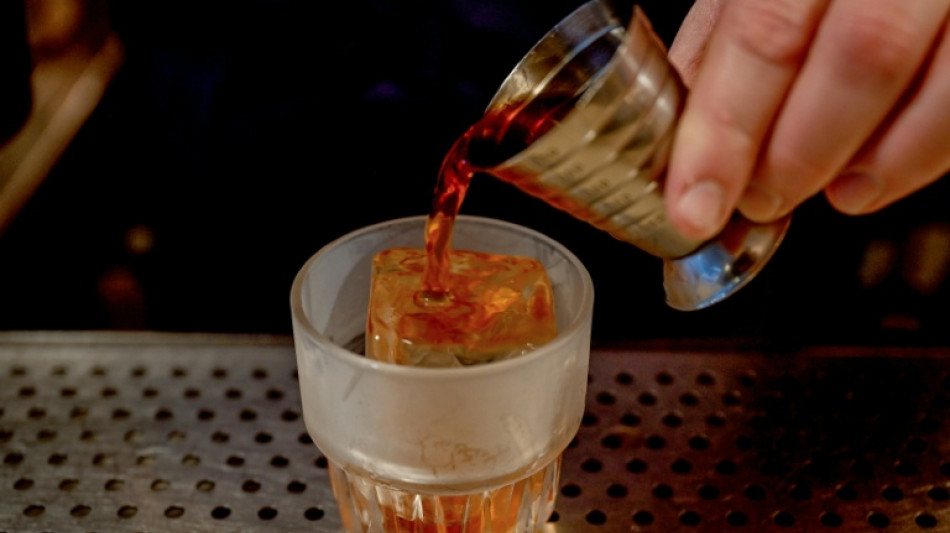
At a Hilton Hotel bar near Tokyo, bartender Shingo Miyachi prepares a negroni with one of Kuramoto Ice's big, clear cubes.
The ice fits perfectly in the glass, and its clarity makes it almost invisible.
"Ice really has a huge impact on the taste of a cocktail," Miyachi told AFP.
If it melts, "it especially affects the lingering aftertaste once you've taken a sip."
Ice handling is considered an essential skill for Japanese bartenders, who often begin their training by learning to break it with precision.
"When you look at the ice and see the level of attention to detail, you can pretty much tell how seriously the bartender takes the flavour of the cocktail and how much care they've put into it," he explained.
"A cocktail only really comes into being when the glass, the ice, and the liquid become one as a single unified whole."
Y.Ishikawa--JT