Major quake off Philippines kills at least 35, dozen still missing / Photo: Edwin Espejo - AFP

A 7.8-magnitude earthquake in the southern Philippines on Monday killed at least 35 people, according to provincial authorities, after toppling buildings and sparking tsunami warnings across the region.
National disaster authorities said at least a dozen people were still missing, while 134 had sustained injuries.
Philippine authorities urged people in affected coastal regions to move to higher ground after the offshore quake hit south of General Santos, a city of about 720,000, where the death toll was now 12, according to the tally at a local command centre.
A series of powerful aftershocks rocked the area from about two hours after the first quake, according to the United States Geological Survey, with the largest measuring magnitude 6.5.
As night descended, AFP journalists watched as rescue workers in General Santos used their hands to dig through the rubble of a popular grocery store chain in a desperate bid to reach two employees buried beneath.
Morphy Angcad, a 35-year-old security guard, told AFP he was not ready to accept that his sister, one of the two, was dead.
"We received a call this morning telling us that she was one of the trapped there," he said, adding he had refused a hotel room so he could stand watch.
"I don't want to leave this site until I see the body of my sister… (but) I'm hoping against hope that she is still alive."
Dioslinda Deluvio told AFP her son Joey, the other employee, had come to visit her just weeks earlier, asking: "Ma, what is your plan for your life? Are you OK?"
"All I can do is cry now, imagining the good things he did in the world," she said.
A few kilometres away, others were preparing to spend the night on a sidewalk.
"I'll be sleeping here outside even if it's uncomfortable, because I'm scared there will be an aftershock," 34-year-old sales clerk Johnson Alerta told AFP.
"I feel safer here."
- 'So many lives' -
Rene Punzalan, disaster chief for hard-hit Sarangani province, told AFP 14 people had died in Glan municipality alone when a landslide buried their homes at the foot of a mountain.
"The landslide happened immediately after the earthquake, so many lives were lost," he said, adding that some areas had yet to report if they had sustained casualties.
"The greatest challenge is communication. The power was cut, so it's hard to get updates," Punzalan said.
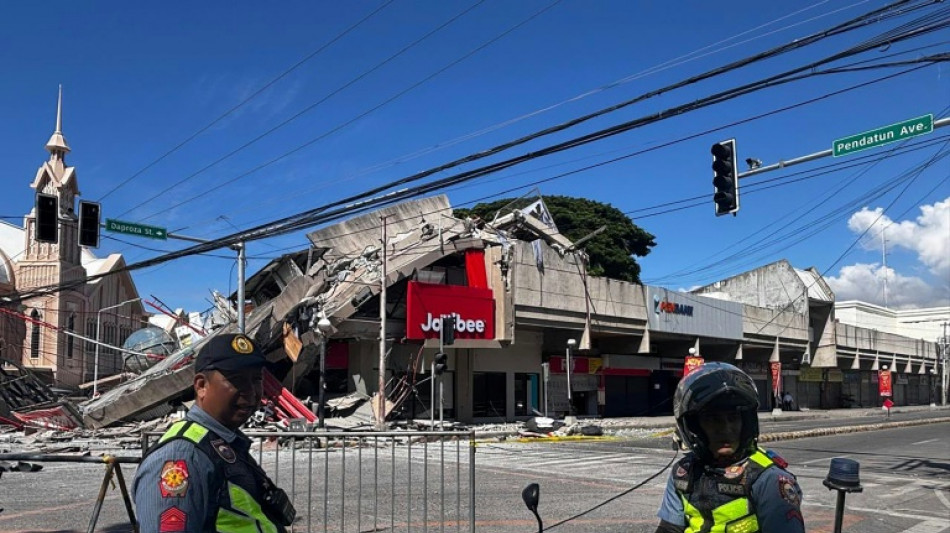
Videos posted to social media and verified by AFP showed a shopping centre with a Jollibee fast food restaurant reduced to rubble in General Santos, while a school building that officials said was unoccupied crumpled in another.
In another video verified by AFP, young schoolchildren could be seen screaming in the arms of their teachers as the quake violently swayed them back and forth on the ground.
- 'Move to higher ground' -
Sarangani's Punzalan told AFP that more than 2,000 people evacuated due to a morning tsunami warning were now awaiting a green light to return to their homes.
"(Authorities) are still assessing the situation now if it will be OK to send them home," he said.
A notice from the Pacific Tsunami Warning Center had said tsunami waves were possible along the coasts of the Philippines, Indonesia, Palau, Taiwan and Papua New Guinea.
But by mid-afternoon, the Philippines and other countries had cancelled their warnings.
Philippine President Ferdinand Marcos, who suspended classes across Mindanao island on what was to have been the first day of school, had called on residents in coastal areas to evacuate immediately.
"Move to higher ground now. Do not wait," he said. "Your life is more important than anything left behind."
Earthquakes are a near-daily occurrence in the Philippines, which is situated on the Pacific "Ring of Fire", an arc of intense seismic activity stretching from Japan through Southeast Asia and across the Pacific basin.
Eastern Mindanao was rocked by a pair of earthquakes of 7.4 and 6.7 magnitude in October that killed at least eight people.
These followed a magnitude 6.9 quake days earlier that killed 76 people in Cebu province in central Philippines.
Y.Ishikawa--JT